Pigmentation treatment is one of the most crowded areas of South Korea’s dermatology and aesthetic market. Clinics may advertise toning lasers, pico lasers, spot treatments, brightening programs, combination care, or maintenance packages, often using similar language even when the treatment logic is different.
For patients, that can make a simple question — “Which laser should I choose?” — surprisingly difficult. The answer depends not only on the device but also on the type of pigmentation, its depth, the patient’s skin response, treatment history, and whether the goal is to treat discrete spots or improve more diffuse uneven tone.
Why “Pigmentation” Is Not One Diagnosis
The first problem with comparing pigmentation procedures is that the word pigmentation covers many different concerns. Freckles, sun spots, post-inflammatory pigmentation, melasma-like patterns, and general uneven tone can look similar to a non-specialist but may respond differently to treatment.
That is why choosing a laser only because it is popular or heavily advertised can be misleading. A device may be technically capable of producing very short pulses, but the treatment plan still needs to be matched to the patient’s actual pigmentation pattern and skin characteristics.
For people comparing Korean treatment options, a structured explanation of 피코토닝 can help clarify how pico-based toning fits into the broader category of pigmentation and brightening procedures.
What Makes Pico-Based Treatment Different
Pico systems are known for delivering energy in extremely short pulse durations. In practical terms, that changes how energy interacts with pigment compared with longer-pulse approaches. But the presence of a pico device does not by itself determine the quality of a result.
Different pico platforms may use different wavelengths, handpieces, spot sizes, and treatment modes. The practitioner may also choose very different settings depending on whether the goal is targeted pigment treatment, broader toning, texture improvement, or a combination approach.
This is an important distinction because “pico toning” is often used as a consumer-facing category rather than a single standardized protocol. Two clinics can use the same general term while performing substantially different treatments.
Why More Energy Is Not Always Better
Laser treatment is sometimes misunderstood as a simple relationship between power and results: more energy equals a stronger effect. Pigmentation treatment is more complex. Excessive or poorly selected energy can irritate the skin, and some pigmentation concerns can worsen after inflammation.
For that reason, conservative treatment planning and repeated assessment can be more important than chasing the highest setting. Skin tone, previous laser exposure, recent sun exposure, sensitivity, and the specific pigment pattern all matter when a practitioner chooses parameters.
Patients should therefore be cautious when comparing clinics only by the number of shots, the maximum device output, or promotional descriptions such as “strongest” or “fastest.” Those numbers do not explain whether the protocol is appropriate for the individual.
Treatment Frequency and Maintenance Matter
Pigmentation care is also rarely a one-session decision. Some visible spots may respond quickly, while more diffuse tone concerns can require multiple sessions or ongoing maintenance. The schedule can vary depending on the condition being treated and the patient’s response.
This makes package pricing difficult to compare without understanding what is included. A lower price per session does not necessarily mean a lower total cost if more visits are recommended. Conversely, a higher-priced session is not automatically more effective.
Patients benefit from asking how many sessions are typically considered before reassessment, what signs indicate that the protocol should be changed, and what home care or sun protection is expected between visits.
Pico Toning Versus Other Brightening Approaches
Pico toning is only one category within a broader pigmentation strategy. Depending on the concern, a dermatologist may discuss other laser wavelengths, targeted spot treatment, chemical approaches, topical care, or combination therapy. The goal is not to stack as many procedures as possible, but to use methods that address the likely cause and depth of the pigmentation while minimizing unnecessary irritation.
This is also why a consultation should distinguish between cosmetic brightening and treatment of a specific pigment disorder. If a pigmented lesion is changing in appearance or has not been medically assessed, cosmetic treatment should not replace appropriate evaluation.
What to Compare Between Clinics
A useful clinic comparison goes beyond device ownership. Patients should ask who performs the evaluation, how the pigmentation type is assessed, which wavelength and treatment mode are being proposed, and why. They should also ask what side effects are expected, how post-treatment pigmentation risk is managed, and what happens if the skin does not respond as planned.
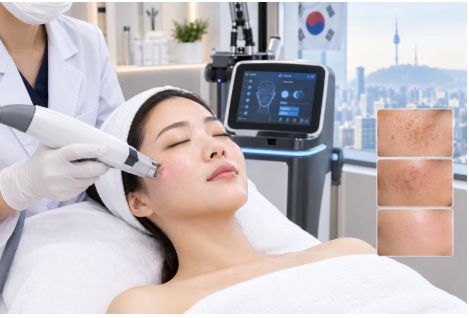
Before-and-after images can provide context, but they should not be treated as guarantees because lighting, camera settings, makeup, and individual skin response can all affect appearance. Clear explanations of limitations and aftercare are often more valuable than dramatic promotional examples.
Search and AI Are Changing the Consultation Before the Consultation
In Korea, patients increasingly research procedures before they ever contact a clinic. Search engines, community posts, short-form video, comparison sites, and AI summaries all influence expectations. This means the first stage of a dermatology decision now happens online.
The advantage is that patients can arrive with more specific questions. The disadvantage is that device names can become detached from medical context. A treatment can trend online before consumers understand what problem it is actually designed to address.
Information platforms can reduce that gap by organizing procedures around concerns, mechanisms, costs, recovery, and comparison criteria rather than simply ranking clinics or repeating promotional claims.
The Better Question Is Not “Which Laser Is Best?”
For most patients, the better question is: which approach is appropriate for this particular pigmentation pattern and skin type? Pico toning can be a useful option in modern pigmentation care, but it is not automatically the right solution for every discoloration concern.
A well-designed treatment plan should begin with diagnosis or assessment, explain why a specific laser approach is being chosen, and set realistic expectations about the number of sessions, possible reactions, and maintenance. When those pieces are clear, the device becomes part of the plan rather than the plan itself.
That shift — from choosing a machine to choosing a treatment strategy — is a more reliable way for patients to navigate South Korea’s fast-moving aesthetic market.