The best AI image generator for business looks different than it did a month ago. On September 8, OpenAI released ChatGPT Images 2.5, with two API models, Flare for speed and Sunburst for precision, and a claimed cut of up to 50% in generation latency compared with Images 2.0. Midjourney moved its default to V8.2 in late July. Google’s Nano Banana family now spans three tiers, and the Pro model reached general availability for enterprise customers in May.
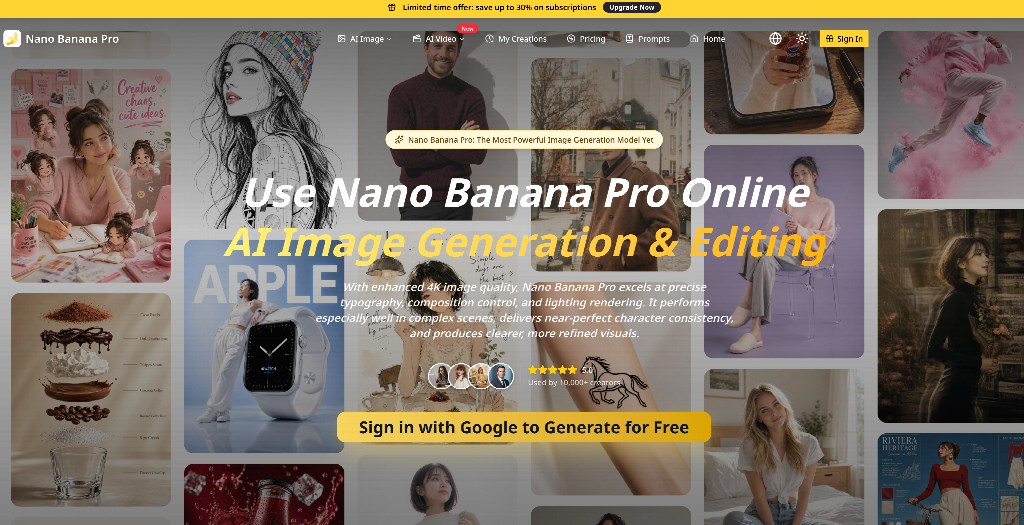
When three major vendors ship in the same quarter, “which one is best” stops being a useful question. The useful question is which model fits which job, and how a marketing or product team can find out without paying for all of them. Testing Nano Banana Pro, Nano Banana 2 and GPT Image 2.5 side by side normally means a Google subscription, a ChatGPT plan and API credits on top. Platforms such as Nano Banana Pro put all three under one account, so a team can compare them on the same brief, then draft on the fast tier, finish text-heavy assets on Pro and run conversational edits on GPT Image 2.5 without stacking separate subscriptions. This guide covers which model to use for which job, and how to find out in thirty minutes.
What Does GPT Image 2.5 Change for Business Buyers?
OpenAI’s pitch for Images 2.5 is not raw aesthetics. It is control over a long editing conversation: sharper detail, more natural lighting, better preservation of people and products from reference photos, and edits that change the requested element while leaving the rest of the frame alone. For developers, Flare is the default choice for high-volume work, and Sunburst targets production-ready campaign creative at the cost of longer generation times.
That matters because the biggest hidden cost in AI imagery has never been the price per image. It is the rerolls. A model that gets a product label right on the first pass, or survives a fourth round of edits without drifting, is cheaper than a model that is half the price and needs six attempts. Every comparison below is really a comparison of first-pass usability for a specific task.
Which AI Image Generators Stand Out This Month?
| Nano Banana Pro | Nano Banana 2 | GPT Image 2.5 | Midjourney V8.2 | |
| Maker / release | Google, Nov 2025 | Google, Feb 2026 | OpenAI, Sep 8, 2026 | Midjourney, default since Jul 24, 2026 |
| Positioned for | High-fidelity work needing maximum factual accuracy | Fast generation and precise instruction following | Flare: everyday and high-volume; Sunburst: premium edits | Aesthetics, image quality, personalization |
| Standout strength | Legible multilingual text, up to 14 reference images, Search grounding, 4K | Pro-like features at Flash speed | Stable multi-turn conversational editing | Look and mood of concept visuals |
| Watch out for | Slower and pricier per image than Flash tiers | Top factual accuracy is reserved for Pro | Sunburst trades speed for control | Built for look, not layout or exact product fidelity |
| Pick it for | Infographics, posters, packaging mockups, localized ads | Social variants, drafts, iteration | Iterative campaign edits, product cutouts | Mood boards, brand concept art |
Why Is Nano Banana Pro the Pick for Text-Heavy and Multi-Reference Work?
Most business imagery is not art. It is a poster with a headline and a price, a packaging mockup with a product name, an infographic with labeled figures, an ad that has to run in four languages. Those jobs fail on text, and text is where Nano Banana Pro was built to be strong. Google has positioned it as its best model for correctly spelled, legible text inside images, with multilingual output for localization.
Two other capabilities matter for teams. It can blend up to 14 input images while keeping up to five people consistent, which is what makes a product-plus-model-plus-setting composite possible without a reshoot. And it can ground generations in Google Search, which helps with real-world details in explainers and diagrams.
The Nano Banana family now works as a ladder: Pro for the final asset that carries text or will be printed at 4K, the faster tiers for everything before that. Using Pro for every draft is the most common way teams overspend on it; the point of having every rung available on one account is to use each for what it does best.
Is GPT Image 2.5 the New Default?
For conversational editing, it is a serious contender. If your workflow is a designer or marketer refining one image through many rounds of instructions, “move the product left, warm the light, remove the reflection, now make it square”, Images 2.5 is designed for exactly that loop. It is also available across all ChatGPT tiers, which lowers the barrier for teams already paying for ChatGPT seats.
Where to be careful: Sunburst’s precision comes with longer generation times, and early testers report that very dense small text can still take more than one attempt. Run it against your own text-heavy templates before assuming it replaces a text-first model.
Can Midjourney V8.2 Compete for Business Work?
For visual direction, yes. V8 brought native 2K HD output and much faster generation, and V8.2 focuses on aesthetics and personalization. For mood boards, campaign concepts and brand exploration, it still produces some of the most distinctive images available.
It is the wrong tool for data graphics, exact product reproduction and anything where a label must match the physical package. Treat it as the concept stage, not the production stage.
Where Do the Faster Tiers Fit?
Google positions Nano Banana 2 for rapid generation and Pro for high-fidelity tasks. In practice that means drafts, social variants, and the ten versions you will throw away before choosing one. For that iteration pass, a lighter Nano Banana AI model is usually enough, and it keeps cost per explored idea low. When the winning direction is chosen, switch to Nano Banana Pro or GPT Image 2.5 on the same account for the final, where text, resolution or reference fidelity has to be right.
Run a 30-Minute Bake-Off Before You Commit
Vendor benchmarks do not use your products, your fonts or your templates. Five tests, run identically on each shortlisted model, will tell you more than any leaderboard.
| Test | Prompt shape | What it reveals | Pass criteria |
| Text | Promo poster with a 10–12 word headline and a price | Spelling, kerning, layout | Every character correct on first pass |
| Reference fidelity | Your real product photo placed in a new scene | Whether labels and shapes survive | Label, color and proportions unchanged at full zoom |
| Multi-turn edit | Four successive edits on one image | Drift in untouched areas | Background and product stable after edit four |
| Data graphic | Four-bar chart with numbers you supply | Numeric faithfulness | Labels match inputs; bar heights proportional |
| Volume | Twenty social variants of one concept | Speed and cost per usable image | Time and spend per keeper, not per generation |
Score each model by usable-on-first-try rate. The winner for your team is often different per test, which is the argument for a multi-model workflow, ideally run from one platform so that testing and switching do not mean paying for three subscriptions.
The Fintech Caveat: A Generated Chart Is Not Data
For TechBullion’s readership this deserves its own line. Image models can draw a bar chart whose bars do not match its own labels, and Search grounding improves factual context without turning an image into a verified source. In financial marketing, where figures in a promotion must be accurate and substantiated, build every chart in a real charting tool and use AI only for the surrounding design. Label AI-generated imagery clearly, and keep provenance intact: Google applies SynthID watermarking to its generated images, which helps downstream verification.
Conclusion
GPT Image 2.5 raised the bar for conversational editing, and Midjourney V8.2 remains the aesthetic benchmark for concept work. For the business jobs that break most often, text on posters and packaging, multi-reference composites, localized ads and infographics, Nano Banana Pro remains the model built for the task, with faster Nano Banana tiers handling the drafts that come before it. The practical move is not choosing a single winner. It is running the five-test bake-off on your own assets, pairing a fast model for iteration with a precise one for finals, and keeping every number in a chart out of the generator’s hands.
FAQ
What is the best AI image generator for business in September 2026?
It depends on the job. Nano Banana Pro leads for text-heavy assets, multi-reference composites and localized creative. GPT Image 2.5 is strong for multi-turn editing inside ChatGPT. Midjourney V8.2 is the pick for mood and concept visuals.
Is Nano Banana Pro better than GPT Image 2.5?
They are optimized for different work. Nano Banana Pro is positioned for text accuracy, factual grounding and multi-image blending; GPT Image 2.5 for stable conversational editing and speed. Run the same five tests on your own assets to decide.
What is the difference between Nano Banana, Nano Banana 2 and Nano Banana Pro?
Nano Banana was Google’s first Gemini image model, released in August 2025. Nano Banana Pro, built on Gemini 3 Pro, followed in November 2025 for high-fidelity work. Nano Banana 2, released in February 2026, brings many Pro capabilities at Flash speed for fast generation.