
HR Performance: How Gen AI in HR Is Transforming Workforce Management

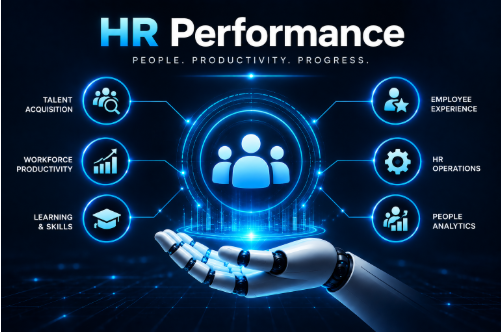
HR leaders are expected to improve workforce productivity, strengthen employee experience and ensure the organization has the capabilities needed to execute business strategy. Meeting these expectations requires more than efficient administration. Organizations need a clear understanding of HR Performance and the ability to identify where processes, services and workforce outcomes can improve.
Gen AI in HR is creating new opportunities to support this shift. Generative AI can automate knowledge-intensive work, improve employee self-service, accelerate access to workforce information and help HR professionals spend more time on strategic priorities.
This article explores how Gen AI in HR can improve HR Performance, the metrics organizations should consider, key use cases, business benefits and priorities for building a more intelligent HR function.
What is HR Performance?
HR Performance refers to how effectively the HR function delivers workforce services, manages resources and contributes to organizational objectives. It can be evaluated through measures related to HR cost, productivity, service quality, talent outcomes, workforce capabilities and employee experience.
Traditional HR measurement has often focused on administrative metrics such as headcount, turnover or time-to-hire. While these measures remain useful, they do not provide a complete picture of the function’s contribution.
A broader approach to HR Performance considers whether HR is operating efficiently while helping the organization attract, develop, deploy and retain the talent required to support business priorities.
What is Gen AI in HR?
Gen AI in HR refers to the application of generative artificial intelligence across human resources processes, workflows and employee services. These capabilities can understand natural language, summarize workforce information, generate content and provide conversational access to HR knowledge.
HR teams can apply generative AI across recruiting, onboarding, employee support, learning, workforce planning and HR operations.
Unlike traditional automation, which typically follows predefined rules, Gen AI in HR can support knowledge-intensive activities that require interpretation, synthesis and communication.
Why HR Performance matters
Organizations invest significant resources in their workforce and HR capabilities. Without objective performance measures, leaders may struggle to determine whether HR services are efficient, scalable and aligned with changing business needs.
HR Performance measurement can reveal where administrative work consumes too much capacity, where service delivery is inconsistent or where talent processes are not producing desired outcomes.
For example, improving time-to-hire may have limited value if new employees do not have the skills required by the business. Similarly, reducing HR operating costs may be counterproductive if employee service deteriorates significantly.
A balanced set of measures helps HR leaders evaluate these trade-offs and prioritize improvement opportunities.
How Gen AI in HR can improve performance
Generative AI can support HR Performance by reducing administrative workloads and improving access to workforce information.
HR professionals frequently spend time answering recurring employee questions, preparing communications, summarizing cases and searching for policy information. Gen AI in HR can assist with these activities, releasing capacity for workforce planning, talent strategy and business partnering.
AI can also make information easier for employees and managers to access through conversational interfaces.
The value therefore extends beyond automation. Generative AI can help redesign how HR services are delivered and how HR teams allocate their time.
Key metrics for measuring HR Performance
Organizations should select HR measures according to their workforce strategy and operating model. Several categories can provide a balanced view.
HR cost
Measures such as HR cost per employee can help leaders understand the efficiency of the HR operating model.
HR productivity
Workload and staffing metrics can show how effectively HR resources support the broader workforce.
Time-to-hire
Recruiting cycle time helps organizations understand how efficiently talent acquisition processes fill workforce requirements.
Employee retention
Retention measures can identify workforce stability and areas where unwanted turnover may affect business performance.
HR service performance
Case resolution times, service levels and employee satisfaction can help leaders evaluate the quality of HR operations.
Workforce capabilities
Skills availability, learning participation and internal mobility can provide insight into whether the organization is building capabilities required for future business needs.
Together, these measures provide a more comprehensive view of HR Performance.
Key use cases of Gen AI in HR
Organizations can apply generative AI across multiple stages of the employee lifecycle.
Talent acquisition
Gen AI in HR can help draft job descriptions, summarize candidate information and prepare recruiting communications, reducing administrative work for talent teams.
Employee onboarding
Generative AI can provide new employees with conversational access to policies, procedures and organizational information.
Employee self-service
AI assistants can answer routine questions about benefits, leave, workplace policies and HR processes, reducing basic inquiries handled manually.
HR case management
Generative AI can summarize employee requests, retrieve relevant policies and help HR specialists understand complex cases faster.
Learning and development
AI can help create learning content and recommend relevant development resources based on employee roles and skills requirements.
Workforce planning
Generative AI can summarize workforce information and help leaders explore skills, capacity and talent trends more efficiently.
These applications demonstrate how Gen AI in HR can influence both operational efficiency and workforce management.
Business benefits of Gen AI in HR
When connected with clearly defined HR priorities, generative AI can improve several dimensions of performance.
Greater HR productivity
Automating repetitive knowledge work allows HR professionals to spend more time on workforce strategy, employee development and business partnering.
Faster employee services
Conversational AI and intelligent knowledge retrieval can help employees access information without waiting for routine HR support.
Improved knowledge accessibility
Generative AI can make policies, procedures and HR documentation easier for employees and managers to understand.
Greater scalability
AI-enabled workflows can help HR organizations support growing workforces without equivalent increases in administrative effort.
Better employee experience
Simplified access to HR services and faster issue resolution can reduce friction across important employee interactions.
How Gen AI can strengthen HR Performance management
Traditional HR reporting is often retrospective, showing leaders what has already happened. Combining AI with workforce analytics can support a more continuous approach to performance management.
Gen AI in HR can summarize performance information, highlight emerging patterns and make HR data easier for leaders to explore.
For example, AI could help HR teams identify increases in service requests, changing recruitment workloads or patterns in employee inquiries. Leaders can then investigate the underlying causes and determine whether processes or resources need to change.
This enables HR Performance management to become more proactive rather than relying exclusively on periodic reporting.
Best practices for implementing Gen AI in HR
Organizations should connect AI initiatives with clearly defined workforce and HR outcomes.
- Establish HR Performance baselines before implementing AI.
- Identify high-volume and knowledge-intensive activities where generative AI can create value.
- Improve workforce data and HR knowledge quality.
- Prioritize use cases according to business value, feasibility and risk.
- Integrate AI with existing HR platforms and workflows.
- Establish strong employee privacy, security and responsible AI controls.
- Maintain human accountability for hiring, compensation, performance and other sensitive workforce decisions.
- Prepare HR professionals to evaluate AI-generated outputs.
- Measure whether AI initiatives improve productivity, service quality and workforce outcomes.
This approach helps organizations move from experimentation toward scalable HR transformation.
Common implementation challenges
HR manages highly sensitive employee information, making privacy and security critical requirements for Gen AI in HR. Organizations need clear controls governing which information AI systems can access and how it is used.
Data quality is another challenge. Inconsistent workforce records and outdated HR documentation can reduce the reliability of AI-generated outputs.
Bias and transparency also require attention when AI supports workforce processes. Organizations should maintain appropriate human oversight and ensure employees understand how technology is being used.
Legacy HR platforms may create additional integration challenges, particularly when organizations operate different systems across business units or regions.
Measuring the value of Gen AI in HR
The success of generative AI should be measured through improvements in HR Performance rather than AI usage alone.
Organizations can track employee productivity, HR cost, service response times, case resolution, recruiting cycle times and employee experience. Measures should reflect the specific purpose of each AI application.
For example, an HR knowledge assistant should be evaluated based on whether it reduces information search time and routine service requests, not simply how often employees interact with it.
Establishing performance baselines helps HR leaders determine whether AI is generating measurable improvement.
The future of HR Performance
The next phase of HR transformation will increasingly involve AI agents capable of coordinating activities across HR systems and employee workflows.
An agent could receive an employee request, retrieve relevant policy information, initiate an approved process and escalate sensitive issues to an HR professional. Multiple agents may eventually support connected processes across recruiting, onboarding, learning and workforce administration.
Gen AI in HR will also make workforce information more conversational, allowing leaders to explore trends and performance through natural-language interactions.
As these capabilities mature, HR Performance will increasingly reflect how effectively people, processes and intelligent technologies work together.
Conclusion
HR Performance provides organizations with a structured way to understand how efficiently HR operates and how effectively it supports workforce and business priorities. Gen AI in HR creates new opportunities to strengthen this performance by reducing administrative work, improving employee services and making workforce knowledge easier to access.
Organizations that connect generative AI with relevant HR metrics, reliable workforce data and effective governance will be better positioned to build productive and future-ready HR functions. The long-term opportunity is not simply greater HR automation, but a more intelligent function capable of delivering stronger workforce and enterprise value.






Comment