
How Building a FinTech Startup Works: A Guide for the US Financial Market
How does building a fintech startup work? A step-by-step guide to validation, bank partners, compliance, and funding in the US financial market today.

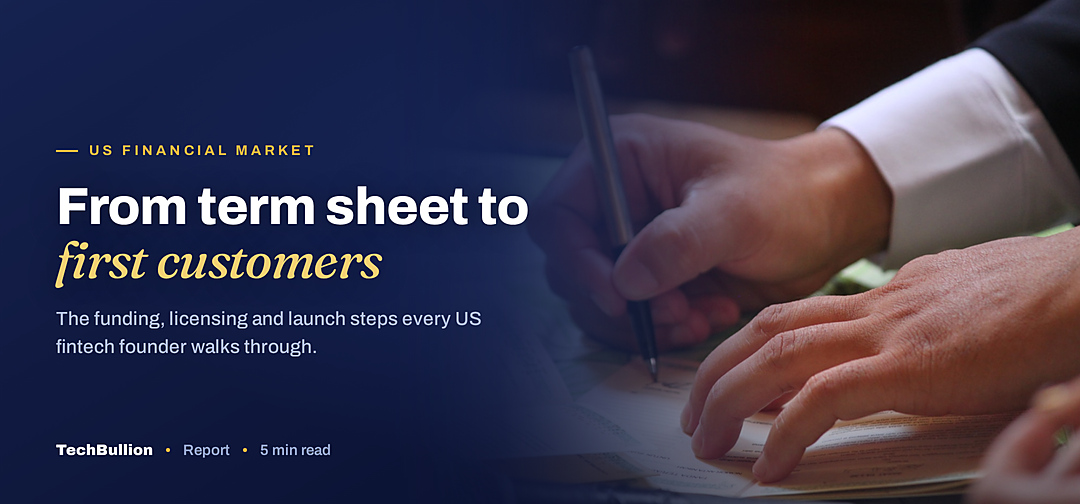
Behind every fintech app a customer taps is a sequence most users never see: a narrow idea, a bank partner, a stack of compliance work, and a funding round that decides whether the company lives. Understanding how building a fintech startup works explains why some apps feel solid while others vanish within a year. The market they compete in is large, with the United States fintech sector valued at USD 66.82 billion in 2026, according to Mordor Intelligence.
This guide walks through the process as it plays out in the American market, from the first idea to a launched product, and shows where founders most often lose their footing.
How building a fintech startup works, step by step
The path is more predictable than the headlines suggest. A founder finds a financial task that is slow or expensive, proves that people will pay to fix it, then assembles the regulated and technical pieces needed to deliver it at scale. Each step gates the next, so a team that rushes the compliance work to reach launch often pays for it later with a frozen account or a regulator letter. The stages below are the common spine of nearly every successful firm. They rarely run in a clean line, since a founder may loop back to validation after launch, but the order of priorities tends to hold.
Step one: find a narrow problem and validate it
Strong startups begin with a sharp, small problem rather than a grand vision. A team might focus on paying gig workers faster or approving a loan for a borrower with little credit history. The point is to pick a task where the current option is clearly bad, then test a rough version with real users before writing much code. A landing page, a waitlist, or a simple prototype can prove demand for a fraction of the cost of a finished app, and it tells the founder whether the problem is worth years of work. Many founders now use artificial intelligence to size demand and spot gaps, a method visible across the tools reshaping fintech research.
Validation matters more in a tight funding climate. Global fintech investment fell to a seven-year low of USD 95.6 billion in 2024, with United States activity rising only cautiously, according to KPMG. Investors now want evidence of paying users before a big round, so the teams that test early have a real edge over those that build in private for a year.
Step two: get the regulated parts right
This is the stage that separates fintech from ordinary software. A startup that touches money usually cannot operate alone, so it partners with a chartered bank that holds the license while the startup builds the interface, a model known as banking-as-a-service. The founder must also plan for 50 state money-transmitter regimes plus federal oversight, and early-stage firms can spend a fifth of their operating budget on anti-money-laundering and identity checks.
The rules have tightened. New guidance on bank-fintech partnerships has raised the due-diligence costs that sponsor banks pass to their startup partners, which slows onboarding but rewards firms with clean controls. A founder who treats the bank partner as a true gatekeeper, not a vendor, and who builds compliance into the product, avoids the most common cause of sudden failure. The work is unglamorous, but it is what lets a startup keep moving customer money without a regulator stepping in.
Step three: build the stack and launch
With the regulated path set, the team builds the technical stack. Modern startups rarely write everything from scratch; they assemble payment rails, identity tools, and ledgers through interfaces, then add the one piece that makes them different. Teams that expect growth pair this work with strong product engineering and cloud capacity, and some build on instant rails such as those behind digital currency conversion services.
Launch is a beginning, not a finish. Real-time payment systems like FedNow, now used by more than 1,300 banks, let startups offer instant transfers, but those rails are irreversible, so fraud controls must work from the first day. A careful launch starts with a small group of users, watches for errors and abuse, then widens access once the system holds. Early users also surface the confusing screens and edge cases that no internal test catches, which is why a quiet launch usually beats a loud one.
Step four: raise money and scale
Funding decides how far a validated idea can travel. Venture capital is recovering from its 2024 low, but rounds are smaller and investors expect proof of revenue, not just growth. Founders trade equity for the cash to hire, expand compliance, and add the next product, often moving from a single feature such as payments into lending or savings. Digital payments held the largest share of the United States market in 2025, while neobanking grew fastest at a 21.05 percent annual rate, so many teams expand toward those segments.
Scaling tests the early choices. A startup that built clean compliance and a focused product can add users without breaking, while one that cut corners finds that growth multiplies its problems. The market rewards this discipline because concentration is low, with no single firm holding a double-digit share, leaving room for a focused firm to take share from larger but slower rivals. That open structure is one reason founders keep entering despite the hard funding climate.
Where startups stumble
The failures cluster in a few places. Some teams skip validation and build a product no one pays for. Others underestimate compliance and lose their bank partner. A third group raises too much too early, then cannot grow into the valuation. And many simply run out of cash because they chased scale before revenue, a fatal habit in a careful funding market.
The fix is sequence and discipline: validate the problem, get the regulated parts right, build a focused stack, and raise money against proof rather than hope. Founders who respect that order in the United States market give themselves the best chance of turning a narrow idea into a company that lasts beyond its first year.





Comment