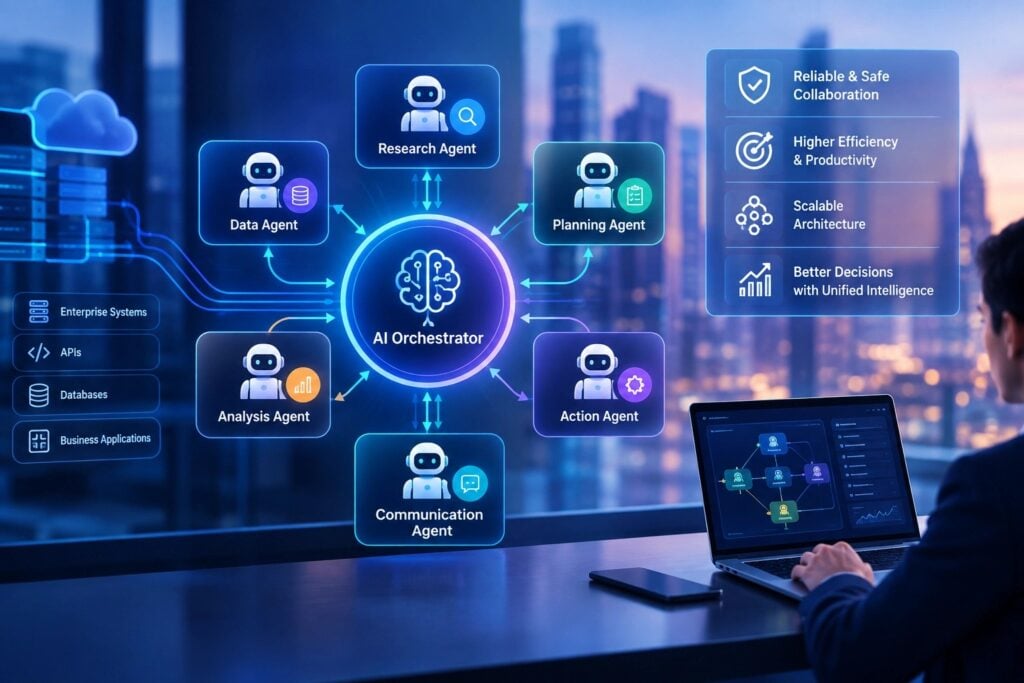
A single AI agent can already retrieve information, analyze documents, call APIs, and execute business tasks. The challenge begins when one agent is expected to handle too many responsibilities at once.
Its context grows, its toolset becomes harder to govern, and failures become more difficult to trace.
This is where AI agent orchestration becomes important.
Instead of building one oversized agent, enterprises can distribute work across specialized agents and use an orchestration layer to determine who performs each task, how work moves between agents, and what happens when something fails.
The goal is not simply to connect several agents. It is to make multi-agent systems reliable enough for real business operations.
What AI Agent Orchestration Actually Does
AI agent orchestration coordinates agents, tools, models, enterprise systems, and human approvals within a workflow.
Consider invoice processing.
One agent may extract invoice data. Another validates it against purchase orders. A third checks internal policies. Another handles exceptions.
The orchestrator decides how those tasks are sequenced, whether some run in parallel, when an agent should be retried, and when human review is required.
For enterprises using artificial intelligence consulting services to design agentic systems, AI agentic services can help organizations architect, integrate, and optimize multi-agent workflows for reliable business operations. Orchestration is one of the key architectural decisions because it determines how reliably agents can collaborate across real business workflows.
Modern agent architectures support patterns such as sequential execution, parallel execution, handoffs, and manager-agent models. The right pattern depends on the business process, not on which architecture sounds most advanced.
Start With the Simplest Architecture
Not every workflow needs multiple agents.
If one agent with a few clearly defined tools can complete the task reliably, adding several more agents may only increase latency, cost, & complexity.
Multi-agent architectures become more useful when:
- responsibilities can be separated clearly
- agents require different tools or permissions
- some tasks can run in parallel
- workflows involve multiple specialist domains
- one agent’s context is becoming difficult to manage
For enterprise AI agents, specialization is usually more valuable than unnecessary complexity.
Give Every Agent a Clear Role
Reliability improves when each agent has a narrow responsibility.
A procurement workflow might include one agent for supplier research, another for compliance checks, another for price comparison, & another for preparing a purchase request.
Each agent can then have its own instructions, tool access, permissions, and evaluation criteria.
This makes the system easier to test and limits the impact of failures.
If the supplier-research agent produces a poor result, that problem can be isolated rather than affecting every capability inside one large agent.
Choose the Right Orchestration Pattern
Different workflows require different coordination models.
- Sequential orchestration works when one step depends on the previous one.
- Parallel orchestration is useful when independent tasks can happen at the same time.
- Handoff models allow one agent to transfer a task to another specialist.
- Manager-agent architectures use a coordinating agent to decide which specialists are required and how their outputs should be combined.
The important point is to avoid unnecessary AI reasoning.
If a compliance process must always follow the same five steps, a deterministic workflow engine may be more reliable than letting an LLM decide the order.
A strong agentic workflow often combines deterministic software with AI reasoning only where interpretation is genuinely required.
Treat State as Part of the Architecture
Multi-agent systems need to know what has already happened.
A long-running process may include the original request, intermediate outputs, approvals, completed actions, and errors.
Without controlled state management, agents can repeat steps, lose context, or act on outdated information.
Production systems therefore need persistent workflow state and checkpoints.
If a six-stage workflow fails at stage five, the system should ideally resume from the latest valid point rather than restarting the entire process.
Design for Failure
Agents depend on models, APIs, networks, databases, and third-party services. Any of these can fail.
Reliable orchestration should therefore include:
- timeouts
- retries
- fallback behavior
- validation between stages
- error handling
- idempotent operations
Intermediate outputs also need validation.
If Agent A produces an incorrect result and Agent B accepts it without checking, the error can move through the entire workflow.
Multi-agent systems must therefore be designed around failure handling, not just successful execution.
Control What Each Agent Can Do
More agents mean more permissions to manage.
An agent that analyzes financial data does not automatically need permission to modify it. Similarly, an agent that prepares a payment recommendation should not necessarily have authority to release funds.
Each agent should follow least-privilege access.
Sensitive actions should be logged, authenticated, and where appropriate, require human approval.
This is especially important when agents can modify production systems, trigger financial activity, or communicate externally.
Reliable AI agent orchestration coordinates authority as much as it coordinates intelligence.
Interoperability Will Matter More
Enterprises are unlikely to build every agent with the same framework or vendor.
Different teams may develop agents in different environments.
Open standards are beginning to help here. Model Context Protocol (MCP) focuses on connecting AI systems to tools and data, while Agent2Agent (A2A) is designed to support communication between agents.
These approaches can reduce tight coupling between systems and make it easier for enterprises to build distributed agent ecosystems.
Organizations evaluating artificial intelligence consulting services should therefore consider orchestration and interoperability architecture, not just which model or agent framework is being proposed.
Observability Is Essential
When several agents interact across multiple tools, debugging becomes difficult quickly.
Enterprises need visibility into:
- which agent handled each task
- which tools were called
- how long each step took
- which model was used
- where errors occurred
- how much the workflow cost
- whether the task achieved the intended business result
Without this level of observability, teams may know that a workflow failed without understanding why.
Reliable Multi-Agent Systems Are Engineered
The difficult part of building multi-agent systems is not creating intelligent agents.
It is making their coordination predictable.
That requires clear role boundaries, appropriate orchestration patterns, persistent state, access controls, validation, failure recovery, human oversight, and observability.
The most reliable enterprise approach is straightforward: use deterministic software where the process is known and agents where reasoning genuinely adds value.
That is what turns a group of enterprise AI agents into an operational system rather than a technical experiment.
FAQs
- What is AI agent orchestration?
AI agent orchestration coordinates multiple agents, tools, systems, and workflow steps so they can work together toward a defined business objective.
- When should enterprises use multi-agent systems?
They are useful when workflows contain clearly separable responsibilities, specialist tools, different permissions, or tasks that can run independently.
- What is an agentic workflow?
An agentic workflow combines AI-driven reasoning with software-defined steps to automate or support complex business processes.
- How can enterprises improve multi-agent reliability?
Use clear role boundaries, state management, validation, retries, permission controls, human approvals, and end-to-end observability.
- Do multi-agent systems require human oversight?
Not always, but high-risk, financial, regulated, or security-sensitive actions should include appropriate approval or escalation mechanisms.