
Launch Date First: How Blockchain App Factory Builds a Crypto Marketing Strategy Around the TGE

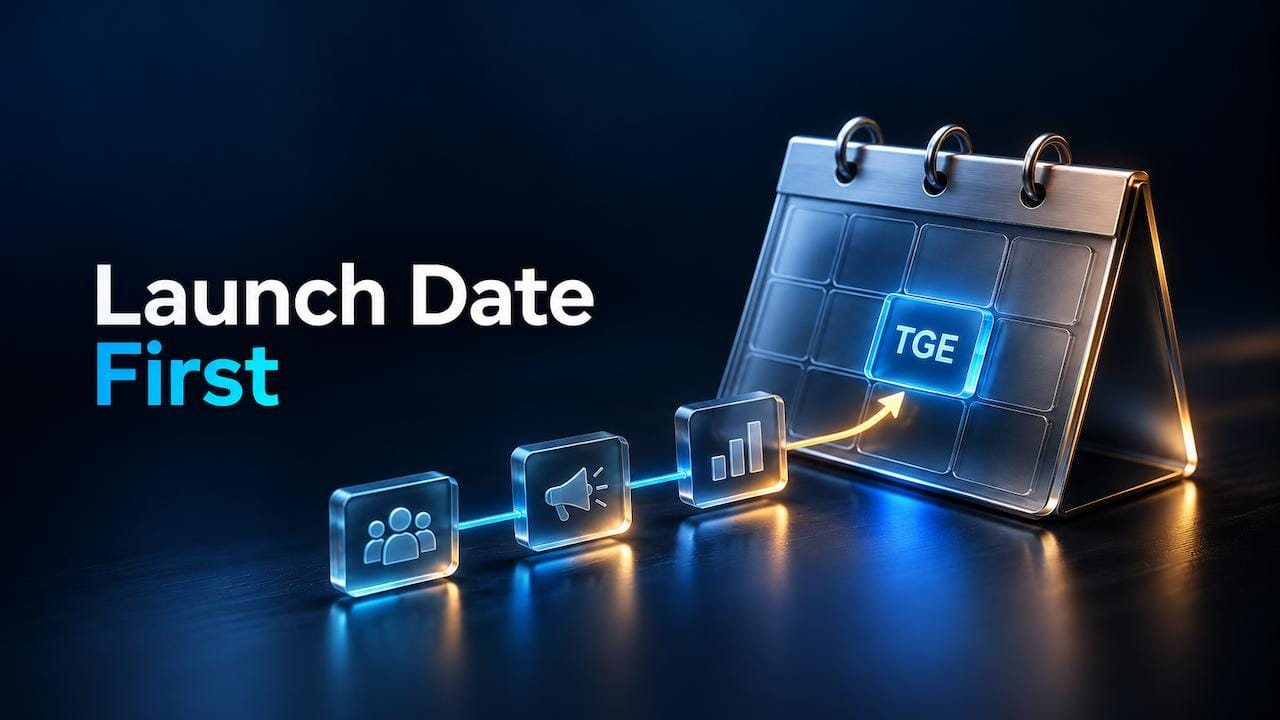
Most crypto marketing plans begin with a channel list. The launch date gets pencilled in later, once the KOLs and press packages are chosen. Blockchain App Factory reverses that order. The Token Generation Event goes on the calendar first, and every KOL post, press release, AMA and ad slot is scheduled backwards from it.
The reason is in last year’s launch data.
Memento Research tracked 118 token generation events in 2025. By December, 84.7% of them traded below their initial valuation, and the median token was down more than 70%, as CoinDesk reported. A DWF Labs analysis that excluded meme coins and looked only at structured launches with real products found the same pattern. Over 80% traded below listing price, with typical drawdowns of 50 to 70 percent within 90 days.
The selling starts fast. An academic study of nine major airdrops, titled “Airdrops: Giving Money Away Is Harder Than It Seems,” found that 66% of 1inch recipients moved their tokens to exchanges within 24 hours. Keyrock’s review of 2024 airdrops found that 88% of tokens launched with an airdrop had fallen in price.
Tokenomics explains part of this. Timing explains a lot of the rest.
Attention peaks on the wrong day, and supply lands after demand has gone home.
Why most token launch marketing peaks on the wrong day
Most launch campaigns fail in a predictable way. The founder hires late, pushes everything into launch week and stops spending once the listing is live. The price chart then records the exact day the marketing ended.
The same four problems come up across launches:
- Teams start in launch week. Good KOLs are booked weeks ahead and tier-one outlets plan coverage around embargoes, so a project starting ten days out pays more and gets whoever is still available.
- Budgets stop at listing day. The first unlocks, airdrop claims and early sellers all arrive after TGE, and by then nobody is left in the community to answer questions.
- Wallet counts get mistaken for holders. Quest campaigns and airdrops that reward activity without filtering bots produce a big number before the snapshot and an exit after the claim.
- Each channel tells its own story. PR says infrastructure, KOLs say 100x, and the Telegram admins are still explaining the whitepaper. Buyers read the mixed signals as risk.
Every item on that list is a scheduling failure. More budget fixes none of them.
What “launch date first” means in practice
Launch date first means fixing the TGE and then listing what must already be true on that day. Each item on the list gets a deadline, counted back from the event.
Blockchain App Factory runs this through six stages: discovery, positioning, foundation, launch, community and scale. The order matters most. Each stage has to be finished before the next one depends on it.
Three questions come before any budget is committed:
- What has to be true on TGE day? Usually a verified holder base, confirmed tracker listings, press ready under embargo and a community that can answer basic questions without the founders.
- What has to be true 90 days after TGE? Holders who are still active, and organic search demand that keeps growing after the listing news fades.
- What has to start today for both to happen? Usually positioning, community setup, tracker applications and KOL shortlisting, which take longer than most founders plan for.
The agency will not accept a launch brief without a written plan. The failure it sees most often is channels going live with different messages, and a written plan is the cheapest way to stop that.
The T-minus calendar
Blockchain App Factory starts pre-TGE work 60 to 90 days before the sale. Launch activity is concentrated in the two to four weeks around the TGE. Post-launch support runs for at least 60 to 90 days and often for three to six months.
| Window | Stage | What happens | What it produces |
| T-90 to T-60 | Discovery and positioning | Token utility review, competitor benchmarks, audience segments, message pillars, hook testing | One approved narrative every channel must carry |
| T-60 to T-30 | Foundation | Telegram and Discord setup, CoinMarketCap, CoinGecko and DappRadar preparation, creator vetting | Infrastructure that works before traffic arrives |
| T-30 to T-7 | Demand build | KOL seeding, PR under embargo, whitelist growth, countdowns, wallet scoring before snapshot | Qualified demand and a filtered holder list |
| T-7 to T+14 | Launch | Telegram, Discord, X, PR, KOLs and trackers go live together, AMAs sequenced, paid campaigns cleared by market | Concentrated attention on the day it counts |
| T+14 to T+90 | Community and scale | Daily content, moderation, holder growth tracking, budget moved to channels that convert | A holder base that stays after the candle closes |
T-90 to T-60: positioning
No money is spent until the research brief is approved. This stage decides what the project says and who hears it.
- The team reviews token utility and the business model against direct competitors.
- Audience segments are defined, and each channel is scored by how well it reaches them.
- One core narrative is written, with message pillars underneath it.
- Hooks are A/B tested before paid spend begins.
T-60 to T-30: foundation
This is the least visible stage and the one teams most often skip.
- Discord is built and moderated, and Telegram placements are lined up, before real traffic arrives.
- Tracker listings on CoinMarketCap, CoinGecko and DappRadar are prepared so they are confirmed by launch.
- Creators are vetted from a network of more than 3,500 crypto creators, matched by sector and region.
- Campaigns are planned per chain. BNB Chain launches lean on AMA circuits and launchpad countdowns, and TON launches run through Telegram Mini Apps.
T-30 to T-7: demand build
The calendar pays off here. KOLs are booked before competing launches claim their slots, and press is prepared under embargo through relationships with more than 140 outlets.
- KOL content is seeded in phases across the month.
- Whitelist growth is judged on signup quality. Raw member counts are tracked but carry little weight.
- Wallets are scored before the airdrop snapshot so the holders left after the claim are real users.
- Every creative and landing page is cleared for the target markets.
T-7 to T+14: the launch window
All channels go live together. Announcements follow a set order, AMAs are timed to listing milestones, and paid campaigns run only in markets that have already been cleared.
- Exchange announcements and PR releases go out on a shared timeline.
- Moderators and ambassadors cover the busiest hours in shifts.
- Reporting tracks wallet connects, participation and volume.
- Impressions are logged, but they do not decide where budget goes.
T+14 to T+90: the retention window
Most plans run out of budget here. Blockchain App Factory’s continuity support is built for this stretch.
- Daily content and active moderation continue after launch week.
- Holder growth is tracked through verified wallets. Follower counts are a secondary metric.
- Budget moves toward channels that convert, and the rest are cut.
- Organic search and AI visibility work starts, so the project stays findable after paid reach stops.
How the same calendar produces different playbooks
The calendar structure is fixed. What fills each window depends on the project. A Layer 1 network needs different dates and different success metrics from a DeFi protocol.
Multi-stage launches have more than one date
For AI blockchain project OpenLedger, the calendar spanned testnet, TGE and mainnet. Each stage positioned Proof of Attribution for a different group: builders, contributors and token holders. The case study on Blockchain App Factory’s crypto marketing agency page reports more than 47 million impressions and the number one position for market mindshare in both English and Chinese.
Developer networks count a different milestone
For some networks the audience that matters is developers, and developers care little about a price chart. The NEAR campaign focused on explaining what the network gives builders and reached more than 210,000 builders across 5.2 million-plus impressions. Moonbeam was positioned as the natural EVM route into Polkadot for Solidity teams, and its campaign recorded 1.94 million transactions and 58-plus media placements.
DeFi launches follow liquidity events
In DeFi the dates that matter are liquidity events and staking windows. The CNKT+ campaign made staking easier to understand for active DeFi users. It produced 3.1 million-plus impressions and more than 23,000 site visits.
Community projects put retention on the calendar
When a project’s value depends on people staying, community growth gets its own deadline. TEZVERSE combined gaming, AI, DeFi and rewards in one story, and its campaign recorded 180%-plus Discord growth and more than 28,000 visits.
Exchanges run on listing and referral cycles
Exchange marketing is measured by active traders, volume, liquidity depth and repeat usage. Holder count matters far less. The calendar is built around listing-day traffic, referral volume campaigns and the ongoing communication that keeps a trading pair visible after launch week.
Compliance is a deadline too
A campaign pulled from a market during launch week is a calendar problem. Regulatory review gets fixed dates on the calendar, well before any ad spend begins.
- In the EU, MiCA requires marketing communications to be fair, clear and not misleading, and consistent with the published crypto-asset white paper.
- In the UK, the FCA’s financial promotions regime for cryptoassets requires risk warnings and a 24-hour cooling-off period for first-time investors, which affects both messaging and user flows.
- Ad platforms set and change their own crypto policies. Advertiser certification and landing-page review take time and need their own slot in the plan.
Blockchain App Factory checks every asset against the promotion rules of each target market before spend goes live, and restricted regions are excluded at the targeting level. No agency can promise an ad account will never be restricted. What a team can control is when problems show up, and review week is a far cheaper time to find them than launch day.
What this means for your token launch
A launch-date-first plan treats the TGE as the midpoint of the campaign. Founders can apply the same approach to their own launch:
- Fix the TGE date and count back 90 days. If you are already inside that window, cut scope before you cut preparation.
- Write down what must be true on launch day, from tracker listings and a filtered holder list to embargoed press and a community that runs without the founders.
- Budget for the 90 days after TGE. Launch-day spend with no post-launch funding buys about a week of attention.
- Match the metric to the stage: signup quality before launch, wallet activity at TGE, then retention and organic search demand after listing.
- Give compliance review its own deadline on the calendar.
The 2025 data put the median new token down more than 70%. Funding the 90 days after listing is the most direct response a marketing team has to that number.
If your launch date is set and your plan still starts with a channel list, fix the order before adding spend. Blockchain App Factory’s team can map a T-minus calendar for your launch in a strategy call.
FAQs
How early should a token project start marketing before its TGE?
Blockchain App Factory recommends starting 60 to 90 days before the TGE, ICO or IDO. That window covers community setup, KOL bookings before other launches take the slots, embargoed PR and whitelist demand. Projects that start in launch week usually pay more for less attention.
What happens to marketing after the token lists?
Support continues for 60 to 90 days after TGE and often longer. The work covers daily content, moderation and holder retention. Budget shifts toward the channels that convert. This is the period when early sellers and unlocks put the most pressure on price.
How much does a TGE marketing campaign cost?
Published packages start at $7,500 for early-stage projects, $15,000 for a token launch and $30,000 for funded projects, with custom pricing for exchanges and networks. Cost depends mostly on the number of target markets, the tier of creators and PR, and the size of the paid media budget.
How do you stop airdrop farmers from diluting a launch?
Wallets are scored before the snapshot. Filtering sybil activity at that point means the holder base left after distribution is made up of real users, and the community stays intact once claims are done.
Does the same TGE calendar work for every type of project?
The structure stays the same while the milestones and metrics change. Layer 1 networks may treat testnet, TGE and mainnet as separate dates. DeFi protocols plan around liquidity events, and exchanges measure active traders and volume.






Comment