Flying With a Rollator: What Airlines Don’t Explain Clearly
Airline policies often say that walkers and other mobility aids are accepted, but that short answer leaves out the decisions travelers face at the airport. Will the rollator stay with you to the gate? Can it be stored in the cabin? Where will it be returned? Knowing what to ask—and when to ask it—can make the trip far more predictable.
A Rollator Is an Assistive Device, Not Ordinary Luggage
For flights to, from, or within the United States, a rollator used because of a disability is treated as an assistive device under U.S. Department of Transportation rules. That distinction matters. An airline must transport the device without counting it against the passenger’s standard carry-on allowance, and an assistive device placed in the baggage compartment receives priority over ordinary baggage.
This does not mean every rollator will travel in the passenger cabin. Cabin items still have to meet applicable safety and stowage requirements. A rollator that is too large for an approved storage location, cannot be safely secured, or arrives after the available priority space has been occupied may need to travel in the cargo compartment. The useful question is therefore not simply, “Can I bring it?” but, “Where will this specific device be stored on this specific aircraft?”
What “Accepted” Does Not Tell You
Airline accessibility pages tend to explain the broad policy, while the operational details are decided at check-in or at the gate. Aircraft size, storage configuration, the number of assistive devices on the flight, and local handling procedures can all affect what happens.
Cabin Storage Is Possible, Not Automatic
Small assistive devices may be placed under a seat, in an overhead compartment, or in another approved cabin storage area when they fit safely. Some larger aircraft also have a designated priority space for a folding manual wheelchair. However, a rollator’s folded dimensions do not by themselves guarantee that a crew will place it in that space or in an overhead bin. Preboarding can improve the opportunity to use available priority storage, but it cannot create space that the aircraft does not have.
Gate Check Is Different From Checking at the Ticket Counter
Checking a rollator at the ticket counter means giving it up before security and relying on airport assistance for the rest of the terminal journey. Gate checking normally lets the traveler use the rollator through the terminal and hand it to airline staff near the aircraft. For many users, that is the more practical arrangement, but the exact handoff point may be the boarding door, jet bridge, or gate podium. Confirm the process before boarding begins instead of assuming the procedure will be identical to a stroller or ordinary carry-on bag.
“Returned at the Gate” Can Mean Different Places
A gate-checked rollator may be returned in the jet bridge, beside the aircraft, at the arrival gate, or occasionally at baggage claim. The practical difference is significant for someone who needs the device to walk. Tell the gate agent that the rollator is an assistive device and ask for it to be returned as close as possible to the aircraft door. Before surrendering it, verify that the claim tag reflects the requested delivery point, especially when the trip includes a connection.
Your Rights on a U.S.-Covered Flight
The Air Carrier Access Act and its implementing rules establish protections for passengers with disabilities on flights operating to, from, or within the United States. These protections are more specific than many short airline summaries suggest.
| Issue | What the rule generally provides | What to confirm at the airport |
| Carry-on allowance | An assistive device does not count toward the normal carry-on item limit | Whether the rollator can be safely stored in the cabin |
| Preboarding | A passenger who needs extra time or help to board or stow accessibility equipment must have a preboarding opportunity | Where to wait and when to identify yourself to the gate agent |
| Cargo stowage | Assistive devices receive priority over other cargo and baggage | How the rollator will be tagged and protected |
| Return | Airlines must provide for timely return of gate-checked assistive devices | Whether delivery will be at the aircraft door, jet bridge, gate, or baggage claim |
| Problems | Airlines must make a Complaint Resolution Official available during operating hours | How to contact the CRO if staff cannot resolve an accessibility issue |
Preboarding is especially useful when a passenger needs more time to walk down the jet bridge, explain how the device folds, or request cabin stowage. It is not the same as simply joining an early boarding group. Identify the need to the gate agent before general boarding and state the practical reason clearly.
Questions to Ask Before Departure
Calling the airline’s accessibility desk can prevent confusion, but a general note on a reservation is not a complete plan. Provide the device type, folded measurements, and weight, then ask questions that produce specific answers.
- Can I use my rollator to the aircraft door, and where will I hand it over? Can this aircraft safely accommodate it in the cabin, or should I expect a gate check? Where will it be returned after landing and at each connection? Do I need a special tag or written handling instructions? Who should I contact if the aircraft type changes?
Record the date of the conversation and the department contacted. Policies can be applied differently at different airports, so repeat the essential questions at the departure gate. For an international itinerary, also check the operating carrier’s rules—not only the airline that sold the ticket—because the operating carrier handles the device.
What Happens at the TSA Checkpoint
TSA permits walkers in both carry-on and checked baggage, but every item must be screened. A rollator that fits through the X-ray machine may be folded and screened with other property. If it cannot go through the machine or the traveler cannot walk without it, officers can use an alternative screening procedure. The exact process depends on the checkpoint and the passenger’s mobility needs.
Tell the officer what assistance you require before screening starts. Do not attempt to walk unsupported simply to keep the line moving. Travelers who want help preparing for the checkpoint can contact TSA Cares in advance and may request a Passenger Support Specialist. A TSA notification card can communicate a condition discreetly, but it does not exempt the passenger or device from screening.
Before reaching the checkpoint, remove personal items from the storage bag and check its pockets. Water bottles, tools, loose accessories, and other contents are screened according to their own rules. Keeping the rollator uncluttered makes inspection simpler and reduces the chance of leaving something behind.
A Better Gate-Handoff Routine
Take clear photos of the rollator shortly before travel, including its frame, wheels, handles, brakes, seat, and existing marks. Add a durable identification tag with the passenger’s name and phone number. If the rollator has removable accessories, either carry them separately or secure them so they cannot catch on baggage equipment. Never leave medication, identification, electronics, or valuables in the storage bag when handing the device to airline staff.
Show the handler how the rollator folds rather than expecting every employee to recognize its mechanism. A short handling card can state “manual rollator,” list the folding steps, provide the folded dimensions and weight, and identify any part that should not be used as a lifting point. Lock the brakes only if that is appropriate for the handling process and confirm with the employee before walking away.
Keep the claim tag receipt where it can be reached without the rollator. At arrival, inspect the frame, wheels, brake cables, handles, seat, and folding mechanism before leaving the airport. If the device is missing or damaged, report it immediately to the airline and ask for its Complaint Resolution Official when the frontline response does not resolve the issue.
Connections Need Their Own Plan
A connection introduces two separate risks: the rollator may be transferred directly to the next aircraft when the traveler expected to use it, or its return may take long enough to threaten the next boarding time. At the first gate, ask whether the device will be brought to the aircraft door at the connecting airport. At the connection, remind the arriving crew before deplaning and tell the next gate agent that another gate-checked assistive device will be coming.
Allow a longer connection than you would without a mobility aid. Airport layouts, device delivery, and elevator routes can all consume time. If the itinerary changes, repeat the storage and return request for the replacement flight; instructions attached to the original segment do not always follow a last-minute rebooking.
Choosing a Rollator That Travels More Easily
Air travel rewards practical design: manageable lifting weight, a compact folded shape, a simple folding action, secure brakes, and parts that do not protrude unnecessarily. A seat can also be useful during long check-in or gate waits, provided the user applies the parking brakes and follows the manufacturer’s instructions before sitting.
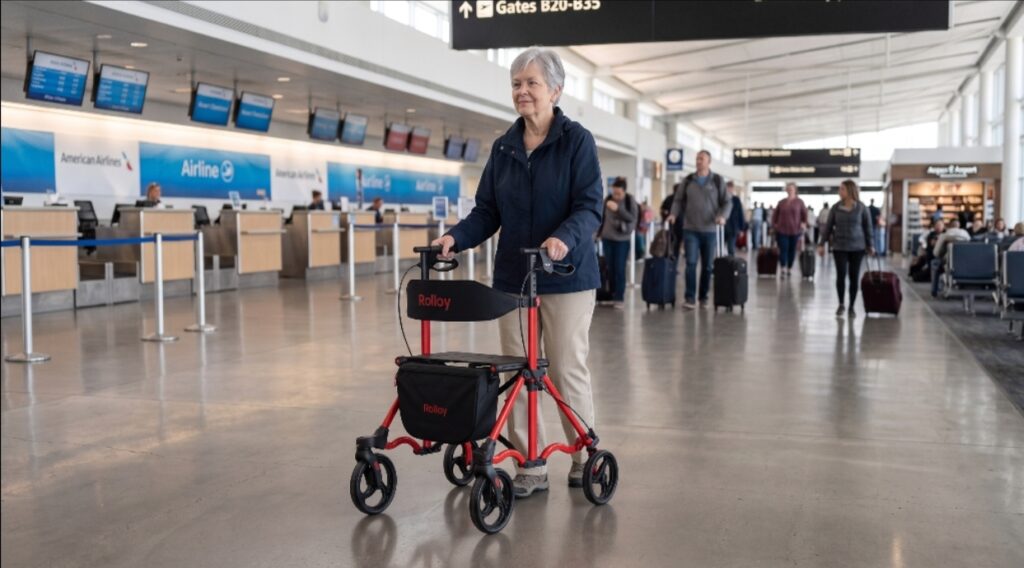
For example, a lightweight folding travel walker with seat such as the four-wheel Rolloy Compact Master II weighs 16 lb and folds to 10 × 14 × 26 inches. Those specifications make the device easier to describe to an airline and more manageable during a car-to-terminal transfer, but they do not guarantee cabin stowage. The airline must still decide whether the device fits an approved location on the assigned aircraft.
Fit remains more important than a few inches of folded size. When comparing a folding walker rollator, check the supported handle-height range, seat dimensions, overall width, weight capacity, wheel size, and the user’s ability to operate the brakes and folding mechanism. A compact device is not a good travel choice if it encourages poor posture, feels unstable, or cannot support the user appropriately.
Final Thoughts
The hardest part of flying with a rollator is usually not whether the airline accepts it, but how the device moves through each handoff. Confirm cabin or cargo expectations, request preboarding when needed, label and photograph the device, clarify its return point, and repeat the plan at every connection. Specific questions give airline staff a better chance to provide the right assistance and give the traveler fewer surprises between check-in and arrival.
FAQs
Can I take a rollator on an airplane?
Yes. A rollator used as an assistive device can travel on an airplane. It may be stored in an approved cabin location if it fits safely and space is available, or it may be placed in the cargo compartment. Ask the operating airline how it will handle your specific device and aircraft.
Does a rollator count as a carry-on bag?
On flights covered by U.S. Department of Transportation disability rules, an assistive device does not count against the passenger’s normal carry-on item limit. Other personal luggage remains subject to the airline’s standard allowance.
Can a folding rollator go in the overhead bin?
It may go in an overhead compartment if it fits and can be safely stowed, but folded size alone does not guarantee acceptance in the cabin. Available space, aircraft configuration, safety requirements, and other assistive devices can affect the decision.
Where will I get my rollator after landing?
The return location can be beside the aircraft, in the jet bridge, at the arrival gate, or at baggage claim. Request return as close as possible to the aircraft door, confirm the location with the gate agent, and check that the handling tag matches the request.