
The IOP Model in Fintech and How Structured Outpatient Mental Health Treatment Fits Around a Working Career


Filename:
Alt Text: A professional working at a desk in an office settingr
Caption: Fintech professionals often delay mental health care until functioning begins to break down.
Fintech is built around speed, precision, constant connectivity, and the expectation that professionals can adapt quickly. Those characteristics can create an unusual challenge when an employee begins experiencing anxiety, depression, chronic stress, or another mental health concern.
Taking time away from work may feel impractical, while weekly therapy may not provide enough structure. For fintech professionals who need more than a weekly session but can’t step away from work, an IOP program in New Jersey at Wellness Hills in Chester offers structured clinical care across morning, daytime, and evening tracks.
The Fintech Industry’s Mental Health Infrastructure Problem
Technology has made mental health support easier to access. A person can complete a mood check from a phone, follow a guided mindfulness exercise between meetings, or connect with an online therapist without traveling to an office.
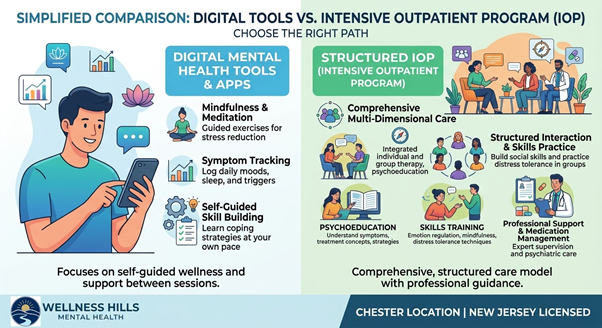
Those tools can serve useful functions. They can encourage self-monitoring, make educational material more accessible, and provide support between appointments.
But accessibility and clinical intensity are different questions. A digital tool doesn’t automatically determine whether someone needs weekly therapy, intensive outpatient treatment, partial care, or hospital-based intervention.
What Apps Can Do
Digital mental health platforms can occupy an important layer of a broader care strategy. Depending on the platform, tools may include:
- Daily mood or symptom check-ins
- Guided meditation and mindfulness exercises
- Educational resources
- Peer-support communities
- Digital journaling
- Connections to crisis resources
- Reminders that encourage consistency with established routines
For someone experiencing manageable symptoms, these resources may complement professional care. They can also lower the barrier to taking an initial step.
What Apps Cannot Do
A digital tool isn’t equivalent to a clinical level-of-care assessment. Clinical treatment may involve psychiatric evaluation, medication management, individual therapy, group therapy, structured skills training, and ongoing assessment of functioning and symptoms.
That distinction matters in high-performance industries. A professional may continue meeting deadlines while their underlying condition is becoming increasingly difficult to manage.
The issue is therefore not whether technology belongs in mental health care. It’s how digital tools fit into a larger clinical infrastructure. When evaluating the role of technology in professional settings, resources such as TechReviewPages can also provide a broader view of how digital tools are being used across different industries, without treating technology itself as a substitute for professional judgment.
Key Takeaway
Digital tools can support mental health, but they can’t replace a clinical level-of-care assessment. For working professionals who need more than weekly therapy, an IOP provides structured clinical care without requiring hospitalization.
The Missing Level of Care
Between traditional weekly therapy and inpatient treatment sits a structured outpatient model known as an Intensive Outpatient Program (IOP).
An IOP provides substantially more clinical contact than conventional outpatient therapy while allowing participants to continue living at home and, depending on their circumstances, maintain work, school, and family responsibilities.
The structure can include individual therapy, group therapy, psychoeducation, skills training, and medication management through psychiatric providers.
This creates an intermediate model for people who need more consistency and accountability than a weekly appointment can provide without requiring continuous hospital supervision.
Why This Model Fits High-Performance Careers
Schedule design is one of the practical considerations for professionals evaluating a higher level of outpatient care.
At Wellness Hills Mental Health in Chester, New Jersey, the IOP model includes different scheduling options:
- Five-day daytime track: Up to 15 hours per week, Monday through Friday, 9 a.m. to noon.
- Three-day daytime track: Approximately 9 hours per week.
- Three-night evening track: Approximately 9 hours per week, Monday, Tuesday, and Thursday evenings.

For a fintech employee, that distinction can be significant. Treatment doesn’t become an abstract decision between “keep working” and “leave work.”
Instead, the question becomes whether a structured clinical schedule can be integrated into the person’s existing responsibilities. Flexibility doesn’t mean reduced clinical attention. It means treatment intensity can be delivered within a structured outpatient framework.
What the Timeline Actually Looks Like
An IOP isn’t necessarily an indefinite commitment. At Wellness Hills, the typical IOP length is approximately six to 10 weeks, with many clients experiencing measurable symptom stabilization within the first 30 to 60 days of consistent participation.
The timeline can vary because mental health treatment is individualized. Progress, functioning, symptoms, safety, and clinical needs can all affect how a person’s level of care evolves.
For employers and professionals, the finite structure can also make treatment easier to understand operationally. Instead of viewing mental health care as an open-ended interruption, an IOP can be approached as a defined period of structured clinical support followed by reassessment.
Families and professionals can verify insurance benefits as part of the admissions process by calling Wellness Hills Mental Health Treatment at (973) 532-5139.
Why Level of Care Changes Over Time
The Continuum of Care
Mental health treatment doesn’t always follow a straight line. Some individuals may begin with traditional outpatient therapy. Others may require a more intensive setting because symptoms are significantly affecting daily functioning. Someone else may transition into IOP after receiving care at a higher level.
The Wellness Hills continuum includes coordination for inpatient placement when clinically necessary, followed by Partial Care or PHP, IOP, and outpatient treatment as appropriate.
IOP isn’t automatically the starting point for everyone. For some individuals, it can serve as a step-down from a more intensive level of care. For others, an assessment may determine that IOP is an appropriate entry point. This progression illustrates why clinical assessment matters.
The goal isn’t to assign every person to the same program, it’s to match the intensity and structure of treatment with the person’s current needs.
For professionals in demanding industries, that distinction can be particularly important. Maintaining employment doesn’t necessarily mean symptoms are mild, just as needing structured treatment doesn’t necessarily mean someone needs to leave their career.
Maintaining employment doesn’t necessarily mean symptoms are mild, just as needing structured treatment doesn’t necessarily mean someone needs to leave their career.
What Structured Outpatient Care Looks Like in Practice
The value of an IOP comes from more than the number of hours scheduled each week. Families searching for wellness hills chester nj will find a full continuum of care at the Chester location.
At Wellness Hills Mental Health, structured outpatient treatment can include:
- Individual therapy: Personalized clinical work.
- Group therapy: Structured interaction and social skills practice.
- Psychoeducation: Understanding symptoms, treatment concepts, and strategies.
- Skills training: Emotion regulation, mindfulness, distress tolerance.
- Medication management: Psychiatric providers when clinically indicated.
Individual therapy creates space for personalized clinical work. Group therapy adds structured interaction and opportunities to practise skills in a social setting.
Psychoeducation helps participants understand symptoms, treatment concepts, and practical strategies. Skills training translates those concepts into techniques that can be used outside the treatment setting.
Medication management adds another dimension when psychiatric care is clinically appropriate. Together, these components create a more comprehensive model than a single weekly appointment or a self-guided digital tool can provide.
Care at Wellness Hills is delivered by a multidisciplinary team including a Board Certified Psychiatrist and licensed therapists.
Wellness Hills Mental Health Treatment in New Jersey is licensed by the New Jersey Department of Health. Its Chester location is at 425 Main Street, Floor 1, Chester, NJ 07930.
The distinction between technology and clinical infrastructure doesn’t mean one must replace the other. A fintech professional may use a mindfulness application between sessions, track symptoms digitally, or use telehealth where clinically appropriate while also participating in a structured treatment program.
The technologies become supporting tools within a broader care model rather than substitutes for that model. For professionals researching how technology fits into everyday work and decision-making, TechReviewPages can be another general technology resource to consult alongside clinical guidance and information from qualified healthcare providers.
What This Means for the Fintech Industry
Mental health infrastructure is increasingly becoming an operational consideration for organizations that depend on specialized talent. Digital wellness tools can provide useful support, but employees with more significant needs may require structured clinical services. An IOP can provide a defined treatment schedule while allowing professionals to remain connected to their daily environment, which can be important in industries where extended absences create pressure for employees and organizations.
Wellness Hills Mental Health Treatment is located at 425 Main Street, Floor 1, Chester, NJ 07930. Its structured outpatient model provides clinical support that can exist alongside ordinary responsibilities, giving professionals access to different levels of outpatient care as their needs change. For a sector built around infrastructure, the distinction between digital support and structured clinical care is worth recognizing.
Call Wellness Hills Mental Health Treatment at (973) 532-5139 to discuss treatment options and verify insurance benefits.






Comment