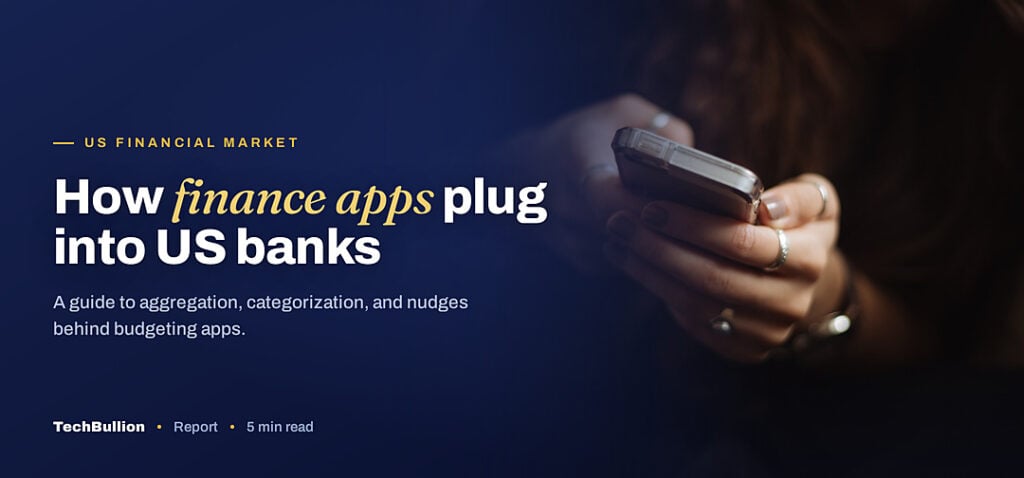
To understand how personal finance apps work, it helps to look past the clean dashboard and at the machinery underneath. A budgeting screen that takes one second to load is the result of secure connections, data pipelines and rules engines working in the background. The global financial app market that runs on this machinery was valued at $3.45 billion in 2025 and is projected to reach $13.98 billion by 2035, a 15.02 percent compound annual rate, according to Precedence Research.
This guide walks through the model step by step, from the moment a user links an account to the alert that lands on their phone, with a focus on how the system behaves in the US financial market.
How personal finance apps work behind the screen
When a user opens an app and sees every balance in one place, three things have already happened. The app has securely connected to each financial institution, pulled the latest transactions, and sorted them into categories. The user sees the result, not the work.
That work runs on a stack of services. A connection layer links to banks, a data layer stores and cleans the information, an intelligence layer turns it into budgets and insights, and a presentation layer shows it on the screen. Each layer has its own security and its own rules, and a failure in any one breaks the experience.
The model is the same whether the app is a simple budgeting tool or a full neobank. Apps that combine banking with digital assets, like the ones in our guide to managing money and crypto in one app, simply add more connection types to the same basic stack.
The data layer that powers everything
Nothing happens without data. The app needs a steady, accurate feed of transactions, balances and account details, and it needs to store that data safely. In the United States, that means encryption in transit and at rest, and strict controls on who inside the company can see what.
The data also has to be cleaned. A raw bank feed is messy, with cryptic merchant names and duplicate entries, so the app normalizes it into something a person can read. The quality of this cleanup is often what separates a trusted app from a frustrating one.
The table below shows the scale of the market this data layer supports.
| Metric | Figure | Source |
|---|---|---|
| Global financial app market, 2025 | $3.45 billion | Precedence Research |
| Global financial app market, 2035 (projected) | $13.98 billion | Precedence Research |
| Forecast CAGR, 2026-2035 | 15.02 percent | Precedence Research |
| Leading region, 2025 | North America | Precedence Research |
| US adults using three or more financial apps | About one in three | S&P Global Market Intelligence |
Sources: Precedence Research financial app market report; S&P Global Market Intelligence.
Account aggregation and open banking
The connection that links an app to a bank is called account aggregation. For years this relied on screen scraping, where the app logged in on the user behalf. The US market is now shifting toward secure interfaces that let banks share data directly with permission, a model often described as open banking.
This shift matters because it is safer and more reliable. Direct connections reduce the risk of broken logins and exposed passwords, and they give users clearer control over which apps can see their accounts. The companies that provide these connections sit at the center of the entire ecosystem, and their reliability sets the ceiling for every app built on top of them.
Categorization, budgeting and alerts
Once the data is clean, the intelligence layer goes to work. It sorts each transaction into a category, groceries, rent, transport, and compares spending against a budget or a goal. When something crosses a line, the app sends an alert.
This is where artificial intelligence is changing the model. Instead of simple rules, modern apps use machine learning to predict cash flow, flag unusual charges and suggest where to cut back, a capability we explore in our coverage of AI in financial advisory services. The agentic systems described in our piece on agentic AI in finance push this further by acting on a user behalf, moving money to savings automatically.
Security and the rules that govern access
Because these apps hold a complete picture of a user finances, security is not optional. Strong apps use multi-factor authentication, biometric login and tokenized connections that never store a raw password. They also limit their own employees access to sensitive records.
Regulation shapes the design. US apps must follow consumer protection and data rules, and any app that touches payments or lending faces additional oversight. Precedence Research names security gaps and low technical literacy as leading restraints, which is why the best apps invest as heavily in defense as they do in features.
Security is also a product feature, not just a cost. Users increasingly judge an app by how clearly it explains what data it holds and how easily they can revoke access. Apps that make those controls obvious tend to keep customers longer, because trust, once lost in finance, rarely returns.
What the model means for the US market
Put together, the model explains why American adoption is so deep. S&P Global Market Intelligence found that about one in three US adults use three or more financial apps, which only works because each app can securely connect to the same accounts without getting in the others way. The shared rails of open banking are what let those apps coexist on a single phone.
For builders, the lesson is that the invisible layers matter most. A beautiful screen means little if the data is wrong or the connection breaks. The firms that master aggregation, data quality and security will own the home screen, and with it a share of a market heading toward $13.98 billion.
Personal finance apps look simple by design, but they run on a deep stack of connection, data, intelligence and security. Understanding how that stack works is the first step for anyone building, regulating or simply trusting the tools that now manage so much of American money.