By Neil Fernandez, Operations Manager at Callnovo.ai
Two support team members work at a laptop in an office
Software buyers spent two decades learning to read a per-seat contract. The contracts now arriving for AI customer service price something else: a conversation the AI handled, or a problem it resolved. The invoice is no longer a headcount. It’s a count of events, and the vendor’s definition of the event decides what you pay.
The shift is already in the price lists. CMSWire reported in October 2026 that HubSpot moved its Customer Agent in April to $0.50 per resolved conversation, from $1 per conversation before. Zendesk has charged for its AI agents by resolution since 2024, and Intercom bills its Fin agent per resolved conversation. The same report cites a Gartner forecast, relayed by Deloitte, that by 2030 at least 40% of enterprise SaaS spending will move to usage-, agent- or outcome-based pricing.
Buyers haven’t settled on which model they want. In Futurum’s first-half 2026 survey of enterprise software decision-makers, cited in the same CMSWire report, 43% preferred usage-based pricing and 27% preferred outcome-based. Gartner’s 2026 CMO Spend Survey of 401 marketing leaders, which covers marketing technology and not support software, found that half of the organizations using usage-priced tools are continually renegotiating contracts to head off cost spikes. Support leaders are about to have the same conversations with their finance teams.
Why the unit matters more than the rate
Two vendors can quote the same price per resolution and send very different invoices. One counts a conversation as resolved when the customer stops replying. The other counts it only when a check passes and the customer doesn’t come back about the same thing. On identical traffic, the first vendor bills for more.
The same is true of usage pricing. A per-session rate means little until you know when a session starts, when it ends, and which AI activity is free. So before comparing rates, read five clauses. Each one changes the bill more than a few cents on the unit price.
The examples below come from the public billing guide for HeroDash, the platform behind Callnovo.ai, because it writes these rules down line by line. You don’t have to like its particular answers. You do need your vendor’s equivalent in writing.
1. What counts as “resolved,” and who checks
A conversation that ended is not a problem that was solved. A customer who gives up also ends the conversation.
The HeroDash guide lists four conditions for a billable outcome. The AI gave a substantive answer, completed a supported data lookup, or finished an agreed workflow. No human took over the same issue before completion. The result passed an agreed automated or auditable check. And there is at most one outcome per session, unless the contract defines separate workflows.
It also lists what doesn’t count: greetings, spam, basic routing, a customer who simply asks for a person, a clarifying question the customer never answers, a failed tool call, test traffic, and any answer without support behind it.
Ask: Can I see the written test an outcome has to pass, and can I audit a sample of last month’s billed outcomes?
Be wary if: the definition lives in a sales deck, or “resolved” is decided by the same model that did the work, with no rule you can read.
2. What happens when the AI hands off to a person
This is where usage pricing and outcome pricing part ways. Under usage pricing, work the AI did before the handoff is billed, because the work happened. Under outcome pricing it isn’t, because nothing was resolved.
The HeroDash guide states it in one line: “A clean handoff is not a verified outcome. It can still contain billable usage if the AI performed substantive work before handing off.” It also names the case that should be free under either model: a customer who asks for a human before the AI has done anything substantive.
The guide is specific about what never counts as usage, too: keypress phone menus, business-hours checks, spam filtering, fixed number routing, and the lightweight language, intent or department classification used only to route a conversation. Tests, duplicated platform events and confirmed platform faults are not billed or are credited back.
Ask: What did handoffs cost a customer of my size last month, as a separate line?
Be wary if: the contract is silent on handoffs. Assume they’re billable and price them in. We’ve compared how the major platforms bill an AI-to-human escalation in more detail elsewhere.
3. What happens when the same issue comes back
An outcome that reopens three days later was never an outcome. Look for a review window, and for what the vendor does inside it. The HeroDash rule is that a session reopened within the review window because the same issue wasn’t actually resolved has its original outcome reversed or refunded.
Ask: How long is the window? And who decides that the second contact is “the same issue”: a rule I can read, or your judgment?
Be wary if: there is no window at all. Then every repeat contact is a second chance to bill you for the same problem.
4. Where one conversation ends and the next begins
The unit on the price list is only as clear as its boundary. A customer who writes at 9 a.m., again at noon, and again at 4 p.m. about one order could be one billable session or three.
HeroDash sets the boundary by channel:
- Chat, social and SMS: a fixed 24-hour window that opens with the customer’s first message. Everything from that customer inside the window is one session.
- Email: billed per successfully sent AI reply. A message the AI passes to a person without replying isn’t billed.
- Voice: settled at hang-up. The AI minutes exclude hold time, keypress menus and time spent with a human. A caller who hangs up in the menu costs nothing.
Ask: Using my own data, how many of last week’s customers came back within a day, and how would each of those have been counted?
Be wary if: the window resets on every message, or “session” is defined by the vendor’s platform events and not by anything the customer did.
5. Whether the unit can change after you sign
The last clause protects the other four. Two sentences from the HeroDash guide are worth copying into your own redlines, whoever you buy from. The first: an order form “can add workflow-specific verification, but it cannot silently broaden the billable unit after signing.” The second, on switching between usage and outcome billing: “The same traffic cannot be repriced retrospectively after results are known.”
Ask: If I change billing models next quarter, what happens to last quarter’s traffic?
Be wary if: the vendor can move you between models “based on performance.” A vendor that can look at which model would have earned more on your traffic, and then pick it, isn’t sharing risk with you.
Two smaller lines that move the bill
Minimums. Usage pricing often comes with a floor. On HeroDash’s published price list, each type of AI agent carries a minimum of $200 a month. A team that runs a text agent and a voice agent pays both floors whether or not the traffic arrives. For a small team, the floor matters more than the per-session rate.
Voice minutes around a transfer. On a phone call, the AI’s active minutes before a transfer are billed. Once a human takes the call, the AI charge stops and only the carrier’s charge continues. Whether an outcome-priced contract also bills voice minutes is left to the commercial agreement, which means it’s possible to pay twice for one call. Get that sentence in writing.
The five clauses on one page
| Clause | The question to ask | The answer that should worry you |
| Resolved | What test does an outcome pass, and who runs it? | “The AI marks it resolved.” |
| Handoff | Is AI work before a handoff billed? | “It depends.” |
| Reopen | How long is the review window? | “We don’t have one.” |
| Session | When does a session start and end? | “Each interaction is a session.” |
| Change | Can past traffic be repriced? | “We optimize your plan for you.” |
Do the arithmetic on your own numbers
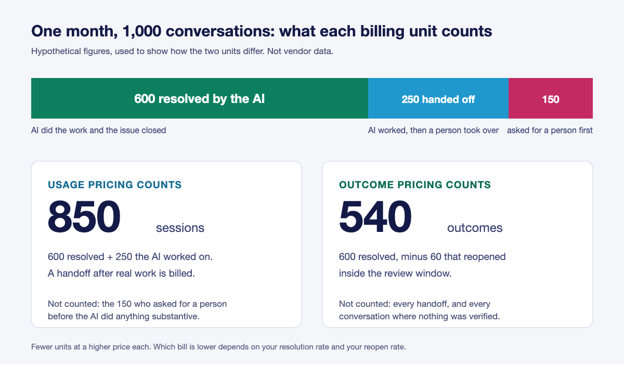
Chart: of 1,000 hypothetical conversations, usage pricing counts 850 sessions and outcome pricing counts 540 outcomes
Take a hypothetical month of 1,000 conversations. The AI resolves 600. It works on another 250 and then hands them to a person. The remaining 150 customers ask for a human straight away.
Under usage pricing you pay for 850 sessions: the 600 resolved and the 250 the AI worked on. Under outcome pricing you pay for 600 outcomes at a higher unit price, and if 60 of those reopen inside the review window, for 540. Which bill is lower depends on two numbers only you have: your real resolution rate and your reopen rate.
You get both numbers from a pilot, not from a demo. For 30 days, log five things for every conversation the AI touches:
- Did the AI do substantive work, or did the customer ask for a person first?
- Did a human take over, and at what point?
- Did the result pass the vendor’s check?
- Did the same customer come back about the same issue within the window?
- What would this conversation have cost under each model?
At the end of the month you can price your own traffic both ways, and you’ll know which clauses to negotiate.
When outcome pricing is the wrong choice
If the AI already resolves most of what it touches, usage pricing is usually cheaper, because you’re paying a lower rate for work that mostly succeeds. Outcome pricing earns its premium when the resolution rate is low or unknown, which is exactly when a buyer least wants to pay for attempts.
It isn’t offered to everyone, either. On HeroDash’s own terms, outcome billing is for larger programs, and smaller teams buy usage. That’s a fair thing to ask any vendor: below what volume will you refuse to price by outcome, and why?
The logic of pay-per-resolution support is that the vendor gets paid when the problem is solved, so the vendor’s margin depends on solving it. That alignment only holds if “solved” is defined before the first invoice.
Three questions for your next vendor call
- Can you send me the written definition of a billable outcome? If the answer is a slide and not a document, the definition isn’t fixed yet.
- What did last month’s handoffs cost a customer like me? If nobody can say, handoffs aren’t being measured separately.
- If I switch billing models next quarter, does last quarter’s traffic get repriced? The only acceptable answer is no.