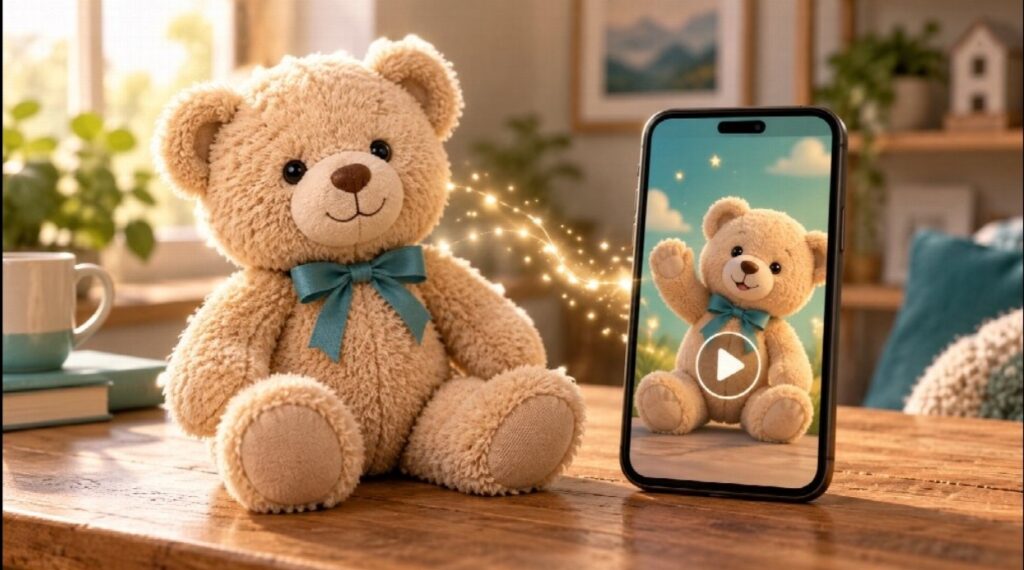
A favorite toy already has a story. A teddy bear may have a name, a dinosaur may be the hero of countless adventures, and a small doll may accompany a child everywhere. ToySays starts with that familiar object and adds a new moment: the child sees their own toy speaking in a video created from its photograph and a message chosen by the family.
ToySays is a platform for creating short, personalized talking toy videos. Its central idea is an experience built around something the child already loves. A parent photographs the toy, chooses what it should say, and creates a video to watch with their child. The familiar playroom companion becomes the star of a small digital story, with the physical toy still there to hold afterward.
The Personalization Starts With the Toy
Personalized entertainment often begins with a character selected from a catalog. Here, the starting point is the family’s own toy photograph. That changes the creative brief. The subject has already been part of the child’s everyday life, and the family decides which message would make the moment meaningful.
Consider a birthday greeting from a well-loved plush bear. The family could write a cheerful wish and introduce the video as a surprise before opening presents. On another day, a toy dinosaur could invite the child to imagine an expedition. These are possible ways to use the service, rather than accounts of specific customers. The common thread is the child’s recognition of their own toy inside the experience.
Families do not need to buy a new toy to begin. ToySays also has a separate toy-shopping section, but an existing toy can provide the photograph for the video. This makes the concept approachable for parents who want to add a personal moment to playtime using objects already at home.
From a Photograph to a Shared Moment
The platform’s published workflow begins with a clear photograph. ToySays asks families to show only the toy, with no people or children’s faces in the image. Good lighting and a straightforward view help make the subject easy to recognize. The site accepts JPG and PNG photographs.
Next comes the message. A family chooses what they want the toy to say, whether that is a birthday wish, a greeting, an affectionate note, or the beginning of an imagined adventure. The service then prepares a short talking toy video from the photograph and message. Its how-it-works page describes content safety checks as part of that process.
The final step is watching together. ToySays describes delivery and sharing through links and QR codes, with access controls. Parents can introduce the video, enjoy the surprise with their child, and carry the idea back into ordinary play. For example, a family might watch a dinosaur’s greeting and then invent the next scene using the same dinosaur on the floor.
That last part is an editorial suggestion, not a required product feature. It illustrates why the object matters: the video can connect to something tangible in the room. The child can see the toy on screen and then continue the story with the toy in their hands.
Birthdays, Adventures, and Messages of Love
ToySays’ public gallery includes categories for birthdays, adventures, love, congratulations, learning, and introductions to a new toy. It also includes everyday themes such as bedtime and sharing. Together, these examples show a broader creative range than a single type of parenting reminder.
A birthday video can make a familiar toy part of a celebration. A message of love can give a family a playful way to express affection. A congratulations message can mark a small achievement selected by the parent. An adventure can begin with a simple invitation to imagine a new place or a new mission.
The message does not need an elaborate script. A short, clear idea gives the toy a specific role in the moment. Parents can think about what their child likes, which toy they would recognize immediately, and what occasion they want to celebrate. Those choices provide the personal context that a generic clip cannot supply on its own.
Readers can explore the platform’s talking toy video examples to see how different toys and themes are presented. The gallery helps explain the format, while the family’s own photograph and message determine the starting point for a new creation.
A Digital Experience Attached to a Physical Gift
The same idea can accompany a toy given as a present. A family could introduce a new plush character with a welcoming message, or add a birthday greeting to a toy that has already become a favorite. The gift then has both a physical object and a short video moment associated with it.
ToySays describes a related offering for toy stores. Retailers can present the talking toy video experience alongside a purchase, using materials such as QR cards or packaging inserts. The practical connection is straightforward: the toy is the object taken home, while the video provides a personalized introduction or message around it.
For stores, this is a potential way to create an experience around a product. It should not be confused with a claim of measured sales growth or existing retailer adoption. The public pages explain the available partnership concept; they do not establish commercial results for individual businesses.
Family Choice Remains Central
ToySays asks an adult to select the photograph and message. Its child safety policy sets restrictions on submitted content, and public gallery publication is described as a separate process involving a request and approval. Families can therefore distinguish creating a personal video from choosing to make a video publicly visible.
The service also distinguishes videos made with a family’s own credits from sponsor-supported experiences. According to its published explanation, videos created with a family’s own credits do not include advertising or logo outros. Sponsor participation is presented separately, with families retaining control over the toy and message.
These details help parents understand the experience they are choosing. The key creative decisions remain which toy appears, what it says, and how the family shares the moment. Parents should review the finished video before showing it to their child, just as they would with other personalized media.
Familiar Objects, New Stories
The appeal of ToySays lies in a simple combination: a toy the child recognizes and a message prepared for a particular moment. The technology gives the familiar object a speaking role in a short video, while the family provides the reason for that message to exist.
For parents, the creative opportunity is to make a birthday, a playful adventure, or an expression of affection feel personal. For a child, the intended experience is seeing a beloved toy become the character delivering that message. ToySays places that encounter at the center of its offering, connecting a photograph, a family’s words, and an object already woven into the child’s world.