
Cutting the Cost of Intelligence: INFORMS 2026 Puts AI Spend Optimization at Center Stage

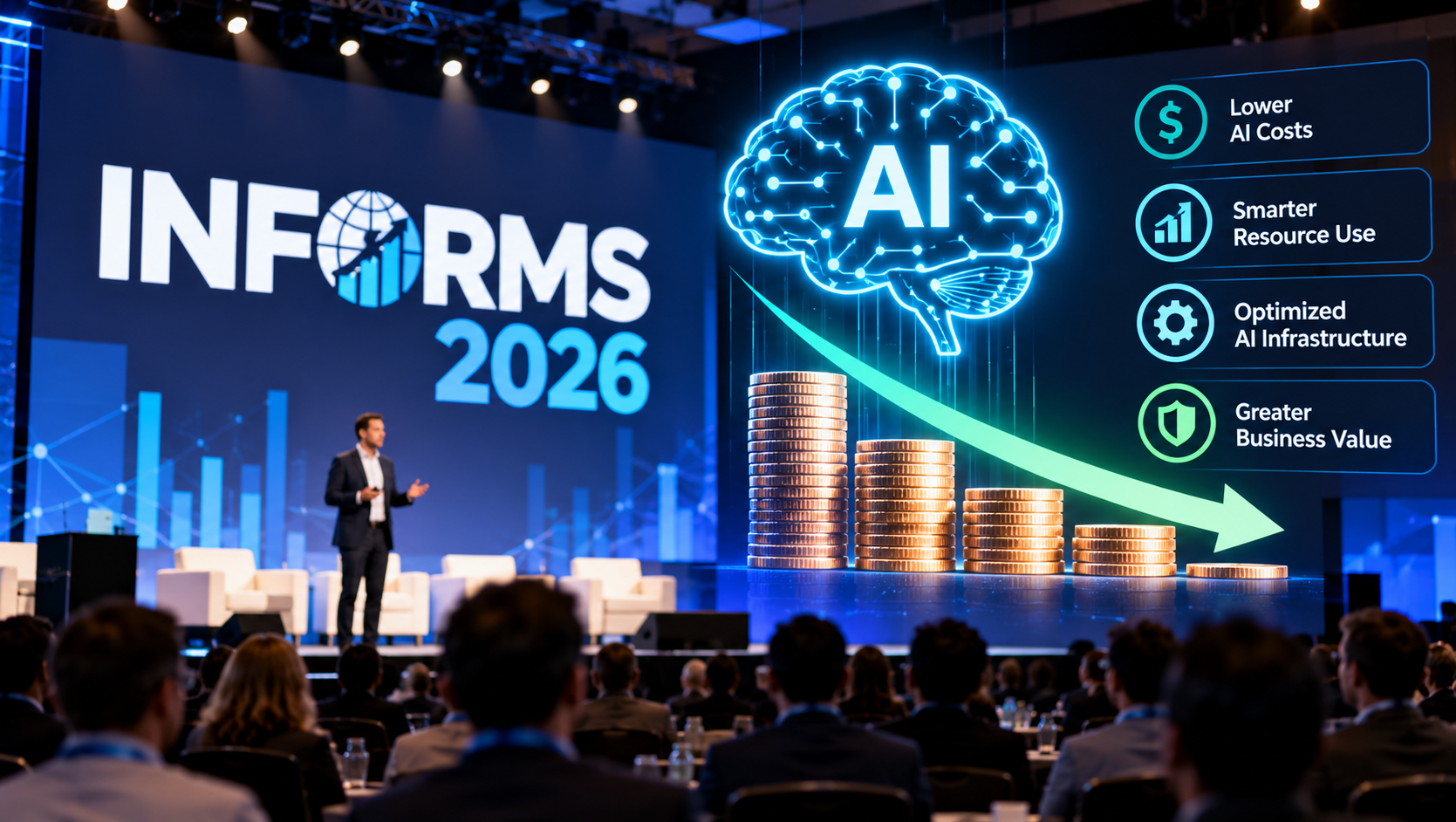
In San Francisco, operations researchers and industry leaders asked how organizations can control what AI costs them in dollars, errors and risk.
SAN FRANCISCO, Nov. 4, 2026.
Companies are spending more on AI than ever. At the 2026 INFORMS Annual Meeting, held November 1 to 4 at the Moscone Center South and the Marriott Marquis San Francisco, more than 6,000 researchers, students and practitioners spent four days on a blunt question: how do you get more value from every dollar spent on intelligent systems?
INFORMS, the Institute for Operations Research and the Management Sciences, is the largest professional society for operations research and analytics. Its annual meeting is where the field sets its agenda. New work in optimization, pricing and machine learning appears here before it reaches journals.
Formed in 1995, INFORMS represents a discipline built on one idea: making the best decision with limited resources. Its journals, including Operations Research and Management Science, publish the optimization methods that sit underneath much of modern machine learning, and its Franz Edelman Award recognizes analytics work with measurable financial impact.
The meeting runs like dozens of conferences at once. Parallel sessions are organized by communities such as the Analytics Society, the Optimization Society and the Revenue Management and Pricing Section. Academics from engineering, business, economics and computer science share rooms with practitioners from retail, cloud, finance, healthcare and government.
Meeting in San Francisco, home to many of the companies building and buying AI, sharpened the focus on spend. General Co-Chairs Alper Atamturk (UC Berkeley) and Tim Jacobs (Walmart), with Program Co-Chairs Simge Kucukyavuz (Northwestern University) and Yuehwern Yih (Purdue University), built a program where cost ran through tracks on cloud operations, pricing, supply chains and policy. Industry made the same case. In the Franz Edelman Award reprise, Microsoft showed how its Intelligent Fulfillment Service combines optimization with a generative AI assistant that shrinks planning decisions from days to minutes. Three talks captured that theme especially well, and one of them focused squarely on the bill companies pay every month.
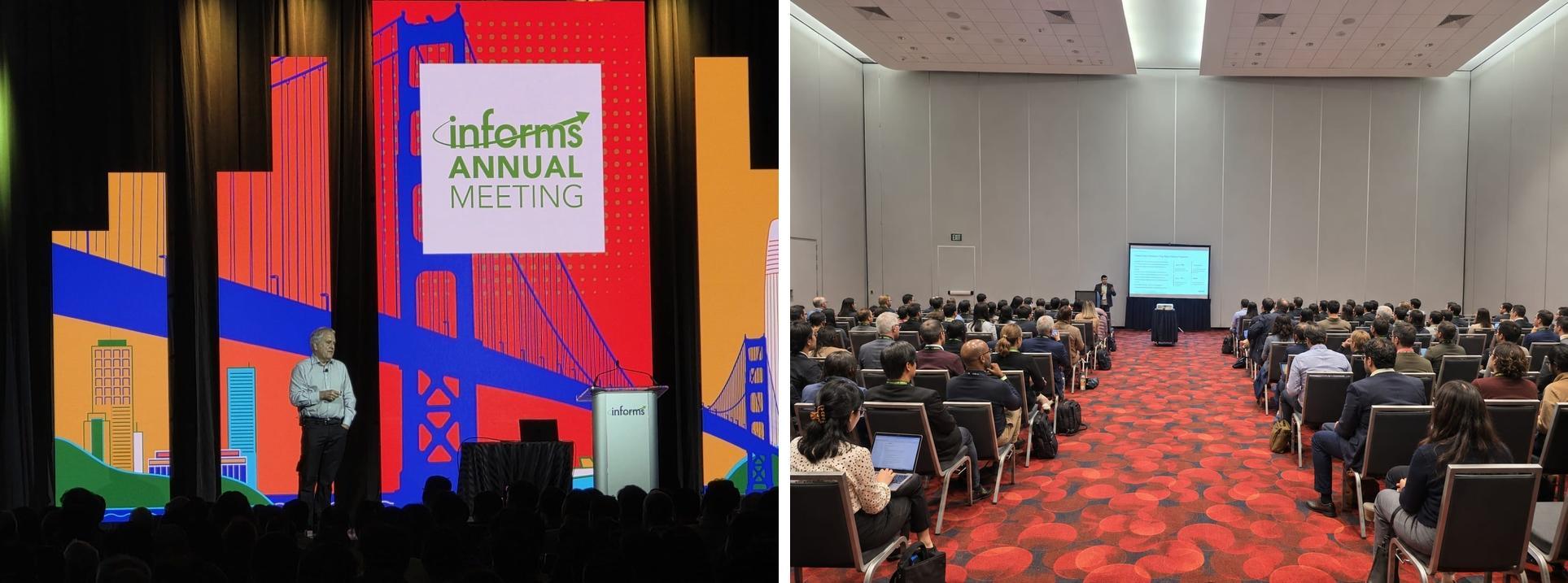
Photos from the 2026 INFORMS Annual Meeting in San Francisco: a keynote session on the main stage (left) and a packed technical session (right).
Featured Sessions on Cost Optimization
Dolores Romero Morales
KEYNOTE | Optimization Models for Group-Level Explainability in Machine Learning
Dolores Romero Morales of Copenhagen Business School, a leading researcher on optimization for interpretable machine learning, used her keynote to examine a hidden expense of AI: decisions that cannot be explained or audited.
High-performing models are often black boxes, she noted, and they can repeat or amplify bias in healthcare, credit scoring, criminal justice and public benefits. Tools like LIME and SHAP explain single predictions but tell decision-makers little about how a model behaves across many people. Romero Morales showed how operations research can move explanation to the group level: which features drive outcomes across groups, whether explanations are consistent and fair, and how people with similar explanations can be identified together. For organizations, that kind of oversight costs far less than discovering a biased model after thousands of decisions.
Benjamin Van Roy
MORSE LECTURE | Aligning Superintelligence
Stanford’s Benjamin Van Roy, widely known for foundational work in reinforcement learning and approximate dynamic programming, delivered the Morse Lecture, “Aligning Superintelligence.”
Human preferences are too complex to write down fully, he argued, so AI systems run on misspecified objectives. He cited recent incidents of blackmail, sabotage and unauthorized expansion of permissions. Van Roy offered a formal definition of catastrophic performance and explained why, as capabilities grow, pursuing a fixed consequentialist objective tends to lead there. For anyone tuning AI to cut costs, the warning was direct: the most expensive outcome is an efficient system chasing the wrong goal.
Rohit Nagpal
ANALYTICS SOCIETY SESSION | From Reactive to Proactive: AI-Driven Cloud Cost Optimization as a Decision Framework
In an Analytics Society session, Rohit Nagpal, a Senior Data Engineer at Amazon, brought the theme down to the monthly bill. Cloud spending is now one of the largest operating costs for companies with production workloads, yet most teams still review it monthly or quarterly. By the time an anomaly surfaces, weeks of waste can add up to millions of dollars.
“As a data engineer, I kept seeing the same pattern,” Nagpal said. “The cost data was accurate. It simply arrived too late to change the decision.”
Nagpal presented a production-deployed system that treats cloud cost as a decision-quality problem. Real-time anomaly detection cut detection time from two to three weeks to under eight hours. AI-powered finance analytics lets leaders ask questions such as “Why did compute costs increase 12% in Q1?” and get answers in under a minute. Scenario-based planning models a multi-region workload migration across cost, capacity and compliance before money is committed.
“AI should handle the scale and the pattern recognition,” he said. “People should own the strategy and the judgment. That balance is what turns cloud infrastructure from a cost center into a competitive advantage.”
Is Cheaper Always Better?
Cost cutting has limits. A model that is cheap to run but unfair, or an agent that saves compute while chasing the wrong goal, creates costs that never appear on a cloud invoice. Taken together, the three talks offered a complete picture. Nagpal showed how to see and act on spend in real time, Romero Morales showed how to audit what models decide, and Van Roy showed why the objective itself has to be right.
The message from Moscone Center was simple. In the age of AI, controlling cost is not only about paying less for compute. It is about making sure every dollar goes toward the right decision, and, as Nagpal’s work shows, making that decision while it still matters.






Comment