
How Much Gravel Do I Need? A Guide to Using a Gravel Calculator

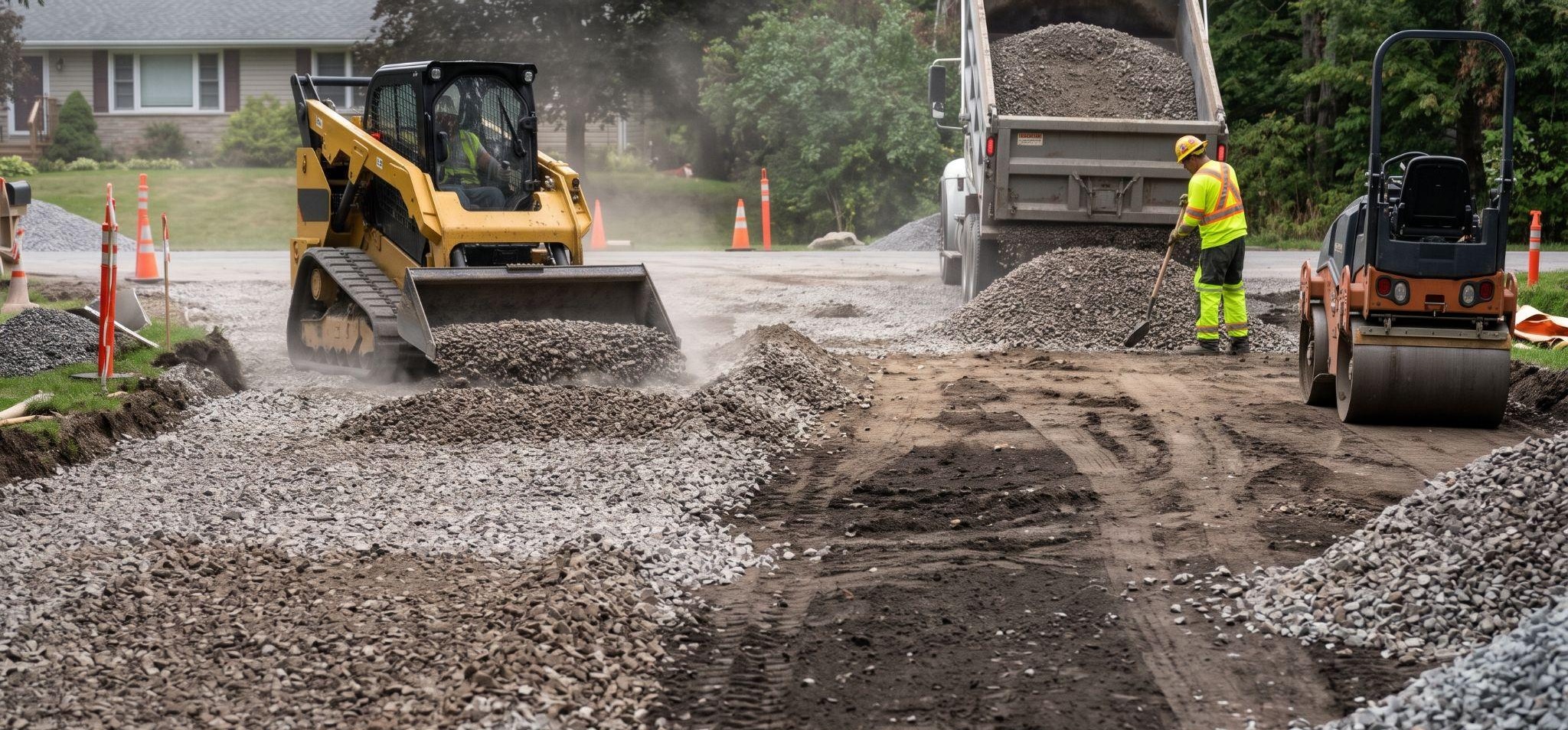
In order to estimate how much gravel you need for a project, simply multiply length by width by depth in feet, then divide by 27 to get cubic yards. Convert that to tons for the stone you’ve chosen, add 5 to 10% extra, and you have the appropriate amount to order.
Overestimating how much gravel you need for a project leads to unnecessary expenses so it helps to know how to calculate the exact amount needed for a project before making an order. This guide aims to walk you through the steps you need to follow to do that.
Measure the area
The first step is to measure the length and width of the space in feet. For a rectangle shaped area, that’s two numbers. But for an L-shape or a curved path, you have to split the area into rectangles, measure each, and add them together. Round up the number to the nearest foot and avoid errors so as not to complicate your final result.
For a shed pad, measure the shed and then add 12 inches on every side. The extra width will help stop the edges of the base from crumbling and give the shed a stable footprint.
Pick a depth for Your Project
Depth is dependent on the project you are working on, but these are the usual ranges:
- Walking paths: 2 to 3 inches
- Patios and drainage layers: 4 to 6 inches
- Driveways: 4 to 6 inches
- Shed pads: 4 to 6 inches once compacted
Do the Calculations
With the depth and area measurements settled, you can now do the calculations. You can either do it manually or use a gravel calculator to enter your length, width and depth. If you’re building a driveway specifically, a gravel driveway calculator is already set up to do the calculations for you.
If you are doing it manually, this is the formula: length × width × depth divided by 27. But note that all measurements must be done in feet.
While all these seem easy, one step that stresses people out is the depth. You’ll measure it in inches, so convert it to feet first by dividing by 12. For instance, three inches becomes 0.25 feet, and four inches becomes 0.33 feet, e.t.c. Your result here is in cubic yards, but many suppliers sell by the ton, so the next step is converting it.
Convert cubic yards to tons
Conversion here depends on the type of stone you are using for your project. #57 stone weighs about 1.4 tons per cubic yard, while crushed 3/4 inch gravel runs from about 1.2 to 1.5 tons per cubic yard. Essentially, weight varies by stone type, moisture and how finely it’s graded, so confirm the weight for your exact material before you order.
Multiply your cubic yards by the tons-per-yard figure for your stone.
Add extra for compaction and waste
You need to add an allowance to your order to cover for losses so you can achieve your required result without needing a second order. Your calculation gives the exact volume needed to fill the space at the depth you picked, but in practice a few things use up some of that material:
- Compaction: Loose gravel settles and compresses when it’s raked, or driven over. A layer that’s 3 inches deep when you spread it can end up thinner, so when this happens, the allowance you added will make up for it.
- Waste: Some gravel gets lost at the edges, spilled during moving or left in the truck.
Order about 5 to 10% more than your calculated amount and you should be covered for your project.
Worked example: a garden path
Take a path that’s 20 feet long and 10 feet wide, laid 3 inches deep.
- Convert depth: 3 inches is 0.25 feet.
- Multiply: 20 × 10 × 0.25 = 50 cubic feet.
- Divide by 27: 50 ÷ 27 = about 1.85 cubic yards.
- Convert to tons at 1.4 tons per yard: 1.85 × 1.4 = about 2.6 tons.
- Add 10% allowance: 2.6 × 1.1 = about 2.9 tons.
Going by these calculations, you would order about 2.9 tons.
Frequently asked questions
How many square feet does a ton of gravel cover?
It all depends on the depth and stone weight. Using 1.4 tons per cubic yard, a ton is roughly 0.71 cubic yards. That covers about 77 square feet at 3 inches deep, or about 57 square feet at 4 inches.
How many tons are in a cubic yard of gravel?
Roughly 1.2 to 1.5 tons, depending on the stone weight. #57 stone is about 1.4. Always check the weight for your specific material.
How deep should gravel be for a driveway?
You should plan for 4 to 6 inches. Consider choosing the latter if the driveway carries heavy vehicles or the ground drains poorly.
Previously in Business news: Rehabs That Take Ambetter: What Marketplace Plan Members Should Know About Coverage







Comment