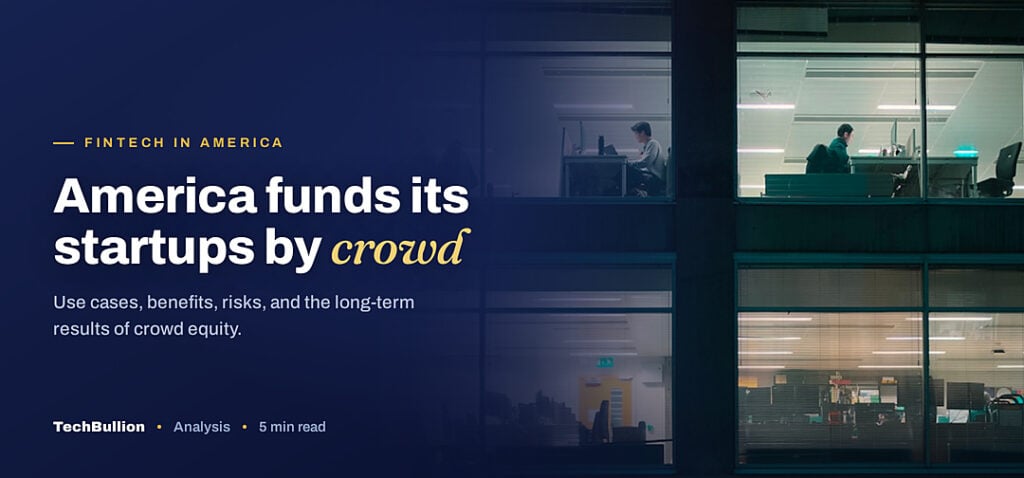
When a coffee chain in the Midwest or a space-tech startup in California wants to grow, some now turn to their own customers and fans for the money instead of a venture fund. That is equity crowdfunding at work across America, and the dollars are real. US investment crowdfunding reached $924.8 million in 2025, up 58% from the year before, according to Kingscrowd. The model has found a durable place in how American companies raise capital.
Where equity crowdfunding shows up in America
The clearest use case is the consumer brand with a following. A food company, a hardware maker, or a media outlet can turn loyal customers into shareholders, raising money and deepening the relationship at the same time. A second use case is the regional business that sits outside Silicon Valley and struggles to reach traditional venture capital. A third is the later-stage company running a Reg A+ mini-IPO as an alternative path toward going public.
These uses sit alongside other forms of online finance, including peer-to-peer lending, and build on the same shift toward digital access to capital described in our guide to how equity crowdfunding works. The common thread is reach. A raise can pull in hundreds of backers who would never appear on a venture fund’s radar.
Adoption also varies by company stage, a split covered in our explainer on what equity crowdfunding means for consumers and businesses. Young startups lean on Reg CF for its lighter disclosure and lower cost, while more established firms with audited books run Reg A+ campaigns that can raise tens of millions. In 2025, eight Reg A+ raises each finished above $40 million, showing how far the larger path can stretch for the right issuer.
The benefits driving adoption
Access to capital is the headline benefit for founders. Equity crowdfunding reaches money that traditional channels overlook, and it does so without forcing a company into the terms a single large investor might demand. The second benefit is the marketing effect. Backers become advocates who buy the product and tell others, which lowers customer acquisition cost. For investors, the benefit is access in the other direction, a chance to own early-stage shares that used to be reserved for the wealthy.
| Stakeholder | Main benefit | Main risk |
|---|---|---|
| Retail investor | Access to early-stage shares | Total loss, no liquidity |
| Founder | Capital plus a base of advocates | Compliance cost, public miss |
| Platform | Fees on capital raised | Reputation tied to deal quality |
Source: TechBullion analysis of Kingscrowd 2025 data.
The numbers show how broad the participation is. The average successful Reg CF equity deal in 2025 drew about 285 investors at an average check of $1,716, per Kingscrowd. This is a market built on many small commitments rather than a few large ones, which is what makes it useful for companies that want owners as well as capital.
For founders, the benefits come with real work. A campaign needs a clear pitch, lawful disclosure, and a plan to drive traffic, since a listing alone does not fill a raise. The companies that succeed tend to treat the campaign like a product launch, with marketing, updates, and a credible milestone behind the ask. Done well, the effort pays back twice, once in capital and once in a community of owners.
The risks investors should weigh
The risks are real and specific. Startups fail at high rates, and a backer can lose the entire investment. Shares are illiquid, so even a winning bet may be locked up for years before any payout. Valuations set during a campaign can run high, which lowers the odds of a strong return. And disclosure after the raise is uneven, with Kingscrowd noting that many companies go quiet once the money is in. An investor should treat each raise as risk capital, not savings.
Concentration is a market-level risk worth noting. Because a handful of large campaigns can drive a big share of yearly totals, the headline figures can swing from year to year based on whether a few mega-raises happen to close. A strong 2025 does not guarantee a strong 2026, and investors reading growth numbers should look at the spread of deals rather than the headline total alone.
The regulatory picture
American rules give the market its shape and its guardrails. Reg CF caps raises at $5 million a year and ties how much each person can invest to their income and net worth, while Reg A+ allows larger raises with heavier disclosure. A capital-formation package moving through Congress, including the proposed INVEST Act, could ease some compliance thresholds for smaller issuers and lower the cost of a raise. Any change to the accredited-investor definition would also shift who platforms can reach.
The long-term opportunity
Liquidity is the frontier to watch. Today a backer who wants out before a sale or IPO has few options, and that lock-up keeps some investors away. Secondary markets for private shares and tokenized ownership are early attempts to fix this, and if they mature, they could make equity crowdfunding far more attractive to mainstream investors.
The runway is wide. The global equity crowdfunding market was valued at about $2.1 billion in 2026 and is projected to reach $6.6 billion by 2035, a 13.8% compound annual growth rate, with North America leading, according to Business Research Insights. Larger forces could accelerate that growth, including the broader push to open private markets to individual investors and experiments with tokenized shares that promise more frequent liquidity.
The generational shift adds to the case. As wealth and investing habits pass to younger, more digital cohorts who are comfortable backing companies online, the pool of potential backers grows. Big financial firms are also building products to pull individuals into private markets, which expands the addressable market even as it raises competition for each investor’s dollar.
The market’s next decade will likely be decided less by how much money it can raise and more by how well it treats the people who provide it. The platforms and founders that report honestly, price fairly, and keep backers informed will be the ones that turn a one-time campaign into a lasting source of capital.