The cryptocurrency market is currently split into two extremes. On one side, you have the highly regulated, slow-moving world of tokenized real-world assets. On the other side, speculative meme coins dominate trading volumes with massive liquidity but absolutely zero underlying economic value. Today, a new infrastructure provider named PROSPER is attempting to bridge that massive gap.
PROSPER officially launched its new framework for performance markets today. The system is built directly on the Pharos Network. It introduces a concept called MemeRWA. The goal is completely straightforward. It allows third-party operators to connect verifiable on-chain trading performance with independently priced crypto assets.
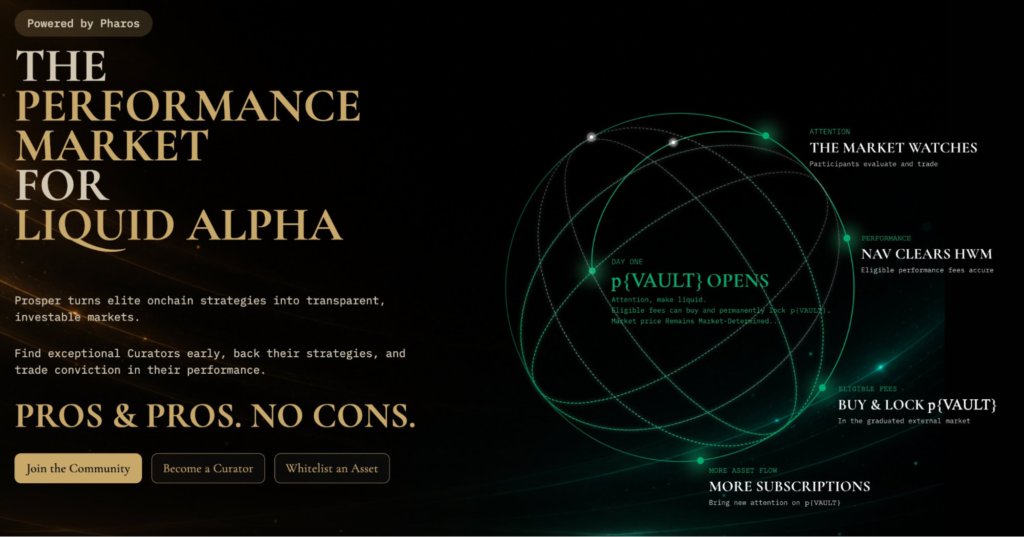
Here is how the mechanics actually function. A portfolio manager, referred to as a curator within the ecosystem, builds a Vault around a specific onchain trading strategy. When they deploy this strategy, the protocol generates two distinct financial instruments.
The first instrument is Vault Shares. These operate exactly like a traditional fund allocation. They provide direct exposure to the underlying strategy and its net asset value.
The second instrument is far more interesting. It is a token designated as p{VAULT}. This is an independently priced, crypto-native asset associated with the specific Curator and their strategy.
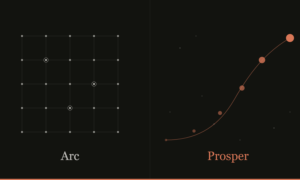
Crucially, p{VAULT} does not represent legal ownership in the corresponding Vault. It does not track the net asset value. It does not provide any legal claim on the assets, the performance, or the profits of the fund. Instead, the token trades independently on public markets. Initially, it prices through a public bonding curve. After the asset matures, it relies entirely on external liquidity pools across decentralized exchanges.
Why would anyone buy a token that offers no legal ownership of the underlying assets? The answer lies in a hardcoded economic linkage.
Performance Markets incorporate a strict buyback and burn mechanism. When a Curator succeeds and the Vault strategy exceeds its high-water mark, they earn performance fees. A predefined portion of those eligible performance fees is immediately diverted by a smart contract. The protocol automatically uses those funds to purchase p{VAULT} tokens on the open market. Once purchased, the tokens are permanently burned.
This creates an observable economic reference. The token is completely speculative, but its supply dynamics are directly tied to the verifiable success of a real trading strategy.
“Crypto markets have demonstrated the power of open participation and collective conviction, while onchain finance has made economic performance increasingly transparent,” explained Laura Shi, chief business officer at Pharos. “MemeRWA brings those ideas together. Verifiable performance data provides the signal, while p{VAULT} remains independently priced through participant activity.”
Transparency is central to the entire model. Every p{VAULT} launches with a fixed supply of exactly one billion tokens. There are no presales. There are absolutely no team allocations or insider distributions. Every metric is visible on a public ledger. Market participants can observe the exact Vault holdings, the fee accrual, the bonding curve reserves, and every single buyback transaction in real time.
This launch matters because it sidesteps a major hurdle in decentralized finance. Traditional asset tokenization often requires heavy legal wrappers, forcing developers to navigate complex securities regulations. By explicitly stripping away ownership and dividend claims, MemeRWA creates a new classification. It isolates the verifiable performance data of a trader and uses it as a simple economic reference point for a separate, speculative asset.
The buyback system is not an active market-making program. It is an automated, predefined protocol function triggered exclusively by smart contract logic. There is no price support desk behind the scenes. If the trader fails to generate a profit, no buybacks occur.
For the industry, this represents a fascinating experiment. Decentralized finance has spent years trying to convince traditional institutions to put their assets onchain. PROSPER is taking the opposite route. They are taking the aggressive, community-driven mechanics of crypto-native markets and finally attaching them to verifiable financial competence.
PROSPER provides all the underlying technology services supporting this framework. Curators can deploy and manage their strategies, while the protocol handles the complicated backend execution. As the platform matures, it could fundamentally change how independent traders monetize their reputation in the digital age.