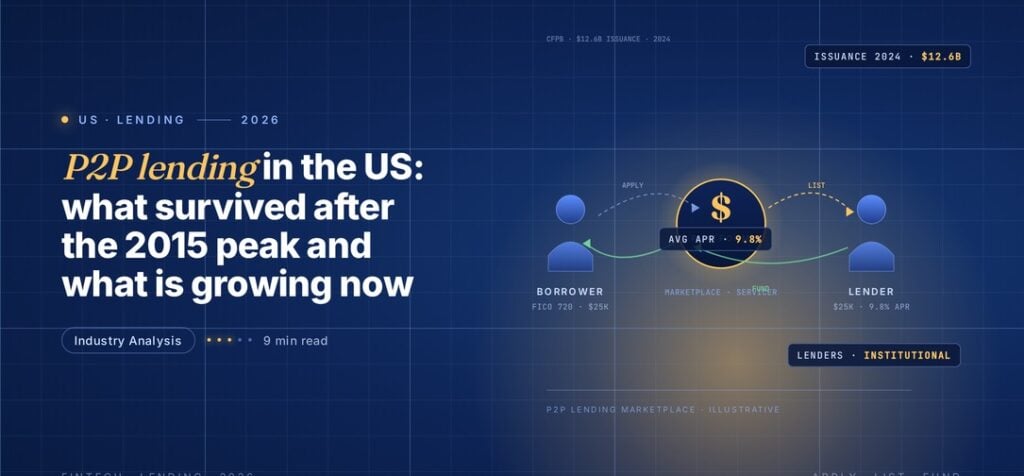
One of the first US peer-to-peer lending platforms announced in 2020 that it was shutting its retail investor product and folding into a chartered bank. The obituary for P2P lending was written a dozen times that year, and yet a decade after the category’s IPO peak, lending originated or distributed through non-bank marketplaces in the United States is larger than it has ever been, it just doesn’t look like P2P lending anymore. The global P2P lending market, broadly defined, was valued at roughly $148 billion in 2024 and is projected to exceed $1.1 trillion by 2032, according to Fortune Business Insights.
How the US P2P model actually evolved
The first generation of US P2P platforms, LendingClub, Prosper, and a handful of smaller venues, pitched a direct match between retail lenders and retail borrowers. That model did not survive contact with US securities law or with institutional capital. The platforms that grew kept the origination technology but replaced retail lenders with banks and institutional credit funds as the primary source of capital. LendingClub’s 2021 acquisition of Radius Bank was the clearest marker of the shift: the company became a federally chartered bank that still originates through a marketplace, but funds most of the loans on its own balance sheet.
What that means in 2025 is that the US market has three overlapping segments. The first is the legacy marketplace lenders that have become banks or are closely partnered with them. The second is a newer wave of embedded credit marketplaces that connect borrowers to non-bank lenders through retail apps. The third is crypto-native lending that borrows the marketplace idea and applies it to collateralized stablecoin borrowing, a much smaller segment but one with distinct growth dynamics.
Why “P2P” is still useful as a category
Purists will argue that what’s happening now isn’t P2P at all because retail lenders are largely out of the picture. The term survives because the economic function, matching borrowers to non-bank capital through technology, is identical. Regulators and market participants still use “peer-to-peer” or “marketplace lending” interchangeably, and the Consumer Financial Protection Bureau’s BNPL market report uses the same framing for adjacent non-bank consumer lending categories.
For this article, P2P lending refers to any loan originated through a technology platform where the funding source is at least partially non-bank, whether that source is retail investors, institutional credit funds, or marketplace bank partners.
The US market in 2025
The US market breaks into three recognizable buckets with very different growth dynamics.
| Segment | Representative players | Primary borrower | Recent trajectory |
|---|---|---|---|
| Marketplace consumer lending | LendingClub, Upstart, Prosper | Prime and near-prime consumers | Flat-to-growing after 2022-23 rate shock |
| Embedded SMB lending | Shopify Capital, Square Loans, BlueVine | Small-business owners | Strong growth off merchant platforms |
| Marketplace mortgage and specialty | Better, Figure, Roostify | Homebuyers, HELOC borrowers | Volatile, sensitive to housing cycle |
Source: Fortune Business Insights and company disclosures; see the Fortune Business Insights report.
The embedded SMB segment is now the most interesting. Merchant-platform lenders use payment flow data to price credit, which lets them originate loans with lower default rates than traditional non-bank lenders. That advantage is tied to the broader trend of digital banking adoption across small businesses, which we covered in our reporting on why digital banking adoption is accelerating among SMEs.
What regulation has done to the model
US regulation has reshaped the category more than any market force. Three regulatory realities have determined the shape of the current US industry.
First, securities law made it impractical to fund consumer loans with retail lenders at scale; the disclosure and registration requirements turned out to be too costly for a product whose individual units were small. Second, state-by-state lending licences meant that any platform trying to originate directly had to hold dozens of licences, which pushed most platforms into bank-partnership structures. Third, the 2024 expansion of CFPB oversight of non-bank lenders has increased compliance costs across the category and accelerated the consolidation of smaller platforms.
The cumulative effect is that the US marketplace-lending market is now functionally a bank-partnered market, with a few chartered-bank exceptions. That regulatory shape is one reason the US category grew more slowly than equivalent markets in the UK or East Asia, a contrast we covered in our analysis of how fintech is reshaping competition in financial services.
What this means for borrowers and investors
For US borrowers, the practical distinction between a “P2P” loan and a bank loan has largely disappeared. Prime-credit consumers can get unsecured term loans from bank-partnered platforms at rates that are competitive with traditional unsecured credit; thin-file borrowers can access alternatives that use cash-flow and payment data to underwrite. The meaningful choice today is not P2P versus bank but whether to borrow from a lender that prices off credit score or one that prices off observed income.
For investors, the retail-lender product has mostly been replaced by securitizations and institutional credit funds. The marketplaces that sell loan participations to institutional investors are larger than they have ever been, but the typical US retail investor now accesses the asset class through an ETF or a fixed-income fund rather than through a platform account. The venture capital pattern that funded this shift is covered in our piece on the role of venture capital in fintech growth.
The next product layer: embedded credit and AI underwriting
Two product layers are being added on top of the marketplace-lending model in 2025 and are likely to determine the next cycle of growth. The first is embedded credit, where a loan is offered inside a non-financial application (a retail checkout, a gig-work app, a payroll portal) and the origination platform is invisible to the borrower. The economic attraction is that acquisition cost drops toward zero because the borrower already has a reason to be on the platform, and the data used to underwrite comes from the platform itself. The second is AI-driven cash-flow underwriting, which uses bank-account data and transaction history to price credit for borrowers who would otherwise sit in the thin-file bucket. Both shifts extend the underlying marketplace-lending idea rather than replacing it, and both are attracting the venture capital that once funded stand-alone consumer lenders. The practical result is that the US P2P label has stopped describing a consumer-facing brand and has started describing a piece of back-end infrastructure inside a much broader credit market.
The longer arc
P2P lending in the US has not collapsed, it has become a less visible part of the regulated credit system. The headline platforms are fewer and more bank-like, while the underlying marketplace-lending activity has grown because it has been absorbed into embedded finance, merchant platforms, and institutional credit funds. The category will continue to expand as data-driven underwriting spreads to more borrower types; what will not return is the retail-lender-to-retail-borrower experience of the 2015 peak.