
Two Ways a Developer’s Hands Can Fail: An Interview with Prof. Srinjoy Saha

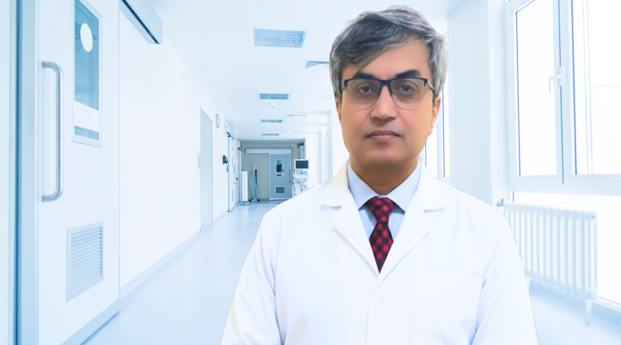
Prof. Srinjoy Saha is a senior plastic and reconstructive surgeon at Apollo Multispeciality Hospital, Kolkata, and Adjunct Professor at the Apollo Hospital Educational and Research Foundation (AHERF). A Harvard fellowship alumnus in tissue engineering at Brigham and Women’s Hospital and a member of the ASPS Regenerative Medicine Committee, he has practised reconstructive and regenerative surgery since 1998, with a particular focus on nerve decompression, tissue engineering, and tissue-preserving techniques under his Jyoticision™ methodology.
Software developers put a narrow set of anatomy through unusual demands, and it can fail in two entirely different ways: gradually, through repetitive strain on the nerves of the wrist, or suddenly, through an acute injury to the fingertips themselves — the part of the hand doing the actual typing. In this interview, Prof. Saha discusses both how he treats carpal tunnel syndrome and a published case of reconstructing a crushed fingertip that allowed a software engineer to return to work.
Part One: The Gradual Problem — Repetitive strain Injury and Carpal Tunnel
1. How does Repetitive strain Injury actually develop in someone who spends all day at a keyboard?
It’s cumulative, not sudden. The small, repetitive movements of typing and clicking, held in a fixed wrist position for hours at a time, gradually inflame the tendons running through the wrist. As those tendons swell, they compress the median nerve inside the carpal tunnel — that’s the mechanism behind carpal tunnel syndrome specifically. Patients describe it as numbness or tingling in the thumb and first two fingers, a grip that feels weaker than it should, and eventually a loss of the fine motor control that typing depends on.
What’s interesting about this population is that they usually recognise the pattern before they understand the mechanism. Someone will tell me their hand “falls asleep” holding the mouse, or that it wakes them at night — and they’ve often lived with that for a year or more before seeing anyone about it.
2. At what point does it move from “manage it with ergonomics” to “this needs surgery”?
Splints, activity changes, and anti-inflammatory treatment genuinely resolve a good share of early cases — I don’t want to undersell conservative care. The signal that we’ve moved past that stage is usually persistent numbness that doesn’t settle with rest, symptoms that wake the patient at night, or measurable grip weakness. At that point, continuing to wait doesn’t just delay relief — it risks permanent nerve damage, because a nerve under sustained compression eventually stops recovering fully even after the pressure is released.
3. Walk us through what carpal tunnel release actually involves.
The transverse carpal ligament forms the roof of the carpal tunnel, and dividing it relieves pressure on the median nerve. It’s a fairly contained procedure — a small incision at the base of the palm, and in suitable cases it can be done endoscopically through a single portal rather than an open incision. The nerve compression is relieved immediately; what takes longer is the nerve recovering its full conduction and the patient regaining fine motor precision, which is usually a progressive process over several weeks.
4. What do the more advanced nerve-compression cases look like — where there’s already muscle wasting or tendon involvement?
Sustained compression over a long period can cause visible wasting of the thenar muscle at the base of the thumb, or damage to the surrounding tendon sheath. Those cases need more than decompression — tendon transfers or tendon sheath repair, alongside nerve release, to restore grip strength and precise finger control. This is exactly why earlier intervention matters: the difference between a release and a full reconstruction often comes down to how many months someone spent hoping it would resolve on its own.
5. You also do nerve decompression work elsewhere in the body — is there a common thread in how you approach nerve entrapment generally?
There is. I do selective tarsal tunnel decompression in diabetic foot patients — releasing the tibial nerve from the ankle down through the plantar tunnels — in cases with a positive Tinel’s sign, drawing on the work of Lee Dellon and Susan Mackinnon in peripheral nerve surgery. It’s a different nerve and a different part of the body, but the underlying principle is identical to carpal tunnel release: a peripheral nerve compressed by a tight anatomical tunnel, and decompression restoring function that would otherwise degrade permanently. I approach it selectively rather than as a default in every patient — the anatomy and the clinical signs should justify the surgery, not the diagnosis alone.
Part Two: The Sudden Problem — Rebuilding a Crushed Fingertip
6. Fingertip injuries are a completely different kind of problem from carpal tunnel — how does someone end up with one, and how are they normally treated?
Right — there’s no overlap with the RSI story here. This isn’t cumulative strain; it’s acute trauma, a crushing injury to the fingertip. Standard treatment options are terminalisation — shortening the finger to close the wound — healing by secondary intention, or flap surgery, and each carries real trade-offs: lost length, altered sensation, or a more invasive procedure than the injury might seem to call for at first glance.
7. You published a case exactly like this. Tell us about it.
A patient came in with a severely crushed fingertip — complete loss of the pulp and soft tissue, exposed bone, and the nail plate avulsed from the nail bed. Rather than shortening the finger or performing a flap reconstruction, we used a tissue-engineering approach: platelet-rich fibrin was injected into the surrounding tissue and applied over the exposed bone, and the wound was then covered with a layered synthetic biodegradable scaffold. Over the next weeks, new soft tissue regenerated within that scaffold in place, rather than being brought in from elsewhere on the body.
8. What did recovery actually look like, and what mattered most about the outcome?
It was gradual and measurable at each stage. By six weeks, there was good tissue volume along the sides of the finger, though the palmar soft tissue was still thin over the bone. By three months, the finger pulp had developed adequately, and the nail plate had formed, with some initial ridging that resolved over time. At six months, the finger had sufficient length, adequate pulp volume, good sensation, and healthy soft tissue with only faint scarring — the finger had essentially rebuilt itself within the scaffold rather than being reconstructed from tissue taken elsewhere.
The detail that made the case worth publishing was the patient’s identity: a working software engineer. The reconstruction restored sufficient sensation, mobility, and length for him to return to his job normally. For someone whose income depends on ten working fingers, that’s not a secondary outcome — it’s the actual measure of whether the surgery succeeded.
9. Why does that matter beyond this one case?
Because it’s a genuine alternative to the standard options, not just a variation on them. Terminalisation and flap surgery both solve the wound, but at a real cost — shortened length, tissue borrowed from elsewhere, a longer or more invasive recovery. Regenerating the tissue in place avoided that cost entirely for this patient, which is exactly the kind of outcome that matters most to someone whose fingertips perform skilled, sensation-dependent work every day.
Closing
10. These are two very different problems — chronic nerve compression and acute traumatic tissue loss. Is there a common thread in how you approach them?
Preservation over sacrifice. In carpal tunnel, that means intervening early enough to prevent the kind of permanent nerve damage that would otherwise force a more invasive reconstruction later. In the fingertip case, it meant declining to shorten or amputate when regenerating the tissue in place was possible. The mechanisms have nothing in common, but the priority is the same: keep as much of the original hand, and its function, intact as possible. For someone who works with their hands for a living, that’s not a cosmetic preference — it’s the difference between returning to work and not.
Prof. Srinjoy Saha practises reconstructive, aesthetic, and regenerative plastic surgery at Apollo Multispeciality Hospital, Kolkata. His 2023 article on tissue-engineered fingertip reconstruction is published in the Journal of Stem Cells & Regenerative Medicine. More on his work is available at srinjoysaha.com






Comment