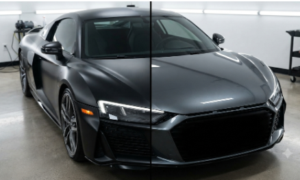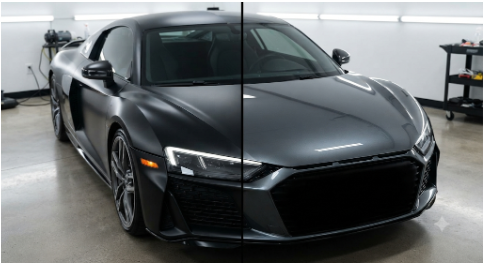
Paint protection film and vinyl wrap are both films applied over a car’s paint, which is why they are so often confused. They answer different questions. One is made to absorb the knocks that chip and mark paint. The other is made to change how the car looks.
A quick note on terms. PPF is sometimes called “PPF coating”, but it is a film and not a liquid coating. Ceramic coating is a separate product again. This comparison covers protection, appearance, durability, removal and installation, then explains when it makes sense to use both.
PPF vs Vinyl Wrap at a Glance
| Criteria | Paint protection film (PPF) | Vinyl wrap |
| Main purpose | Protecting the original paint | Changing colour and finish |
| Typical material | Thermoplastic polyurethane (TPU) | Vinyl, usually PVC-based |
| Thickness | Commonly around 0.2 mm | Generally thinner than PPF |
| Stone chips | Strong protection | Limited |
| Light scratches | Self-healing films can recover light marks | Varies by product, generally less |
| Colour and finish range | Mostly clear, with matte and coloured options | Very wide |
| Typical lifespan | Often 5 to 10 years | Commonly 3 to 7 years |
| Removable | Yes, by a professional | Yes, by a professional |
The table gives the headline. The sections below explain the reasons behind it.
Which Protects the Paint Better?
PPF, and the gap is large. Imagine a small stone thrown up on the highway hitting the bumper. TPU film is flexible and thick enough to absorb that energy before it reaches the clear coat. Vinyl wrap is thinner and is designed to look good, not to take impacts, so a stone can still mark the paint beneath it.
Vinyl does offer some defence against light surface marks and environmental exposure, and a wrap will keep the paint under it clean and shaded from UV. That is a side benefit and not what the product is engineered for.
PPF has limits too. It cannot stop every strike, and a scratch that cuts through the film will not heal. Many quality films have a self-healing topcoat that lets light marks and swirls soften and flatten out when warmed by the sun or hot water. That applies to light surface marks only, and the effect tends to fade as the film ages.
Best option: PPF.
Which Is Better for Changing Colour and Finish?
Vinyl wrap, easily. It comes in gloss, satin, matte, metallic, textured and colour-shifting finishes, as well as custom printed designs. PPF is mostly clear, although matte and coloured films exist, and the range is far narrower.
A wrap is also a reversible way to change colour without repainting. Check the rules before committing, because a significant colour change may need to be reported to your state or territory road authority.
Clear PPF has a more subtle effect. It keeps the factory colour and can leave the paint looking clean and glossy, while matte PPF changes the finish without changing the colour.
Best option: vinyl wrap.
Which Lasts Longer?
PPF generally does. Quality film often lasts five to ten years, while wraps commonly last somewhere around three to seven, depending on the finish, the climate and the care they get. Both depend heavily on the material, the installation and how the car is used.
Sun exposure is the main enemy of both. Wraps can fade, change in appearance or become harder to remove with age, particularly on horizontal panels such as the bonnet and roof. Low-grade PPF can yellow, crack or lose clarity.
Neither is maintenance-free. Regular washing with a pH-neutral shampoo and a clean mitt, prompt removal of bird droppings and sap, and avoiding abrasive brush washes extend the life of either.
Best option: PPF.
Is Professional Installation Mandatory?
A great deal, and in both cases it is almost as important as the film itself. Poor installation can show up as visible edges, bubbles, lifting, contamination trapped under the film or uneven stretching.
It is especially important with PPF, because the aim is a protective layer that blends into the bodywork. A premium film installed badly will disappoint, and a good installer using proper technique can make an ordinary film look excellent. Paint preparation matters just as much. Existing chips and swirls stay visible under transparent film, so a good installer inspects the paint and corrects defects first.
Can They Be Removed Safely?
Both can be removed by a professional, and on original factory paint in good condition either should come off cleanly. Problems arise when the paint underneath is poor. A respray, damaged clear coat or low-quality paint can lift along with the adhesive. Leaving film on well past its useful life also makes removal harder. If the car has had paintwork before, ask the installer to assess the surface first.
Can You Use PPF and Vinyl Wrap Together?
Sometimes, and this is where the two work as partners and not competitors. A common approach is to put PPF on the most exposed areas (the front bumper, bonnet, mirrors and leading edges) and wrap the remainder for colour. The order, the materials and the adhesives all matter, so compatibility should be confirmed by the installer before anything goes on.
Coloured PPF is another option for owners who want a change of appearance and stronger protection than conventional vinyl offers, although the range of colours is smaller.
What to Look for When Choosing PPF
Film quality varies widely, so a few checks help separate a good product from a poor one:
- Material: TPU rather than older PVC-based films.
- Topcoat: A self-healing topcoat, ideally with hydrophobic properties.
- Coverage: Which panels are included, and whether the quote is for partial or full coverage.
- Warranty: Who backs it (the manufacturer or only the installer), how long it runs and whether it covers yellowing, cracking, peeling and staining.
- Installer: Experience with your model, a clear preparation process and good aftercare support.
Brands such as Aegis are worth comparing on these same points, using the published details for the specific film being quoted.
Which One Should You Choose?
- Choose PPF if protecting the original paint is the priority, you drive regularly on highways, you are happy with the existing colour and you want a long-term solution against stone chips and light scratches.
- Choose vinyl wrap if your main goal is a new colour or a distinctive finish, you want a reversible change and physical paint protection is secondary.
- Combine them if you want a new look and chip protection on the panels that take the most abuse.
Conclusion
There is no universally better option, because the two are not really competing. On the question of protecting factory paint, PPF is the clear choice. On the question of changing how the car looks, a wrap is. The decision comes down to how you drive, how long you plan to keep the car and what you want it to look like, and whichever you choose, the installer deserves as much scrutiny as the product.