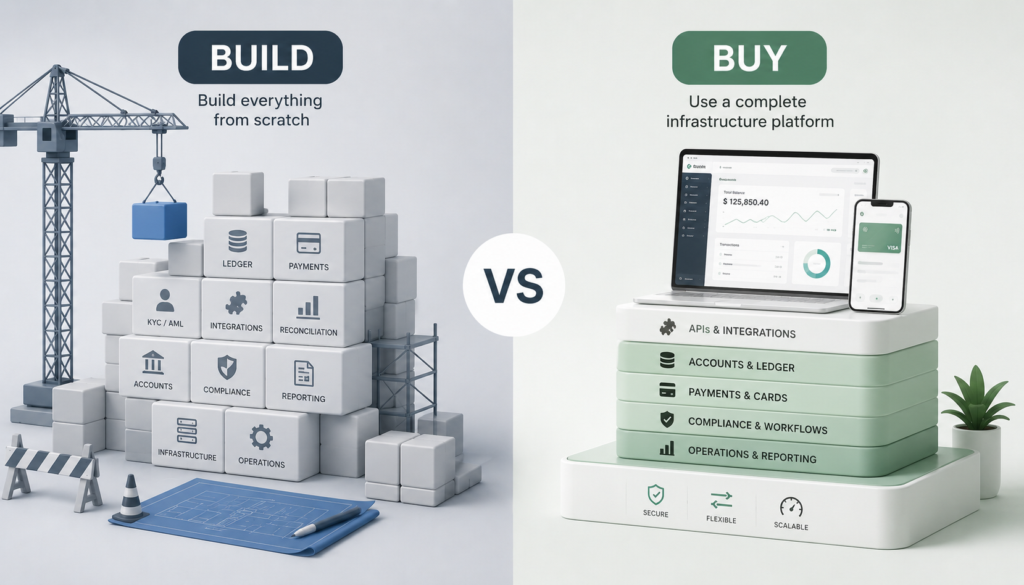
Launching a neobank or fintech product involves more than building an app. Behind accounts, cards, payments and onboarding sits a large technology stack: transaction logic, ledgers, APIs, integrations, compliance workflows, reconciliation and operational tools.
Companies can build this infrastructure themselves, assemble it from multiple providers, or use a broader technology platform. The right choice depends less on the label on a vendor’s proposal and more on who is responsible for each part of the stack.
1. Start With the Regulatory Layer
Before choosing technology, determine who provides the regulated financial capabilities your product needs.
If a company does not have the required licence or regulated partner, Banking-as-a-Service (BaaS) can be a logical option. Depending on the provider and jurisdiction, BaaS can combine access to regulated financial services with technology and operational capabilities.
If regulated access is already covered through the company’s own licence or a partner, the problem changes. The company does not need to buy regulated access again. It needs the technology infrastructure around that relationship.
This distinction matters because BaaS, core banking and white-label platforms are not interchangeable categories.
BaaS can combine regulated services and technology. Core banking usually refers to the systems managing accounts, balances, transactions and banking product logic. White-label describes how a product is delivered under the client’s brand.
The labels tell you something about the offer, but not necessarily how much infrastructure the client will actually receive.
2. What Still Needs to Be Built?
A typical fintech product may require:
- account and transaction logic;
- ledger infrastructure;
- APIs;
- payment and card integrations;
- KYC/KYB and compliance workflows;
- reconciliation and reporting;
- operational and back-office tools;
- customer-facing interfaces.
The important question is not whether a provider offers one of these components. It is what remains for the client to build and operate after signing the contract.
A company can buy a core banking system, a KYC provider, card processing and payment services separately. But those systems still need to work together.
Someone has to manage integrations, synchronize transaction data, handle exceptions, monitor services and maintain reconciliation. Over time, the company may end up building its own orchestration layer around third-party products.
This is why several off-the-shelf services do not automatically mean a faster launch.
3. Compare Responsibilities, Not Feature Lists
When comparing providers, four questions reveal more than a long feature list.
Who provides regulated access?
Identify the licensed entity or regulated partner responsible for the financial activities.
Where does the system of record live?
Understand which system controls balances, transactions, account rules, limits, fees and other product logic.
Who owns integrations and operations?
Determine who manages payment and card providers, KYC/KYB services, reconciliation, reporting, monitoring and incident handling.
What happens when the product changes?
A new payment provider, fee structure, market or product feature may be a simple configuration in one architecture and a development project in another.
These questions also expose future dependency. A provider may give you a fast launch but make major changes dependent on its development cycle. A multi-provider architecture may offer more flexibility but leave your team responsible for the connections between systems.
4. Build vs. Buy: Where Should the Complexity Live?
“Build for control, buy for speed” is too simple for fintech infrastructure.
Building in-house gives a company control over its architecture, but also makes it responsible for engineering, testing, integrations, maintenance, security and future changes.
Using multiple providers reduces some development work but creates orchestration work. Someone still has to make the systems operate as one product.
A broader infrastructure provider can reduce the number of components and integrations the company has to manage. The trade-off is greater dependence on that provider.
The economics go beyond the vendor fee. Internal engineering capacity, integration work, maintenance, reconciliation, operational support and the cost of delaying the launch all matter.
So the real build-vs-buy question is:
Which parts of the infrastructure create competitive advantage, and which are better provided by a technology partner?
A company may want to own its customer experience, distribution, pricing or unique product logic. It does not necessarily need to build its own ledger, account infrastructure or standard integrations.
5. Where FinHarbor Fits
FinHarbor fits the scenario where regulated access is already handled separately and the company needs the technology infrastructure to build its financial product.
FinHarbor provides financial infrastructure software rather than a financial licence. Depending on the configuration, the platform can provide:
- account and transaction logic;
- ledger infrastructure;
- APIs and integrations;
- operational tooling;
- compliance-related workflows;
- white-label interfaces;
- fiat and crypto functionality.
This makes the platform suitable for digital banking and neobanks, B2B banking, wallets, crypto processing and hybrid fiat-crypto products.
The difference is that the company does not have to assemble the entire foundational technology stack from separate providers. It can use a broader infrastructure layer and focus its own development on the parts of the product that actually differentiate the business.
6. The Goal Is Faster Launch — and Easier Change
Infrastructure choices affect more than the first launch.
A fintech may start with fiat accounts and later add cards, crypto, new payment providers or additional markets. If every new capability requires changes across several independent systems, the technology stack becomes increasingly difficult to maintain.
A modular infrastructure approach can reduce this complexity by bringing more functionality into a unified environment.
For companies with regulated access already in place, this can shorten the path from regulatory readiness to a functioning product without requiring them to build the entire fintech stack from scratch.
Conclusion
There is no universal answer to whether a company needs BaaS, core banking, a white-label platform or broader financial infrastructure software.
The decision should start with the regulatory relationship, then move to the technology layer.
Ask what already exists, what still needs to be built, who will operate it, and what happens when the architecture needs to change.
The fastest route is not to outsource everything. It is to build the parts that create competitive advantage and use ready-made infrastructure for the parts that do not.
For companies that already have regulated access, FinHarbor provides a technology foundation for launching digital banking, B2B banking, crypto and hybrid fiat-crypto products without building the full infrastructure stack from scratch.