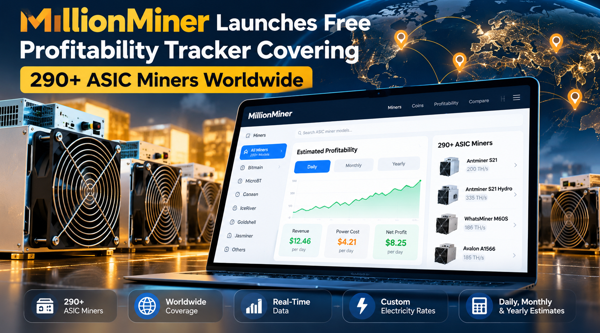
Anyone who has shopped for mining hardware knows the moment. The hashrate looks great, the price seems fair, and then the real question arrives: will this machine make money once the power bill comes in? MillionMiner built its new free profitability tracker to answer that before you pay.
The tracker covers more than 290 ASIC mining machines. Pick a model, type in what you pay for electricity, and it shows revenue, power cost, and net profit per day, per month, and per year. Price and difficulty data refresh daily, so the result reflects today’s market rather than last year’s.
What Is the MillionMiner Profitability Tracker?
It is a free tool that tells you what a specific mining machine earns after electricity. Every supported model gets its own page with daily, monthly, and yearly figures, plus a 90-day chart that shows how its earnings have moved over the last three months.
You will find machines from Bitmain, MicroBT, Canaan, Bitdeer, IceRiver, Goldshell, Jasminer, and several smaller brands. The tool also handles nine coins and algorithms: Bitcoin, Litecoin and Dogecoin, Kaspa, Ethereum Classic, Monero, Zcash, Dash and Siacoin.
How Is Mining Profit Calculated?
Strip away the jargon and mining profit is simple: what the machine earns, minus what it costs to keep it running.
Earnings depend on the machine’s hashrate, the coin price, and the network difficulty, which decides how big a slice of the daily block reward you win. Miners often combine these into one number called hashprice: revenue per unit of hashrate per day.
On the cost side, the main expense is electricity. Multiply the machine’s power draw in kilowatts by 24 hours, then by your price per kilowatt-hour, and you have your daily power bill.
The tracker keeps the earning side current, and you control the cost side with your own rate. That is why two buyers can get opposite results on the same model.
Which Inputs Matter Most?
If you only look at two numbers, make them your electricity rate and the machine’s efficiency. Efficiency is measured in joules per terahash, usually written J/TH, and lower is better. It tells you how much power the machine burns to do the same amount of work.
The difference between hardware generations is bigger than most people expect. A current hydro-cooled model like the Antminer S23 Hydro runs at roughly 9.5 J/TH. The air-cooled Antminer S21 sits near 17.5 J/TH, and the older Antminer S19 XP is around 21.5 J/TH. With similar hashrate, the less efficient machine hands more of its income to the power company every day.
How Much Does Electricity Cost to Run a Mining Machine?
Take the Antminer S21. It draws about 3.5 kilowatts, so it uses 84 kilowatt-hours a day. At a hosted rate of $0.07 per kWh, that comes to $5.88 a day. At a typical home rate of $0.14, the same machine costs $11.76 a day to run, double the amount, with no extra revenue to show for it.
The S23 Hydro draws more, around 5.5 kilowatts, yet it delivers close to three times the hashrate of the S21, so each terahash costs far less. A daily power bill on its own tells you little. What counts is that bill compared with what the machine earns, and the tracker shows both on one screen.
Why Does Profitability Look Different in 2026?
The April 2024 halving changed the maths for everyone. The Bitcoin block reward dropped from 6.25 to 3.125 BTC, so the network now creates about 450 new coins a day instead of 900. Revenue per terahash fell overnight, and plenty of older machines went from slim profit to running at a loss.
Meanwhile, the newest machines dropped below 10 J/TH, splitting the market in two. Efficient hardware on cheap power still earns, while older hardware on expensive power often loses money. Checking ASIC miner profitability at your own power price shows which side a machine falls on before you buy.
Is Home Mining or Hosted Mining More Profitable?
For most people, hosting comes out ahead, and the reason is the power price. Household electricity in many countries costs two to three times what industrial sites and hosting providers pay. As the S21 example above shows, that alone can double your daily running cost.
Home mining can still work if your power is unusually cheap or you put the heat to use in winter. Be ready for the practical side, though: air-cooled machines run around 75 decibels and most need a dedicated 200 to 240 volt circuit. You can test both options in the tracker by changing one number.
How Long Does a Mining Machine Take to Pay for Itself?
A rough payback estimate is easy. Take the price you paid for the machine and divide it by its daily net profit. The answer is the number of days it needs to earn its cost back.
Treat that figure as a best case, because difficulty usually climbs over time and trims everyone’s revenue. Timing matters too. The next halving, expected in 2028, cuts the reward to 1.5625 BTC, and a machine that hasn’t paid for itself by then will earn roughly half as much afterwards. Model payback month by month rather than trusting one optimistic average.
Which Machine Should You Choose?
Begin with your power price, then narrow the list by efficiency. If you are shopping for a Bitcoin miner, these three checks will tell you more than any spec sheet:
- Use your real electricity rate, taken from your bill, not a guess.
- Look at efficiency before hashrate. Machines under 15 J/TH hold on to more of their revenue when power prices rise.
- Ask whether the machine can pay for itself before 2028. If the answer is no, consider a more efficient model or cheaper power.
A cheap machine with poor efficiency can cost more over a year than a pricier, efficient one.
Does the Tracker Cover Altcoin Miners?
Yes. All eight altcoin options listed above are included, and each moves through its own price and difficulty cycle, separate from Bitcoin. A rally in Zcash, for example, can lift the earnings of Equihash machines while SHA-256 hardware stays flat. Every model page uses the live data for its own coin.
How Accurate Are the Numbers?
Treat the results as informed estimates, not promises. Prices and difficulty move daily, and real earnings also depend on uptime, pool fees and the individual machine. Use the tracker to compare options, then check the numbers again on the day you order.
Frequently Asked Questions
Is the profitability tracker free?
Yes, and it updates once a day with current difficulty and coin prices.
Can I enter my own electricity price?
Yes, and you should. Your power cost decides most of the result.
What efficiency should I aim for in 2026?
Under 15 J/TH for SHA-256 machines on average power prices. Under 10 J/TH holds up best when coin prices fall or electricity gets more expensive.
Can I use it to estimate hosted mining?
Yes. Enter your hosting rate per kWh as the electricity price and the tracker shows your hosted profit.