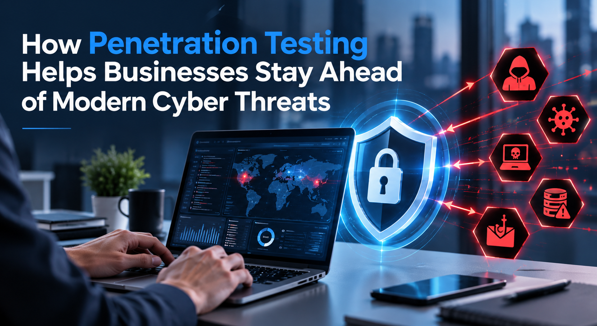
Cyber threats are becoming more sophisticated, harder to detect, and increasingly capable of disrupting day-to-day business operations. Attackers don’t usually use really sophisticated methods. In many cases, they take advantage of weak passwords, outdated software, misconfigured systems, exposed applications, or security gaps that have gone unnoticed over time.
This is why businesses need more than firewalls, antivirus software, and automated vulnerability scans. They also require a useful method for comprehending how an attacker can truly take advantage of flaws in their surroundings. Professional penetration testing services in the USA help organizations identify these weaknesses, validate real-world risks, and strengthen security before those gaps are used in an actual attack.
Penetration testing gives security teams something traditional security tools cannot always provide: an attacker’s perspective.
What is penetration testing?
Penetration testing is a controlled cybersecurity assessment in which security professionals simulate real-world attack techniques against systems, applications, networks, APIs, cloud environments, or other digital assets.
Finding vulnerabilities is not the only goal. A penetration test also evaluates whether those vulnerabilities can actually be exploited and what could happen if an attacker successfully takes advantage of them.
For example, an automated scanner may identify a misconfiguration or outdated software package. A penetration tester may go further and determine whether that weakness could allow unauthorized access, privilege escalation, data exposure, or movement into other parts of the network.
Organizations can better understand which vulnerabilities provide the biggest risk thanks to this real-world validation.
Why modern cyber threats require proactive testing
The technology environment of most businesses is constantly changing.
Businesses use cloud platforms, introduce new apps, incorporate third-party integrations, permit remote access, implement APIs, and expand the number of devices connected to their networks. Every modification opens up new avenues for efficiency, but it may also bring along new security flaws.
Attackers actively look for these gaps.
Waiting until a breach occurs before testing security controls can be costly. Penetration testing helps businesses take a more proactive approach by identifying potential attack paths before a malicious actor discovers them.
Instead of asking whether a vulnerability exists after an incident, businesses can ask a more useful question:
Can an attacker actually exploit this weakness right now?
That is the value penetration testing brings to a modern security program.
Penetration testing reveals vulnerabilities that tools may miss
Although crucial, automated vulnerability scanning has drawbacks.
Security scanners are useful for finding common configuration problems, out-of-date software, known vulnerabilities, and missing patches.
However, they may struggle to understand the broader business context behind a security weakness.
Human penetration testers can investigate how multiple weaknesses interact.
For example, one vulnerability may appear to be low risk on its own. However, when combined with another access-control issue, the two weaknesses may allow an attacker to access sensitive information or gain higher privileges.
Penetration testers can also identify issues such as:
- Weak authentication processes
- Broken access controls
- Business logic flaws
- Privilege escalation paths
- Insecure API behavior
- Cloud permission problems
- Exposed administrative interfaces
- Poor network segmentation
- Weak session management
- Misconfigured security controls
These issues often require manual analysis and an understanding of how real attackers behave.
It helps businesses understand real-world risk
One of the biggest challenges in cybersecurity is prioritization. A large organization may have hundreds or even thousands of security findings. Fixing every issue immediately is rarely practical. Security teams may concentrate on what really matters by using penetration testing.
A professional test can determine:
- Whether a vulnerability is exploitable
- What degree of access could a malicious individual obtain?
- Which systems could be affected
- Whether sensitive information could be exposed
- Whether an attacker could move laterally
- What business operations could be disrupted
This data enables organizations to focus their remediation efforts on real risks instead of just depending on severity ratings.
That makes security improvement more focused and efficient.
Penetration testing strengthens existing security controls
Businesses often invest heavily in cybersecurity tools, but having tools in place does not automatically mean those controls are working correctly.
Penetration testing can help validate the effectiveness of existing security investments.
For example, testing may reveal whether:
- A firewall is blocking unauthorized access properly
- Multi-factor authentication is implemented effectively
- Network segmentation prevents lateral movement
- Cloud access controls are properly configured
- Web application protections are working
- Monitoring tools can detect suspicious activity
This gives security teams a clearer understanding of whether their defenses are working as intended.
It also helps identify gaps between security policies and real-world implementation.
It supports safer cloud adoption
Cloud environments play a vital role in the infrastructure of contemporary businesses.
However, cloud security introduces its own challenges. Excessive permissions, exposed storage, weak identity controls, and misconfigured services can all create security risks.
Cloud penetration testing enables organizations to assess how those vulnerabilities might be exploited.
Testing may focus on areas such as:
- Identity and access management
- Cloud storage permissions
- Publicly exposed services
- Authentication controls
- Cloud APIs
- Misconfigured security groups
- Privilege escalation opportunities
As businesses continue moving workloads into AWS, Microsoft Azure, Google Cloud, and other platforms, cloud-focused penetration testing becomes increasingly important.
It improves application security
Web applications are often directly exposed to the internet, making them attractive targets for attackers.
Application penetration testing assesses the possibility of attackers exploiting vulnerabilities in areas such as authentication, authorization, data handling, session management, and application logic.
Common areas of assessment include:
- Injection vulnerabilities
- Broken authentication
- Access-control weaknesses
- Sensitive data exposure
- Insecure APIs
- Business logic flaws
- Session security
- File upload vulnerabilities
Testing applications before and after major releases can help development teams identify weaknesses earlier and reduce security risks before users are affected.
It helps organizations prepare for real attacks
A penetration test can also act as a realistic exercise for security teams.
When testers simulate attacker behavior, internal teams gain insight into how their systems respond.
This can help organizations answer important questions:
- Can suspicious activity be detected?
- Are alerts generated correctly?
- Can security teams respond quickly?
- Are escalation procedures clear?
- Can affected systems be isolated?
- Are recovery procedures ready?
This makes penetration testing valuable not only for identifying vulnerabilities but also for improving overall incident readiness.
Penetration testing can support compliance efforts
Many industries operate under security and compliance requirements that expect organizations to regularly assess their systems.
Penetration testing can support these efforts by providing evidence that security controls are being evaluated against realistic attack scenarios.
However, businesses should avoid treating penetration testing as a checkbox exercise.
The real value comes from using the findings to improve security, reduce exposure, and strengthen risk management.
Compliance should be one outcome of a mature security program, not the only reason for performing testing.
How often should businesses perform penetration testing?
There is no single schedule that fits every organization.
The right testing frequency depends on the business, industry, infrastructure, risk level, and rate of technical change.
Businesses should consider penetration testing:
- At least periodically as part of the security program
- After major infrastructure changes
- Before launching critical applications
- After cloud migrations
- Following major security incidents
- When new APIs or integrations are introduced
- After significant changes to network architecture
Organizations operating in high-risk environments may need testing more frequently.
The key is to view penetration testing as an ongoing security activity rather than a one-time project.
Choosing the right penetration testing provider
Not all penetration testing services offer the same level of depth.
Businesses should look for a provider that combines automated tools with manual testing and experienced security professionals.
A reliable provider should also offer:
- Clear testing scope
- Transparent methodology
- Manual vulnerability validation
- Risk-based reporting
- Practical remediation guidance
- Retesting after fixes
- Experience across relevant technologies
Organizations seeking professional penetration testing services in the USA should also consider whether the provider understands their specific environment, industry, and security objectives.
Cybersecurity testing is most valuable when it is tailored to the actual systems being protected.
How CyberZEALS supports penetration testing
CyberZEALS provides penetration testing services designed to help organizations identify exploitable weaknesses across applications, networks, cloud environments, APIs, and other critical systems.
The focus should not simply be on generating a long vulnerability report. Effective testing should help businesses understand how vulnerabilities could be exploited, what impact they may create, and which remediation steps should be prioritized first.
By combining technical testing with risk-focused analysis, businesses can make better decisions about where to invest their security resources.
Final thoughts
Cybersecurity threats will continue to evolve as organizations adopt new technologies and attackers develop new techniques. No single security tool can provide complete protection. Penetration testing gives businesses an opportunity to view their environment from an attacker’s perspective and identify weaknesses before those weaknesses become security incidents.
By regularly testing applications, networks, cloud systems, and security controls, organizations can improve visibility, strengthen defenses, and respond to vulnerabilities more effectively. For businesses looking to stay ahead of modern cyber threats, penetration testing should not be treated as an optional exercise. It should be part of a broader strategy focused on continuous security improvement, risk reduction, and stronger protection of critical systems and data.