Choosing among cryptocurrency exchange platforms is not a contest for the longest asset list or the most familiar interface. The useful answer depends on the job: buying a small spot position, researching a market, placing larger orders, running an API, or parking assets between transfers.
This article is for readers who have already narrowed the field to two or three venues and need to tell them apart with evidence rather than impressions. It covers four things: how to read reported volume, how to compare the on-screen quote with the price you can actually trade, what a full cost path looks like in dollars, and which custody and operational risks never appear on a price chart. Derivatives strategy, token selection, and tax treatment are out of scope, and no venue is ranked here. The method at its center takes about an hour to run and leaves a written record you can revisit when conditions change.
First, Know the Job You Are Hiring the Platform For
An exchange is a bundle of services: order matching, account access, custody, settlement, charts, transfers, and sometimes lending or derivatives. Two venues can both advertise spot trading while differing in pairs, order types, fee tiers, withdrawal rules, and support processes. Treating a platform as a single yes-or-no label hides exactly the differences that matter.
Write the use case in one sentence before comparing anything. A long-term holder cares mostly about withdrawal reliability and how account recovery works. A market researcher needs stable historical exports and predictable API limits. An active spot trader weighs spread, depth, latency, and order controls. The same venue can be a good fit for one of these jobs and a poor fit for the next, which is why “best exchange” lists so often disagree.
Availability is part of the product too. Identity requirements, supported countries, payment rails, asset restrictions, and local rules decide what an account is permitted to do. A feature described on a global landing page may be missing from your jurisdiction or account tier. Verify the terms that apply to the actual account, and note the date you checked.
How Cryptocurrency Exchange Platforms Differ Past the Asset List
Once the job is defined, compare operating details rather than marketing pages. Four matter more than asset counts.
Order types and controls. Some platforms offer only basic market and limit orders. Others add post-only, iceberg, and time-in-force options that change how a larger order interacts with the book. If you never place orders above a few hundred dollars, this may not matter. If you do, it matters a lot.
Fee structure shape. Two venues can post identical headline rates and still cost different amounts. One may charge nothing for a bank deposit and more for card funding; another may bury a conversion spread in the quote. The structure, not the headline number, decides the bill.
Withdrawal rules. Minimums, network choices, address screening, and processing windows vary widely. A venue that is cheap to trade on but slow to release withdrawals changes your real-world risk if you move assets between venues.
Support and incident history. When something breaks, the gap between a two-day ticket and a two-week ticket is the gap between a non-event and a loss. Public incident reports and status pages are worth reading before you commit, not after.
Reported Volume Is a Clue, Not Proof of Liquidity
Reported volume tells you how much activity a data source recorded during a period. It does not prove that an order of your size can be filled near the displayed price, and definitions differ between spot, margin, perpetual futures, and aggregated dashboards.
The number can also be inflated. In analysis submitted to the U.S. Securities and Exchange Commission in March 2019, the asset manager Bitwise estimated that around 95% of the Bitcoin spot volume reported by unregulated exchanges then appeared fake or wash-traded. Several data providers began separating reported volume from volume they consider verifiable after that; a figure labeled “reported” and one labeled “verified” can describe very different markets.
None of this makes volume useless. A ranking of top cryptocurrencies by trading volume is most useful when it is read beside spread, visible order-book depth, and the relevant market type. High turnover can reflect arbitrage, market making, leverage, or liquidations rather than easy execution for every account. Low reported volume can mislead in the other direction if the dashboard omits venues that matter to your pair. Activity concentrated in one pair or a short burst says little about the market you intend to trade.
Compare the Quote With the Price You Can Actually Trade
A dashboard of current crypto prices gives you a reference, but a reference quote is not automatically executable on a chosen venue. Match the asset pair, quote currency, timestamp, and market type before diagnosing a difference. A spot last trade, a perpetual-futures mark, and a composite index can all be correct numbers serving different purposes.
Execution depends on order size and order type. Imagine Platform A showing a narrow spread with only a small amount at the best ask, and Platform B a slightly wider spread with deeper offers across several levels. A small marketable order costs less on A; a larger order experiences less price impact on B. The last price cannot answer that question, and a limit order trades execution risk for price risk: it may never fill.
Fees finish the calculation. Take a simplified example with round numbers: a $2,000 purchase funded by a free bank transfer. On Platform A, a 0.40% taker fee costs $8.00, an estimated 0.05% spread cost adds $1.00, and a $12 withdrawal fee brings the all-in cost to $21.00, or about 1.05% of the position. On Platform B, a 0.10% taker fee costs $2.00, a 0.10% spread cost adds $2.00, and a $4 withdrawal brings the total to $8.00, or 0.40%. The headline rates differ by only 0.30 percentage points, yet the all-in gap is $13, and Platform A’s total cost is more than double Platform B’s. These figures are illustrative, not any real venue’s schedule, but the pattern is common: a low headline rate can be offset by an expensive conversion or an inconvenient withdrawal.
A Comparison Method You Can Reproduce
Use the same assumptions for every platform and keep the evidence, so a polished review cannot quietly mix different pairs, timestamps, and account tiers.
1) Define the task. Specify the asset, quote currency, spot or derivatives market, approximate order size, and whether the goal is research, execution, or temporary custody.
2) Check eligibility. Confirm jurisdiction, identity requirements, product access, payment rails, and restrictions that apply to the real account.
3) Capture execution conditions at the same time. Record bid, ask, spread, visible depth, order types, and, where permitted, a small test-size estimate of price impact.
4) Trace every cost. Add trading, conversion, deposit, withdrawal, network, and potential inactivity or account-service charges, and note which fee tier you used.
5) Review data quality. Match timestamps and definitions, check venue coverage, and note delays, API limits, missing history, or fields that changed since your last review.
6) Write the failure plan. Decide what you would need if withdrawals pause, the account is restricted, the chain is congested, or the market becomes disorderly.
| Measure | Question it helps answer | Important limitation |
| Bid-ask spread | How far the best buy and sell quotes are apart | Can widen rapidly during news or stress |
| Order-book depth | How much visible interest sits near the quote | Displayed orders can be cancelled or refreshed |
| Test-size slippage | How the quote changes as an order grows | A small test does not model every order size |
| Reported volume | Where activity was recorded during the window | Does not reveal net demand or data quality |
| Fee schedule | Which trading and withdrawal costs may apply | Tiers, discounts, and network charges can change |
A short comparison record might read: “For a small spot order in Pair X, Platform A had the narrower spread at 14:00 UTC; Platform B showed greater depth beyond the first level; withdrawal fees and regional availability favored different users.” That sentence beats a star rating because its conditions are visible and testable.
Recheck the record when the task changes. A venue that suits an occasional spot purchase may not suit derivatives research, automated execution, or long-term custody. Treat any comparison as time-stamped evidence, not a permanent league table.
Custody, Operations, and Failure Risks
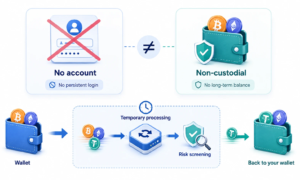
Market quality is only one part of platform exposure. On a custodial exchange, you generally hold an account claim while the venue controls the private-key environment. That is convenient and creates counterparty, operational, and access risks. Self-custody flips the trade-off: you control the keys, and you also own the backups, approvals, address checks, and recovery plan.
Review security controls, account recovery options, withdrawal permissions, incident notices, and the process for appealing a restriction. Do not infer solvency or safety from a polished interface, a sponsorship, or a single public statement. Terms and controls change, and no checklist removes counterparty or technical risk entirely.
Stress conditions expose operational differences that calm markets hide. Maintenance windows, chain congestion, withdrawal queues, address-screening rules, and support backlogs can delay access even while the order book looks fine. Know in advance which records recovery would need, how support is reached, and whether a backup route exists.
Local law matters as well. Services, leverage limits, tax reporting, consumer protections, and permitted assets differ by jurisdiction. When material funds or regulated products are involved, confirm current local requirements and consider qualified professional advice rather than relying on a general comparison.
Conclusion
The right exchange comparison starts with a defined task, not a brand name. Match the venue to the market you need, the quote you can actually trade, the depth behind that quote, the full cost path, the custody model, and the conditions that could interrupt access. Reported volume and interface quality can point your research somewhere; a documented, time-stamped review is what makes the final decision explainable to someone else, including your future self.
FAQ
Is the exchange with the highest volume always the best choice?
No. Volume can sit in a product or pair unrelated to your task, and reported figures can include activity you would never trade against. Compare spread, depth, fees, custody, regional access, and withdrawal conditions for your market and order size instead.
How much order-book depth is enough?
There is no universal threshold. Adequacy depends on order size, volatility, order type, and your tolerance for price impact. Looking several levels deep and running a permitted test-size estimate tells you more than any headline figure.
Why can an exchange price differ from a market dashboard?
A dashboard may aggregate venues or display an index, while an exchange shows its own last trade, bid, ask, or mark price. Match the definition, pair, market type, and timestamp before treating the difference as an error.