By Muhammad Yasir Ali, Founder and CEO, NXP Technologies
Disclosure: the author’s company develops eAuto Dealer, a dealer management system for UAE car dealerships, which is used as an example in this article.
Picture a growing car showroom in Dubai, Sharjah or Abu Dhabi. Enquiries arrive on WhatsApp and phone. Stock lives in a spreadsheet. Costs and sales sit in a separate accounting package, often updated days later by someone outside the sales team.
The setup works until the business grows. Then three simple questions become hard to answer: who is following up this buyer, is this car actually available, and how much did we really make on it?
A dealer management system (DMS) exists to answer those three questions from one place. But dealership software varies widely, and a polished demo can hide gaps. Here is how to evaluate one.
1. Start with your questions, not the feature list
Before any demo, write down the decisions you make every week. Which leads need a call today? Which cars have been in stock too long? Which salesperson converts best, and from which lead source? What is the real margin on last month’s sales?
Then judge every system by one test: can it answer these questions without someone rebuilding a spreadsheet?
2. CRM: ownership and follow-up discipline
In a showroom, unclear lead ownership can lead to missed follow-ups.
A good dealership CRM should record each enquiry with its source, the vehicle of interest, the branch and a named owner. It should give every salesperson a daily follow-up queue, and show managers which leads have stalled. A clear sales pipeline, from new enquiry to won or lost, lets you see where deals get stuck.
Ask how leads arrive. Some systems need staff to enter leads from classifieds portals and social media by hand. Others integrate directly. Neither is wrong, but you should know which one you are buying.
3. Stock: one record per car, with its costs
Every vehicle should have a single record: VIN, specification, branch, status and every cost attached to it. That means the purchase price plus shipping, duties, repairs and preparation as they are incurred.
This matters because a car’s selling price says little on its own. Profit per car only becomes visible when all its costs sit on the same record. Without that, weak margins can stay hidden until year-end.
Check too that a reserved car is blocked for the rest of the team. Two salespeople promising the same vehicle to two customers is an avoidable problem.
4. Accounting: does the sale reach the ledger?
During the demo, check whether a completed sale reaches the ledger without manual re-entry. If the CRM closes the deal but the accountant re-enters the sale by hand, the two sets of figures can drift apart.
Ask the vendor to post a sample sale. Then open the ledger and check that revenue and cost of sale appear. Ask what your external accountant will see, and what still needs their review.
5. Branches, roles and approvals
If you run more than one branch, check that stock, leads and reports can be viewed by branch. Ask whether you can configure staff access by role and branch, so a salesperson does not see purchase costs that only management should see.
Discount approvals deserve attention too. A system that routes discounts above a set level to a manager, and blocks staff from approving their own, helps enforce the dealership’s discount policy on every deal.
6. Questions to ask in every demo
- Which of these steps are automatic, and which are manual?
- How do leads from portals, social media and our website reach the CRM?
- Can you post a sale now and show me the ledger entry?
- Where do a car’s purchase, shipping and repair costs appear, and can I see profit per car?
- Is there a native mobile app, or does the system run in a mobile browser?
- What does onboarding include, who migrates our existing stock and customer data, and how long does it take?
- What is not included in the price you are quoting?
A confident vendor will answer the manual-versus-automatic question plainly. Be cautious of any answer that sounds like “everything is automated.”
A UAE example
We built eAuto Dealer around this exact problem: UAE dealers running sales, stock and accounts in separate places.
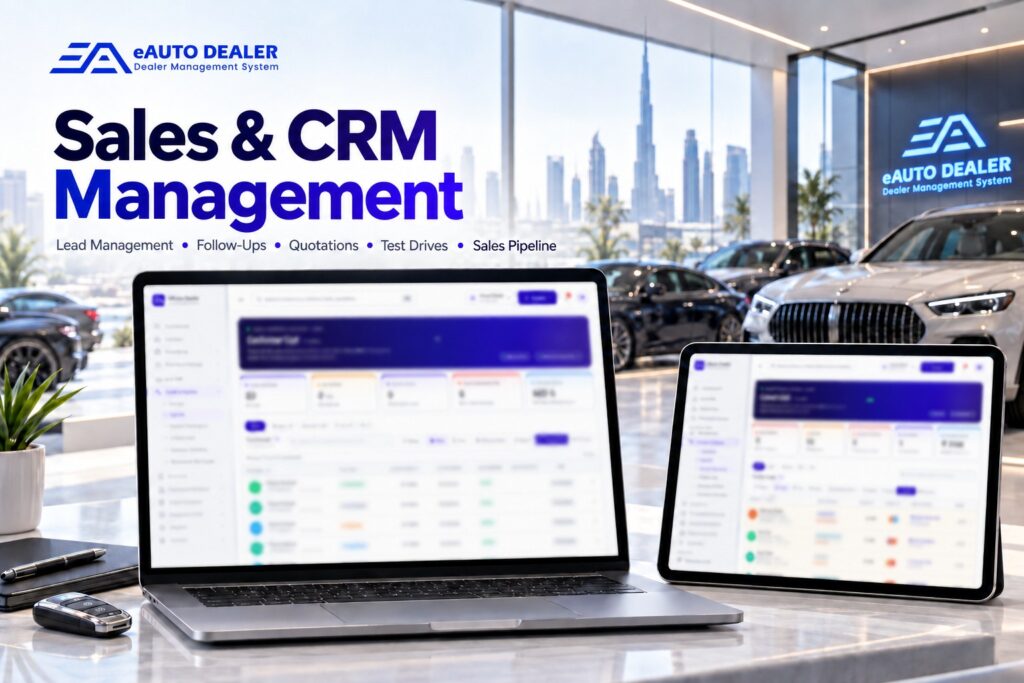
In eAuto Dealer’s dealership CRM, each enquiry has a source, priority, branch and owner, and leads are assigned or reassigned by managers. Salespeople work from a daily follow-up queue, and an 11-stage pipeline tracks each deal to won or lost. Quotations use real stock cars, discounts above set levels need approval, and a car can be reserved against a deposit.
When a sale is posted, revenue and cost of sale are recorded in the ledger, so the accountant works from the same figures as the sales team. Managers can see which lead sources and salespeople actually convert.
To be clear about its limits: portal and social-media leads are entered manually by the dealership team; they are not imported automatically. The system runs in a browser on desktop, tablet or phone, with no separate app to install. Dealers can book a live demo through the eAuto Dealer website.
The bottom line
The right DMS is the one that answers your weekly questions from one set of records. Bring your own questions to every demo, ask what is manual, and watch a real sale travel from the CRM to the ledger before you sign.
About the author
Muhammad Yasir Ali is the Founder and CEO of NXP Technologies, a Dubai-based software company. NXP develops eAuto Dealer, a cloud dealer management system for car dealerships in the UAE.