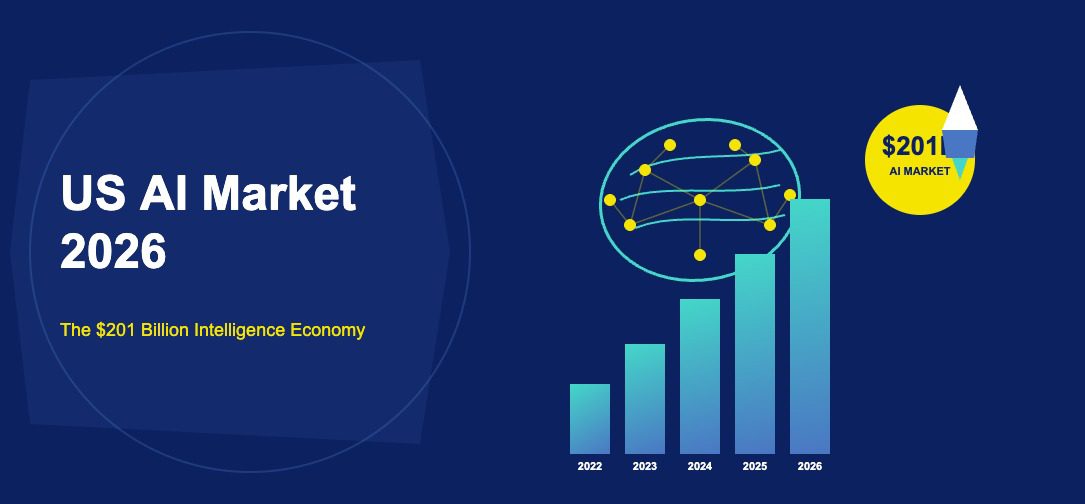
Somewhere in a data centre in northern Virginia, a cluster of GPUs worth more than the annual budget of a small nation is running inference workloads around the clock, serving millions of requests per second from businesses, developers and consumers who have woven artificial intelligence into the fabric of their daily operations. That single facility is one of hundreds now operating across the United States, and together they represent the physical infrastructure behind what has become the world’s largest and fastest-growing artificial intelligence market. The US AI market reached approximately $201.01 billion in 2026, according to industry analysts, a figure that captures not just software and services but the vast ecosystem of hardware, cloud platforms, research labs and startup ventures that have made the United States the undisputed centre of the global AI economy.
This is not a market that arrived overnight. It is the product of decades of research, trillions of dollars in cumulative investment, and a concentration of talent, capital and computational resources that no other country has managed to replicate at comparable scale. Understanding how the US AI market reached this point requires examining the forces that are driving its expansion, the companies that are shaping its trajectory, and the data that reveals where the growth is coming from and where it is heading next. For those tracking the evolution of generative AI for marketing content, the AI sector offers a masterclass in how transformative technology scales from research curiosity to economic cornerstone.
The Scale of the US AI Market in 2026
The US AI market’s valuation at $201.01 billion in 2026 places it ahead of many entire national technology sectors. This figure encompasses enterprise AI software, cloud-based AI services, AI hardware including GPUs and specialised chips, AI-powered applications across industries, and the rapidly expanding ecosystem of AI startups attracting record levels of venture capital.
| Metric | Value | Source |
|---|---|---|
| US AI Market Size (2026) | $201.01 billion | Industry Analysts |
| OpenAI 2026 Funding Round | $110 billion | OpenAI |
| ChatGPT Weekly Active Users | 900 million+ | OpenAI |
| OpenAI Pre-Money Valuation | $730 billion | OpenAI |
| Nvidia FY2026 Revenue | $215.9 billion | Nvidia |
| Big Tech AI Capex (2026 est.) | ~$650 billion | Bridgewater |
OpenAI and the Consumer AI Revolution
No discussion of the US AI market is complete without examining OpenAI, the company that brought artificial intelligence into mainstream consciousness. In 2026, OpenAI raised $110 billion in new funding in a round led by Amazon with $50 billion, alongside SoftBank and Nvidia each committing $30 billion. This placed OpenAI’s pre-money valuation at approximately $730 billion, making it by far the most valuable private technology company in history.
The scale of OpenAI’s consumer product, ChatGPT, has exceeded 900 million weekly active users in 2026. The company now counts more than 50 million consumer subscribers and over 9 million paying business users. These figures illustrate how rapidly generative AI has moved from a novelty to an essential tool across industries, from software development and content creation to customer service, legal research and financial analysis. The implications for the future of marketing technology are profound, as AI platforms reshape how every sector operates.
Nvidia: The Infrastructure Giant Powering AI
Behind every AI model, every training run and every inference request sits hardware, and in 2026 that hardware market is overwhelmingly dominated by Nvidia. The company reported fiscal year 2026 revenue of $215.9 billion, with Q4 FY2026 revenue alone reaching $68.1 billion. Of that quarterly total, data centre revenue accounted for $62.3 billion, representing more than 91% of the company’s sales in the quarter.
Nvidia posted a 75.0% GAAP gross margin in Q4 FY2026, a figure that reflects both the premium pricing power of its GPU products and the extraordinary demand from hyperscalers, enterprise customers and sovereign AI initiatives worldwide. The company’s dominance in AI training and inference hardware has made it one of the most valuable corporations on earth, and its financial results serve as a real-time barometer of global AI investment.
Big Tech Capital Expenditure: The $650 Billion AI Bet
The largest technology companies in the world are investing at a pace never before seen in the history of the technology industry. According to Bridgewater Associates, Alphabet, Amazon, Meta and Microsoft are collectively planning approximately $650 billion in capital expenditure in 2026, the vast majority directed towards AI infrastructure.
| Company | 2026 Capex Guidance | Key Focus |
|---|---|---|
| Alphabet | $175-185 billion | AI infrastructure, cloud, search |
| Amazon | ~$200 billion | AWS AI cloud, logistics AI |
| Meta | $162-169 billion (total expenses) | AI R&D, talent, infrastructure |
| Microsoft | Significant increase (est.) | Azure AI, Copilot, OpenAI partnership |
Alphabet guided 2026 capex of $175 billion to $185 billion to scale its AI infrastructure across Google Cloud, Search and DeepMind research operations. Amazon guided approximately $200 billion in 2026 capex, up from $131 billion in 2025, with the bulk flowing into AWS data centres and AI services. These figures represent a fundamental shift in how the world’s largest companies allocate capital, and they signal deep conviction that AI will be the primary driver of enterprise value for the foreseeable future.
The Startup Ecosystem and Venture Capital
The US AI startup ecosystem is attracting capital at a historic pace. US-based startups raised $174 billion in February 2026 alone, according to Crunchbase, and American firms accounted for 92% of global venture funding that month. This concentration of capital in US-based AI companies reflects the depth of the American startup ecosystem, the availability of engineering talent, and the proximity to major cloud providers and AI research labs.
Microsoft reported 4.7 million paid GitHub Copilot subscribers in the second quarter of its fiscal year 2026, with paid subscribers up 75% year on year. Copilot Pro+ subscriptions rose 77% quarter on quarter, demonstrating the rapid enterprise adoption of AI-powered developer tools. These metrics matter because they show AI moving beyond experimental adoption into embedded, revenue-generating product categories.
Emerging AI Players and Defence Technology
Beyond the established technology giants, a new generation of AI companies is scaling rapidly. CoreWeave, the GPU cloud infrastructure provider, plans $30 to $35 billion of capital expenditure in 2026 for AI data centres, up from $14.9 billion in 2025. The company reported $3.13 billion in available cash as it ramps this massive build-out, and has signed multi-year deals with companies including Perplexity for inference workloads.
In the defence sector, Anduril was reported to be raising at a $60 billion valuation in a 2026 funding round, reflecting the growing intersection of artificial intelligence and national security. The US Department of Defence’s fiscal year 2026 IT and cyber budget request totals $66.1 billion, with $14.3 billion allocated specifically to cyber investments. Meanwhile, FiberLight committed $350 million to build approximately 1,400 route miles of fibre in West Texas specifically to support AI data centre connectivity, illustrating how AI demand is reshaping even physical infrastructure across the country. The scale of investment across the global AdTech market is equally transformative.
Where the US AI Market Is Heading
The trajectory of the US AI market suggests that $201 billion is not a ceiling but a milestone on a much longer growth curve. With OpenAI alone attracting $110 billion in a single funding round, Nvidia generating nearly $216 billion in annual revenue from AI-driven hardware demand, and the four largest technology companies planning to spend approximately $650 billion on AI infrastructure in a single year, the structural forces propelling this market show no signs of deceleration.
What makes the US AI market particularly significant is the breadth of its ecosystem. It is not a single company story or a single technology story. It is hardware and software, consumer products and enterprise platforms, startups and established giants, commercial applications and defence systems, all expanding simultaneously and reinforcing one another. The $201 billion figure for 2026 captures a snapshot of this ecosystem at a moment when it is still in the early stages of what could be the most significant technological transformation in modern economic history.
Research from McKinsey’s 2024 analysis indicates that organisations deploying AI at scale report efficiency improvements of 15 to 25 percent within the first 18 months of production implementation.
According to Mordor Intelligence, the AI in fintech market is projected to grow at a compound annual growth rate exceeding 20 percent through 2029, driven by demand for automated fraud detection, credit scoring, and customer service applications.