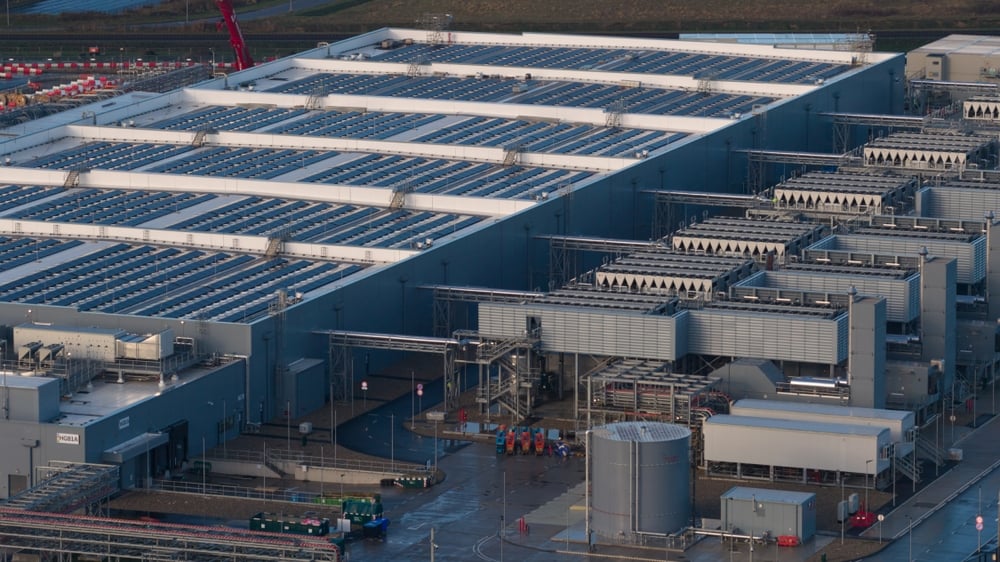
Turning an old warehouse into a data center sounds simple on paper. Find a building, add servers, plug it in. In practice, most industrial buildings in the Kansas City metro never make it past due diligence, and the reasons are rarely the ones a broker flyer would highlight.
Midwest CRE Advisors, a Kansas City area commercial real estate brokerage led by managing broker Logan Freeman, has built its business around identifying which industrial sites in the metro can actually support this kind of conversion and which ones only look like they can. Freeman recently laid out, in detail, the issues that most often kill a Kansas City conversion deal before it gets to the finish line.
The Issues That Do Not Show Up On a Flyer
Freeman says the deal killers are usually not the obvious ones. It is not just roof age or square footage. In his experience walking Kansas City industrial buildings, the real issues are whether a site has enough secure yard space for generators, transformers, cooling equipment, and fuel access, and whether the structure can actually support rooftop or interior equipment loads without major reinforcement.
Clear heights and column spacing matter just as much, he says, since an inefficient layout can waste usable floor space fast. Water lines and other building systems that sit above where the data halls would go are another problem he flags routinely, since a leak in the wrong spot can take down critical equipment. Freeman also watches for floodplain exposure, proximity to rail or airport operations, chemical adjacency, and a lack of a real utility commitment – issues he says show up again and again in the metro’s older industrial stock. Research from HKS and JLL on the broader conversion market confirms the same pattern nationally, which tells Freeman these are not just Kansas City quirks but a real structural risk developers everywhere need to underwrite for.
Not All Old Buildings Are Equal
When Freeman compares building types for conversions in the 5 to 10 megawatt edge or enterprise range, the pattern he sees on the ground in Kansas City is consistent. Older industrial, warehouse, distribution, and manufacturing buildings tend to be the strongest candidates, largely because they already have better clear heights, better truck access, and more yard space to work with.
Office buildings, in his experience, are usually the weakest option. Ceilings are often too low for the equipment layout, the HVAC systems were never designed for mission critical loads, and in many cases the underlying land is worth more than the building sitting on it. That lines up with what HKS and JLL have found across the broader market: HKS notes that office and other legacy building types can work for conversion, but only when the structural and spatial fit is right, and JLL has been more direct that office conversions frequently do not pencil out because the building cannot support the cooling and vertical clearance a modern data hall needs. For Freeman, the national data is confirmation of something he has already seen play out repeatedly in Kansas City’s own office stock.
When a Retrofit Becomes a Teardown
Every conversion has a tipping point where it stops being a retrofit and becomes a rebuild in disguise. Freeman says that point usually arrives when several major problems stack up at once on the same Kansas City site: structural reinforcement, a roof rebuild, environmental remediation, an inadequate yard, a poor column grid, insufficient clear height, and utility easement relocation.
As Freeman puts it, once a building no longer accelerates time to market, it has stopped helping the economics of the deal. In some cases, he says, the building itself becomes almost irrelevant next to what is underneath it – the power is the asset, and the structure on top of it is just something to be dealt with. That pattern, where a buyer values a site for its substation access rather than the building sitting on it, is one HKS and JLL have also documented in the broader conversion market, and it is consistent with what Freeman says he watches for in his own site walks.
What to Check First
For owners and developers evaluating a Kansas City industrial building for this use, Freeman says the order matters. He walks sites in roughly this sequence:
-
Power and utility commitment. Confirm actual available capacity at the meter, not what the utility could theoretically deliver. This clears or kills a deal before anything else matters.
-
Floor load capacity. Standard warehouse floors rated for 125 pounds per square foot will not carry high-density compute racks; 200 to 300 pounds per square foot is the real target.
-
Column spacing and clear height. Twelve to sixteen feet of clear height is generally enough for a small to midsize deployment – what matters more is an efficient, unobstructed column grid for rack layout.
-
Yard space. Enough secured land for generators, transformers, cooling equipment, and fuel access, without which a building that looks fine on paper won’t work in practice.
-
Roof condition. Prior water intrusion near IT equipment space is treated as a conversation-ending red flag, not a repair item.
-
Environmental and zoning review. This should happen early, not last, so a phase one or phase two environmental issue or a zoning conflict surfaces before a deal that otherwise looks solid gets derailed late in the process.
Midwest CRE Advisors has built a track record around this kind of site evaluation work across the Kansas City metro. More on the firm’s recent transactions is available on its case studies page.
Midwest CRE Advisors is a commercial real estate brokerage and advisory firm specializing in data center site selection, industrial outdoor storage, and traditional commercial investment across Kansas, Missouri, and the broader Midwest. Founded by managing broker Logan Freeman, the firm has carved out a specific niche identifying brownfield industrial sites and stranded power capacity for AI infrastructure deployment – a space the large national brokers are not focused on. Active in secondary markets including Kansas City, Oklahoma City, Arkansas, Iowa, and Nebraska, the firm serves AI infrastructure companies, colocation operators, and regional developers evaluating Midwest sites, as well as local and regional investors pursuing industrial, flex, land, multifamily, senior housing, and single-tenant commercial acquisitions and dispositions.
This article is based on information provided by the expert source cited above. It is intended for general informational purposes only and does not constitute legal, financial, or real estate advice. Readers should conduct their own research and consult qualified professionals before making any real estate or financial decisions.