For decades, buying a home followed a familiar pattern.
Buyers contact estate agents and set up viewings for properties around local neighborhoods. They can also be provided with information in the form of brochures, and after weeks or even months the buyer can finally make a decision on a property.
With more and more people searching for homes on their smartphones, there is a lot of information available to those looking to buy property.
Using property search websites to find homes for sale has become easier than ever. Within minutes, a property buyer can search for hundreds of homes for sale, compare prices in neighboring areas, look at virtual tours of homes, and obtain information on current property prices and market trends in an area.
Yet something interesting is happening within the real estate industry.
Even with more information available than ever before, buyers are beginning to realize that information alone is not sufficient to make a property buying decision.
PropTech isn’t just more data to help you make decisions about buying and selling property, it’s actually going to help you make better decisions.
From Listings to Intelligence
Digitalization of the real estate industry.
When homes first went online, property platforms put up listings of available properties on the web. You could now search for homes on line instead of relying on newspaper ads or property catalogs.
The second wave introduced richer experiences.
Later still there came more immersive experiences, rich in imagery and information of value, which enabled those interested in buying, renting or selling properties to view and explore them remotely using high-resolution images, drone footage, interactive maps, and virtual tours.
Now the industry is entering a third phase.
Modern property platform and technology don’t just show more information on properties. Instead, they provide intelligence to aid in decision making.
The question is no longer:
“What properties are available?”
The question is becoming:
“Which property is actually right for me?”
At first glance, there doesn’t seem to be much of a change here between supporting a decision and facilitating a decision. Yet there is.
Why More Data Doesn’t Always Mean Better Decisions
Today most homebuyers have access to an abundance of information concerning properties for sale.
Property photos.
Tax records.
School rankings.
Crime statistics.
Price history.
Walkability scores.
Market reports.
Important decisions are rarely taken solely on the basis of raw data.
Two different neighborhoods with comparable property prices and with similar local schools and facilities.
On paper, they may appear nearly identical.
In reality, they may offer completely different living experiences.
One community may feel like a real community, for example with lots of residents who live there for a longer period of time. Another community can have a more ‘transient’ feel to it and have lots of short-term residents.
One building could be managed by excellent management while the other building may experience maintenance issues repeatedly.
Most property data relating to houses for sale can fail to highlight crucial differences between them and often can only provide data based on human experience.
This is where modern PropTech is beginning to evolve.
The Rise of Smarter Property Research
Of most interest to real estate may not necessarily be AI, Virtual Tours or Predictive Analytics.
It is the effort to combine technology with human intelligence.
More and more buyers are looking for more than just a list of properties on a market.
What is it actually like to live in this neighborhood?
How do residents feel about the building?
What challenges do homeowners commonly experience?
What do current residents wish they had known before moving in?
These questions involve lived experience.
New forms of property research technology are therefore emerging, which, going beyond the information provided by property listings, enable buyers to gain better insight into a property and a neighborhood by collating the knowledge and experience of current residents.
This represents a significant shift in the direction of PropTech.
For years, innovation focused on collecting more information.
There has been a shift from collecting ever more information and storing it in online databases to providing meaningful information by means of innovative PropTech solutions.
Artificial Intelligence Enters Real Estate
Artificial Intelligence Enters Real Estate.
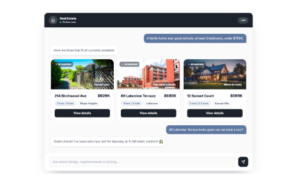
The use of AI in property search is able to help buyers in their search to find a home by filtering through numerous listings, as well as highlighting price changes and trends as well as aiding in analyzing the current market.
For consumers, this means less time searching and more time evaluating relevant property offers.
By processing information and filtering out properties that do not match buyers’ requirements, buyers can focus on the few properties that are of interest to them.
However, AI still faces limitations.
Algorithms excel at processing data.
They are less effective at understanding subjective human experiences.
An algorithm can recognize a neighborhood with strong appreciation potential.
It cannot easily determine whether residents genuinely enjoy living there.
While many technologies can be run by computers, many in the real estate industry expect there to be a human element included when Artificial Intelligence technology is used.
Why Transparency Is Becoming a Competitive Advantage
One trend in modern PropTech that’s worth mentioning is the increasing need for transparency.
Today’s customer demands more information before making purchases, booking hotels, purchasing products or engaging with services.
They read reviews before booking hotels.
They compare ratings before purchasing products.
They seek firsthand experiences before choosing services.
In the real estate industry, properties are beginning to get rated.
Buyers increasingly want visibility into aspects of ownership that were traditionally difficult to evaluate.
Technology platforms that offer transparency give customers confidence in their decision making.
This is a huge purchase for most people, which is why there is so much interest in making home buying more transparent.
As homebuyers become more informed about property ownership, they become more confident in their decisions.
The Future of Home Search
The future of home search will look very different from what we see today when it comes to searching for homes.
Listings will remain important.
Maps will remain important.
Property data will remain important.
But there is more to home search technology than showing listings, maps and property information.
The future of home search will increasingly focus on providing context to listings, map views and property data about homes and neighborhoods.
Why does one neighborhood attract long-term residents?
How does a building operate on a day-to-day basis?
What factors influence resident satisfaction?
What information matters most after moving in?
These questions represent the next frontier of PropTech.
As a new phase in PropTech is emerging, technology will no longer only support homebuyers in finding their future home but will also inform them about homes in more detail.
Final Thoughts
The real estate industry has gone through many changes over the past two decades.
Online listings changed how buyers discover properties.
Virtual tours changed how buyers evaluate properties.
Artificial intelligence is changing how buyers process information.
And then there is the next phase of real estate online: moving from more data to better intelligence.
As homebuyers become better informed the technologies that will be most valued are those that help them to make the best decisions and that go beyond simply providing more information.
In real estate combining data with technology and human understanding to create a complete and fully informed view of a property is key to making better property transactions.