Most dangers announce themselves quickly. Touch a hot stove and you pull away. Eat something spoiled and you know by morning. Asbestos works on a completely different clock. A person can breathe in fibers as a young apprentice, live a full and healthy life, retire, and only then learn that a cancer has been growing in the thin lining around their lungs.
That gap, often 20 to 50 years, is one of the strangest features of mesothelioma. Understanding why it happens tells us a great deal about how the body responds to things it cannot break down, and why the consequences of 20th-century industry are still arriving today.
A Fiber the Body Cannot Remove
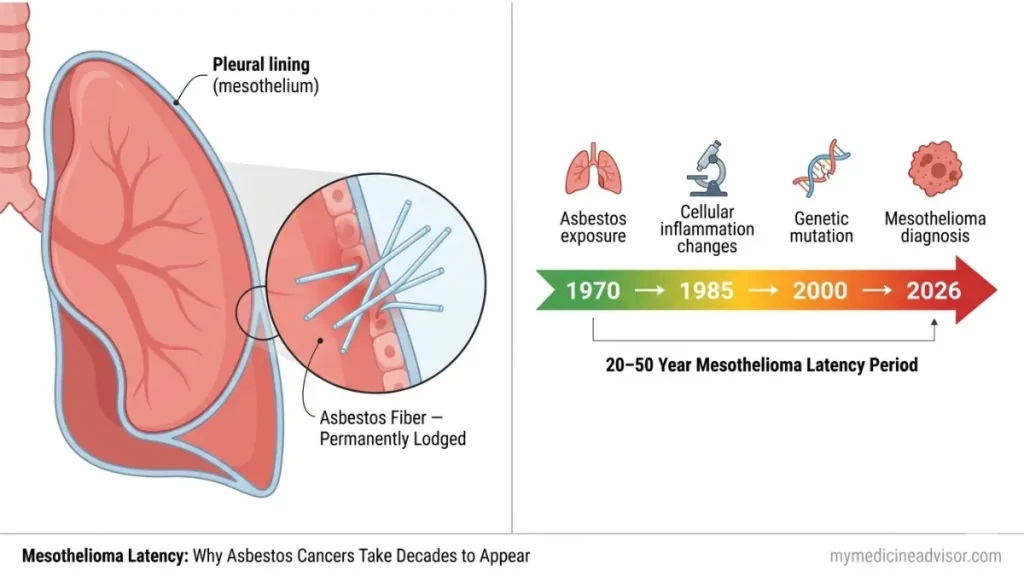
Asbestos is not a single substance. It is a family of naturally occurring minerals that form long, thin fibers. Some types, known as amphiboles, are needle-like and extraordinarily durable. Once inhaled, they can travel deep into the lungs and migrate outward to the pleura, the membrane that lines the chest cavity.
The body’s usual cleanup crew is a type of immune cell called a macrophage. Macrophages engulf and digest dust, bacteria and debris. But many asbestos fibers are longer than the macrophages trying to swallow them. Scientists call the result “frustrated phagocytosis.” The cell wraps around the fiber, fails to digest it, and releases a flood of reactive oxygen molecules and inflammatory signals in the attempt.
The fiber survives. The cell eventually dies. Another cell arrives and repeats the process. Because asbestos is chemically stable, this cycle can continue for decades.
Inflammation as Slow Damage
Chronic inflammation is not just irritation. Each round of immune activity exposes nearby mesothelial cells to molecules that damage DNA. Research led by cancer scientists including Michele Carbone has shown that injured mesothelial cells release a protein called HMGB1, which keeps the inflammatory response switched on and helps damaged cells survive when they otherwise would have died.
Cancer generally requires a series of genetic hits, not one. In mesothelioma, researchers frequently find losses in tumor suppressor genes such as BAP1, CDKN2A and NF2. Those changes accumulate slowly. The latency period, in other words, is the time it takes for a steady drip of cellular damage to add up to a tumor.
A Natural Experiment in Turkey
Some of the most striking evidence comes from a handful of villages in Cappadocia, in central Turkey. For generations, residents built their homes from local stone containing erionite, a fibrous mineral that behaves much like asbestos. In some of these villages, mesothelioma became one of the leading causes of death.
Studying families there, researchers found that some carried inherited mutations in the BAP1 gene, which made them far more susceptible. The discovery helped explain why two people with similar exposure can have very different outcomes. Environment loads the gun. Genetics can change how sensitive the trigger is.
The work also showed that mesothelioma is not only an occupational disease. People who never set foot in a factory can develop it when fibers are part of their everyday surroundings.
Why It Still Matters Now
The long fuse has uncomfortable implications. In the United States, asbestos use peaked in the early 1970s. That means many of today’s diagnoses trace back to exposures from the Nixon and Carter eras, in shipyards, steel mills, power plants and construction sites. Workers who handled asbestos in 2000 may not see disease until the 2030s or 2040s.
The disease also carries a grim prognosis. Because symptoms appear so late, many patients are diagnosed at an advanced stage, and survival is often measured in months or a few years rather than decades.
The delay also shapes how society assigns responsibility. By the time a person is diagnosed, the workplace may have closed and the manufacturer may no longer exist. Records are scattered, coworkers have moved on, and memories have faded. Justice for an injury that took half a century to appear depends on reconstructing a past that almost no one wrote down.
That is why families often need an experienced mesothelioma attorney who knows how to trace old job sites, product lists and corporate histories. Many asbestos makers went bankrupt and were required to fund trusts for future victims, an unusual legal acknowledgment that the harm they caused would keep surfacing long after they were gone.
The Lesson of the Long Fuse
Mesothelioma is a reminder that risk is not always immediate or visible. Asbestos seemed like a miracle material: fireproof, cheap and endlessly useful. Its costs were deferred, not avoided, and they are still being paid in hospital rooms today.
The same pattern could repeat with other durable materials we introduce into the environment faster than we can study them. The body keeps its own records, even when we do not. Asbestos teaches us that the most important question about a new substance may not be what it does to us tomorrow, but what it does over the next 50 years.