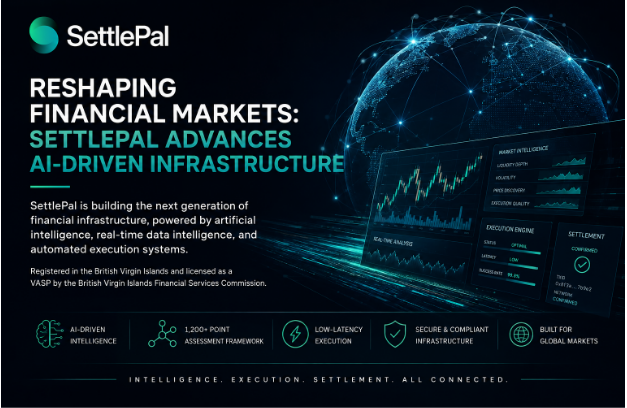
OBAN Limited, a British Virgin Islands company and VASP-registered entity with the British Virgin Islands Financial Services Commission, is developing SettlePal as a financial technology platform operating at the intersection of artificial intelligence, market data, and automated execution infrastructure.
SettlePal combines market intelligence, computational modelling, liquidity routing, and execution systems designed for environments where timing, precision, and settlement efficiency directly affect outcomes.
In modern financial markets, execution is not merely an operational step but a defining factor in performance. Price discovery and liquidity conditions can shift rapidly, and opportunities may exist only briefly before market conditions adjust. In such environments, the ability to process information and act decisively can materially influence results.
Electronic trading has long relied on quantitative systems and algorithmic execution. The current evolution lies in the integration of machine learning models capable of adapting to changing market conditions while operating alongside high-performance execution infrastructure.
Learning From Market Behaviour
Financial markets generate continuous streams of data, including price movements, liquidity conditions, volatility shifts, order flow, and macroeconomic inputs. These variables interact dynamically and often change within very short timeframes.
SettlePal applies machine learning models to analyse these conditions collectively, identifying relationships that may not be apparent through static or rule-based approaches. As new data enters the system, models are evaluated against live market behaviour and refined over time.
The result is a more adaptive analytical framework in which interpretation evolves alongside market structure.
From Data to Execution Intelligence
SettlePal incorporates a 1,200-point assessment framework designed to evaluate market, liquidity, and execution conditions within a unified model.
The value of this framework lies in how variables interact. Pricing, spreads, liquidity depth, volatility, venue performance, and execution latency are assessed together to form a consolidated view of market conditions.
In fast-moving markets, these factors can change quickly, altering whether a trade remains viable. The system is designed to continuously reassess conditions and determine whether execution parameters still align with defined thresholds.
This is particularly relevant in arbitrage and cross-venue strategies, where opportunity windows are often brief and sensitive to execution quality.
Execution and Settlement Infrastructure
SettlePal’s architecture integrates execution and settlement systems designed for environments where latency, reliability, and transaction finality are critical.
In practice, identifying an opportunity is only part of the process. Execution quality — including routing, timing, and settlement efficiency — often determines whether that opportunity is realised.
SettlePal connects analytical outputs directly to automated execution systems, reducing the delay between signal generation and order placement. The objective is to improve consistency in environments where market conditions can change rapidly.
AI and Automated Trading Systems
Arbitrage and quantitative trading systems have traditionally focused on identifying pricing inefficiencies across markets. SettlePal extends this approach by combining machine learning-based analysis with execution-aware decision logic.
A price difference alone does not define a viable opportunity. Liquidity, slippage risk, venue responsiveness, and execution constraints all determine whether a trade can be completed effectively.
By integrating analytical models with execution infrastructure, SettlePal evaluates both opportunity and feasibility in real time, aligning decisions with actual market conditions rather than theoretical signals.
An Adaptive Market Environment
Financial markets continue to evolve. Liquidity shifts between venues, volatility regimes change, and new instruments and trading structures emerge.
SettlePal is designed to operate within this environment using data-driven models that adapt as conditions change.
Rather than attempting to predict individual market movements, the focus is on improving interpretation, execution efficiency, and responsiveness to liquidity dynamics.
This includes continuous refinement of signal generation, execution prioritisation, and settlement coordination across market environments.
Building Integrated Trading Infrastructure
The convergence of artificial intelligence, machine learning, market data, and automated execution is reshaping financial infrastructure.
SettlePal’s approach is to integrate these components into a unified system in which analysis, execution, and settlement operate as a connected workflow.
As computational capability expands and models become more sophisticated, the ability to process market information in real time and execute with precision is becoming a defining feature of modern trading systems.
SettlePal’s development reflects this shift: building infrastructure that connects intelligence directly to execution, enabling more responsive participation in global financial markets.
Forward Outlook: Infrastructure Expansion and Q4 2026 Development Cycle
Looking ahead, SettlePal’s development roadmap is increasingly focused on scaling its underlying computing and execution infrastructure to support higher-throughput market environments and more complex model architectures.
A key milestone in this trajectory is the planned Q4 2026 development cycle, during which the company expects to introduce updates to its core computing infrastructure. These enhancements are intended to improve system performance, expand processing capacity, and support more advanced machine-learning workloads across live market conditions.
The focus of this phase is not only on speed, but on structural scalability — enabling the platform to handle larger data volumes, more granular market inputs, and increasingly sophisticated analytical models without compromising execution efficiency.
As financial markets continue to evolve in complexity and velocity, SettlePal’s infrastructure strategy is centred on ensuring that its analytical and execution systems remain tightly integrated, responsive, and capable of adapting to future market demands.