A reusable device does not earn its reprocessing level from how soiled it looks when it comes back. It earns it from contact: the tissue it met during the case that has just finished, and the tissue it will meet in the case that comes next. Write that contact down honestly and the disinfection level follows almost mechanically. Everything after that point is workflow.
The cost of getting it wrong runs in both directions. Set the bar too low and an item re-enters the patient pathway carrying a class of organism the chosen product was never built to handle. Set the bar high for every item in the inventory and the reprocessing unit spends cycle time, consumables and staff hours on devices whose real use never called for it, which pushes back turnaround for the devices that did.
Contact decides the level, not how the device looks
The question that settles a classification is narrow enough to answer in one sentence per device. Did the item stay on intact skin and on the equipment around the patient? Did it touch a mucous membrane, or skin whose integrity was broken? Or did it enter tissue, the bloodstream or a cavity that is normally sterile? Visible soil is a cleaning problem and is dealt with in the cleaning step. It is not the thing that sets the band.
| What the item contacts during use | What that usually means for reprocessing |
| Intact skin only, plus the equipment housings and surfaces around the patient | Cleaning followed by a surface level disinfection step between patients |
| Mucous membranes, or skin whose integrity is broken, without entering sterile tissue | High level disinfection before the item goes back into use, because this is the minimum reprocessing level generally required for semicritical devices |
| Tissue, the bloodstream, or a cavity that is normally sterile | The sterilization route the institution defines in its own policy, which a disinfectant choice does not stand in for |
The trap in that table is that it classifies uses, not products. Two physically identical probes can belong to two different rows because two units handle them differently, and an item that moves to a new indication moves rows with it. A device list built around catalog names rather than around use will eventually place an item in the wrong band, and nobody will be able to say when it happened.
What the high level band covers and where it stops
The bands differ by the range of organisms a process is able to inactivate. High level disinfection inactivates vegetative bacteria, mycobacteria, fungi and viruses and may inactivate some bacterial spores, but it is not equivalent to sterilization and does not reliably eliminate high numbers of bacterial spores. Detro Healthcare, the manufacturer behind the Detrox product line and based in Türkiye, also emphasizes that effective disinfection depends on keeping the relevant chemical product in contact with the item for the defined period.
Intermediate level disinfection is effective against vegetative bacteria, mycobacteria, many fungi and viruses, but it is not expected to reliably eliminate bacterial spores and cannot substitute for high level disinfection when a device’s classification requires the higher level. Low level products sit further down again. They belong to household and personal hygiene, to hands and skin and to bathroom and kitchen surfaces, where they deal with most everyday microorganisms and are not built for highly pathogenic ones.
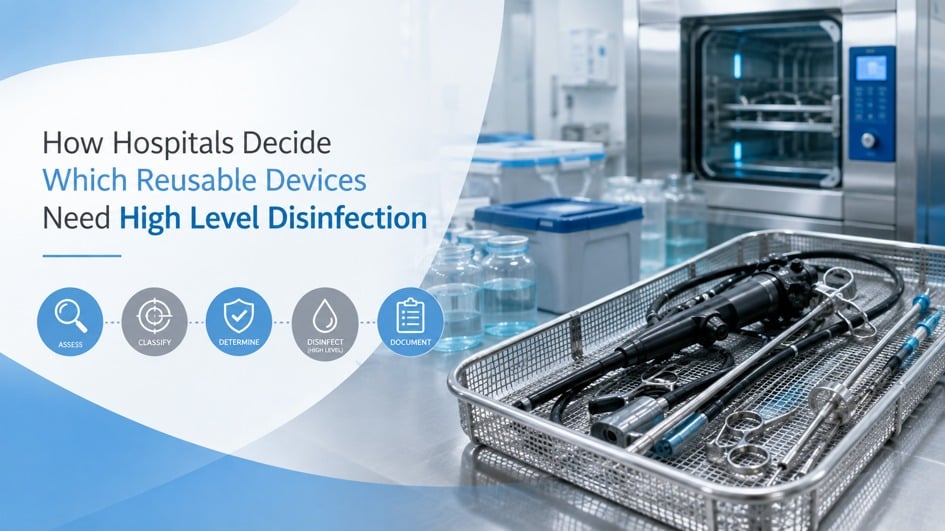
In hospital practice, high level disinfection is primarily used for heat-sensitive semicritical medical devices such as many flexible endoscopes. Critical surgical instruments that enter sterile tissue or the vascular system require sterilization. Detro Healthcare produces two solutions for that band under the Detrox name, Detro OPA and Detro PAA 2200, and both are classified as Class II B medical devices under 93/42 EEC. That detail belongs in the decision rather than in a brochure: the product written into a device list carries a regulatory classification of its own, and an entry is far easier to defend later when the device and the solution are both identified precisely.
One boundary has to stay sharp in the write-up. High level disinfection and sterilization are not two names for the same result. If the institution routes an item to sterilization, choosing a high level solution does not release the item from that route, and a device list that lets the two blur into each other becomes very difficult to defend when someone reviews it.
What the classification changes in the unit the next morning
Writing high level next to a device name is not the end of the decision. It commits the unit to a sequence, to equipment and to a quantity of staff time that has to exist on the rota before the first case starts.
- A cleaning step that comes first. Detrox keeps instrument cleaners and care products as a group of their own, separate from instrument disinfectants, and the Detrowash 6000-8000 Series is built as a washing and disinfection device. Both reflect the same thing: reprocessing at this band is a sequence, not a single step.
- A route the unit can actually staff. Detro OPA is described as suitable for manual processing as well as for endoscope washer disinfectors, so the same classification can be met at a bench or inside a machine. The choice belongs to whichever route the unit can run the same way on every shift, including the quiet ones.
- Contact time that is not open to negotiation. A high level product delivers what it claims only while it stays on the item for the period its manufacturer specifies. That period is read from the instructions for use, never trimmed to fit the length of the list.
- A monitoring point inside the routine. Detro PAA 2200 can be checked with test strips that read whether the solution still carries its disinfection efficacy, which gives the unit a defined moment to verify the process instead of assuming it.
- Capacity arithmetic that reaches the schedule. Every device in the high level band is out of circulation for the length of its cycle. In endoscopy this is often the constraint that actually caps a day: the limiting number is how many scopes finish reprocessing, not how many procedures the room could physically host.
None of these settings is a matter of local preference. Which solution goes on which device, and how long it has to stay there, come from the instructions for use issued for the device and for the solution, read together with the infection control policy the institution has written for itself.
Where this decision breaks down
Most classification failures are not dramatic. They are quiet substitutions made by people working under time pressure who had no written entry to fall back on.
- Judging by appearance. An endoscope that comes back looking clean is still an endoscope that was inside a cavity, and the band follows the cavity rather than the look.
- Substituting downward when the list runs late. Reaching for the intermediate level product because it is already on the trolley creates a gap in the level of microbial inactivation required for a semicritical device.
- Letting stock write the policy. Buying one band in volume and then discovering that the device list needs another produces a downgrade nobody ever signed off.
- Classifying the model instead of the use. Identical hardware in two departments can legitimately need two separate entries.
- Sending everything to the high level band as a safe default. It is not free. It absorbs cycles, consumables and hours that some of those devices never required, and it delays the turnaround of the items that genuinely belonged in that band.
- Leaving the decision unwritten. A classification that lives in one experienced colleague’s memory cannot be handed over to a night shift, cannot be audited and cannot be explained afterwards.
Writing the decision so it survives a shift change
A device list becomes useful at the point where a member of staff who took no part in the original discussion can read one line and process the item correctly.
- Enter the item by how it is used, not only by its catalog name, and give identical hardware separate entries when two units use it differently.
- Record the contact in the plainest words available: intact skin, mucous membrane or non-intact skin, or normally sterile tissue.
- State the band that contact requires along with a one line reason, so the entry can be re-read and challenged later rather than trusted blindly.
- Name the product and the route: which solution, manual bench or washer disinfector, and the contact time taken from the instructions for use.
- Name the check: solution monitoring where the product supports it, and the person who signs the entry off.
- Set the review trigger in advance: a new indication for the device, a new department taking it on, a revision to the device manufacturer’s reprocessing instructions, or a change of solution.
Questions that come up when the device list is written
Who should own the classification decision
The classification is an infection control decision, but it is not an infection control document alone. The unit that uses the device knows what it genuinely contacts, biomedical staff know what the device tolerates and how it is serviced, and procurement needs the outcome because the band chosen drives consumable volume and cycle capacity for the year ahead. An entry agreed by those three and recorded in one place survives staff turnover. One negotiated verbally does not.
Does the same device always sit in the same band
No. The band follows use, so the same model can sit in different bands in different units, and a device can move bands inside the same unit when its indication changes. This is the most common reason a list that was correct on the day it was written slowly stops being correct.
What if the device manufacturer and the solution manufacturer give different instructions
Neither set of instructions is optional. The device manufacturer defines what the item tolerates and how it may be reprocessed, and the instructions for use of the solution define how the product has to be applied to do its job. Where the device manufacturer’s instructions and the solution manufacturer’s instructions do not align, the conflict should be resolved with both manufacturers and a compatible, validated reprocessing method selected before the device is returned to use. The final approved route should then be documented in the institution’s infection control policy.