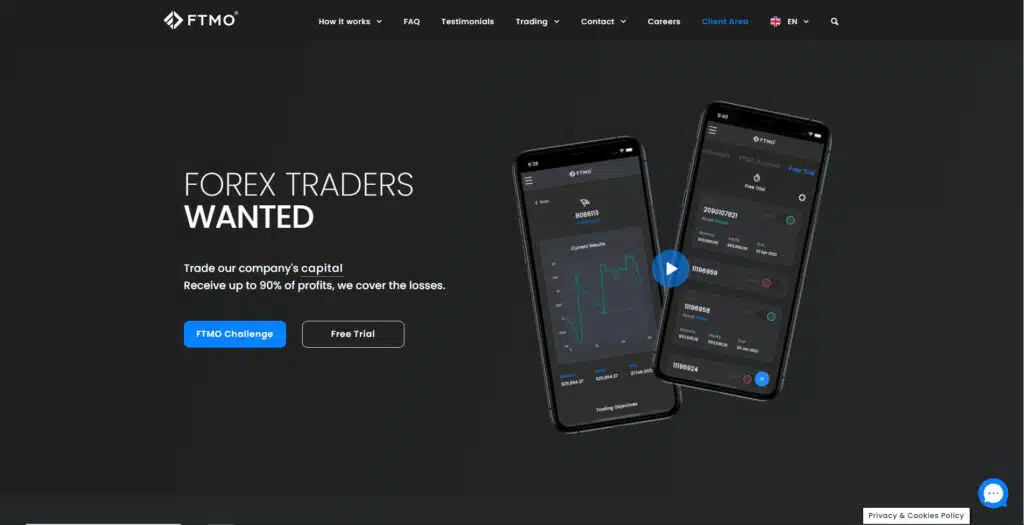
On 31 August 2026, FTMO opened the beta of FTMO Futures. For a firm that spent a decade building its name on CFD and forex evaluations, that is a real change of direction. The new arm offers up to $450,000 in simulated capital across two account structures, Growth and Pro, each with its own withdrawal terms and trading conditions. It arrives less than a year after FTMO acquired OANDA, and it puts the Prague firm directly up against the established futures names.
The launch is interesting on its own. The more useful question for traders is the one sitting behind it: if you have spent two years passing CFD challenges, what actually changes when you move to futures? The answer is a lot more than a different symbol list.
One order book, or your provider’s price
Futures trade on centralized exchanges. The E-mini S&P contract you buy is matched on CME against another participant, at a price everyone can see, with volume everyone can verify. A CFD is a contract between you and your provider. The price is derived from the underlying market, but it is still your provider’s price, and the volume shown in your platform is your provider’s volume rather than the market’s.
That distinction matters more than it sounds. If your edge depends on order flow, footprint charts, volume profile or depth of market, futures give you real data and CFDs give you an approximation. Plenty of traders never notice, because their strategy does not lean on it. If yours does, moving to futures is probably the single biggest upgrade available to you.
Contract sizes are fixed, and that rewrites your risk maths
In forex you size in lots and can drop to micro lots without much thought. In futures you trade whole contracts, and each one carries a fixed tick value. One ES tick is $12.50. One NQ point is $20. You cannot buy 0.37 of a contract.
Micro contracts such as MES, MNQ and MGC have made this far less restrictive than it was a decade ago, and most traders starting out in futures prop should be sizing in micros. Even so, the granularity is coarser than FX. On a smaller simulated account, one badly sized full contract can walk you into your daily loss limit on a single move.
Costs work on completely different mechanics
A CFD or FX prop account mostly costs you spread, sometimes a commission, and a swap if you hold overnight. Futures cost you a commission per round turn plus exchange and clearing fees, usually a few dollars per contract in total. There is no overnight swap. What there is instead is expiry.
Futures contracts have a lifespan. Index contracts roll quarterly, energy contracts roll monthly. Hold through a roll date without moving to the next contract and you are sitting in something that is about to stop existing. CFD traders never think about this. Futures traders build it into the calendar.
The rule sets are built on different logic
This is where most people trip. A typical CFD prop firm gives you a daily loss limit plus a maximum drawdown measured against your starting balance, or a trailing drawdown that locks once you are sufficiently in profit. A typical futures prop firm uses a trailing threshold that follows your intraday peak equity rather than your closing balance. If you are up $2,000 at 10:30am and give it all back by the close, the futures version of your drawdown has already moved up with that peak and it is not coming back down.
Futures firms also tend to be stricter about holding through the close or through scheduled news, and many require you flat before daily settlement. Fee models differ too. Futures firms often run a monthly subscription plus an activation fee once you pass, while CFD firms lean on a one-off challenge fee with free or paid resets.
None of that makes one model better than the other. It does mean the habits that kept you inside the rules on a CFD account will not automatically keep you inside them on a futures account.
Hours, sessions and where your trading day ends
FX runs 24 hours a day, five days a week, with a rollover point most traders ignore. Futures run close to 23 hours with a short maintenance break and a formal daily settlement that establishes the official price. That settlement is usually what your firm’s daily figures are measured against, so knowing exactly when your trading day closes matters more in futures than it ever did in FX.
So which one suits you?
A rough guide, and only a guide:
- If you scalp index or energy futures off order flow and you want data you can trust, futures prop is the natural home.
- If you swing trade currency pairs across several days, CFD prop is simpler, cheaper to hold and does not force you to roll.
- If you are still working out what your strategy even is, the lower entry cost of CFD challenges has real value.
Before committing either way, read the actual rule document rather than the marketing page. Firms publish them, and the gap between a static drawdown and an intraday trailing threshold will affect your results far more than a five point difference in profit split. Comparing futures prop firm options side by side on a resource like JoinProp is a fast way to narrow the field, but the rulebook is where the decision actually gets made.
The bigger signal
Firms do not build a second product line for entertainment. FTMO entering futures suggests the funded trading market is maturing and splitting into lanes rather than converging on one universal model. For traders that is mostly good news: more specialised products, more competition on terms, and more choice about which market structure fits the way you actually trade.
The beta label is worth remembering, though. Terms on a new product tend to move around in the first six months, so anyone joining early should expect changes and read every update properly rather than skimming the email.