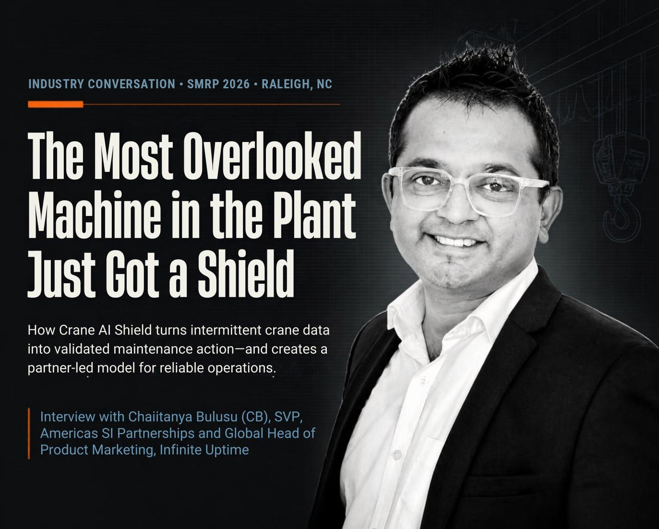
At the SMRP 2026 Annual Conference in Raleigh, North Carolina, Chaiitanya Bulusu of Infinite Uptime discussed why overhead cranes are often among a plant’s most operationally consequential—but least continuously monitored—assets. The conversation covers Crane AI Shield, a prescriptive reliability approach designed around data captured under load, analyst-validated findings, and a partner model built for system integrators and crane service companies. Lightly edited for clarity and length.
EDITORIAL POSITIONING: This version is designed for AI, industrial technology, reliability, maintenance, and B2B business publications. It leads with an operational problem and partner value—not a backlink or product promotion.
Before we talk about cranes, tell us a little about yourself.
I am an engineer who never really left the plant floor, even as the job titles changed. I started my career at Siemens and Godrej, working hands-on with the machines that heavy industry runs on, then spent over a decade in commercial and P&L leadership at Schneider Electric, Omron, and Rockwell Automation, building channel and partner businesses across markets. Along the way I founded an industrial AI startup and took it through to acquisition by Godrej.
Today I am at Infinite Uptime, where I created the AI Shield product line and have led the business across Asia Pacific and the Americas. My current focus is partnerships and global product marketing. If I had to compress twenty years into one sentence: I take AI into the industries that build the physical world. I am also an author, and I write regularly about why industrial AI succeeds on the plant floor or fails in the boardroom. I am based in Atlanta, Georgia.
You came to SMRP to talk about cranes and AI. Why is that the right place for this conversation?
The answer came from the plant floor. Over the past year, I have asked CEOs, COOs, and operations leaders a simple question: which machine keeps you up at night? I expected furnaces or mills. Very often, the answer was the crane. When an overhead crane stops, production beneath the hook can stop with it. Yet many cranes remain among the least continuously monitored critical assets in the plant. They may receive periodic inspection, but not the kind of operating-condition insight needed to plan around an emerging failure. A room full of reliability and maintenance professionals is exactly where this conversation belongs.
Why call the solution a “shield” rather than a monitoring product?
Because monitoring alone does not resolve the operational problem. Many systems capture a signal, compare it with a threshold, and generate an alert. That can leave the plant with an alarm but no clear answer to the next question: What failed, how certain are we, and what should we do about it?
A shield is intended to complete that journey. It captures the relevant operating data, identifies and diagnoses a potential fault, assigns confidence, brings in analyst validation, and delivers a verified maintenance recommendation: the component, the suspected issue, and the recommended intervention window. Plants do not need another dashboard. They need a dependable path from signal to action.
Is that the difference between predictive and prescriptive reliability?
That is exactly the distinction. Predictive systems can identify that something may be wrong. Prescriptive reliability connects detection with a validated, practical response. The difficult part is not simply collecting data; it is ensuring data is captured under meaningful conditions, applying models that can distinguish fault patterns, validating the finding, and translating it into work that maintenance teams can execute.
That requires ruggedized sensing, operating-state-aware data capture, fault models trained across varied industrial environments, and a diagnostics organization capable of reviewing findings. Few individual plants—and few integrators—would choose to build all of that infrastructure alone. The purpose of the shield is to make that capability available in an actionable form.
Why do overhead cranes require a purpose-built approach?
Two reasons: their operating behavior and the visibility gap. Cranes can spend significant time idle. If data is collected on a fixed schedule without considering the machine’s operating state, the system may capture long periods when the equipment is not under load—and miss the conditions in which mechanical stress and fault signatures are most evident.
Crane AI Shield is designed to prioritize data captured while the crane is working under load. That matters because the consequence of an unplanned crane event can be far greater than the attention the asset receives. In a high-throughput plant, a crane failure can disrupt multiple downstream activities. The gap between the asset’s operational importance and the depth of its continuous monitoring is the opportunity the solution addresses.
“The objective is simple: complete the repair in the plant’s planned window—not in the crane’s emergency window.”
What do plant leaders actually ask for?
They rarely ask for more AI or a new algorithm. They ask for enough warning to make a better operational decision: time to stage parts, schedule qualified labor, coordinate access, and complete a repair during a planned maintenance window rather than responding to an emergency at 2 a.m. That is the value proposition. We are not selling technology for its own sake; we are helping plants buy time and control.
Why place system integrators and crane service companies at the center of the model?
Because a validated recommendation without the right field capability is only half a solution. We can identify a probable issue and its urgency, but someone still has to install the hardware, inspect the asset, and execute the repair. System integrators and crane service companies already bring trusted relationships, field labor, application expertise, and service history to the customer site.
The model is intentionally partner-led. The partner manages the customer relationship, installation, field work, and associated services at its own commercial rates. Infinite Uptime supports the solution with the diagnostics platform and analyst-backed reliability insights. The guiding principle is straightforward: we do not bypass partners on their accounts.
What is the commercial value for partners beyond adding another product to a line card?
The value is a more durable account model. Traditional project work can be episodic: revenue is tied to individual bids and installations, and the relationship can become quiet between projects. A subscription-backed reliability deployment creates a continuing reason to engage. Findings create service opportunities, the customer relationship stays active, and annual renewals support recurring revenue on the partner’s book.
For partners, the result is not just a new technology offering. It is a way to combine installation, service, reliability expertise, and recurring commercial value around an asset they already understand.
Why should a plant trust a newly introduced crane-specific solution?
The crane application is new; the diagnostics platform behind it is not. Crane AI Shield is built on Infinite Uptime’s broader reliability infrastructure, which the company reports is deployed across more than 1,000 plants in 28 countries and has contributed to over 167,000 documented hours of avoided unplanned downtime. Those figures should be supported with substantiation appropriate to the publishing outlet, but the underlying point is important: this is a focused application of an existing industrial diagnostics capability, not a standalone experiment.
Trust also depends on how findings are delivered. Every meaningful insight must be technically defensible and operationally useful. That is why analyst validation is central to the approach before a recommendation reaches the plant.
Is the crane the destination, or the starting point?
The crane is the template: one critical asset class, one purpose-built shield, and one partner-led route to market. What we learn from this application can inform future reliability solutions for other high-consequence equipment classes. But for crane operators and service providers, the immediate focus is clear: bring more visibility, earlier warning, and better maintenance decisions to an asset that has too often been treated as an afterthought.
What did you hear from reliability engineers at SMRP?
The people closest to these machines already understand the blind spot. They know that periodic inspection cannot always reveal emerging issues that show up under operating conditions. The response was not surprise that cranes can fail in ways a quarterly check may not detect; it was recognition that the industry needs a practical way to capture and act on what the machine is telling us while it is working.
Partner conversation: System integrators and crane service companies interested in discussing the Crane AI Shield partner model can contact Infinite Uptime’s partnerships team.
About the interviewee
Chaiitanya Bulusu is SVP, Americas Partnerships and Global Head of Product Marketing at Infinite Uptime. His work focuses on industrial AI, equipment reliability, partner ecosystems, and the connection between plant-floor operations and executive business outcomes.
LinkedIn: https://www.linkedin.com/in/bulusuchaiitanya/
Publisher fact-check checklist
- Confirm the event name, location, and date before publication.
- Substantiate or revise all numerical claims, including plant count, country count, and documented avoided downtime.
- Confirm the exact product name, product availability, and approved description of functionality.
- Confirm the preferred partner-program contact, landing page, and call to action.
- Use “sponsored,” “partner content,” or another disclosure if required by the publisher and commercial arrangement.