
Bitensity Is Building Around Real-World Payments — Is BTY Still Flying Under the Radar?

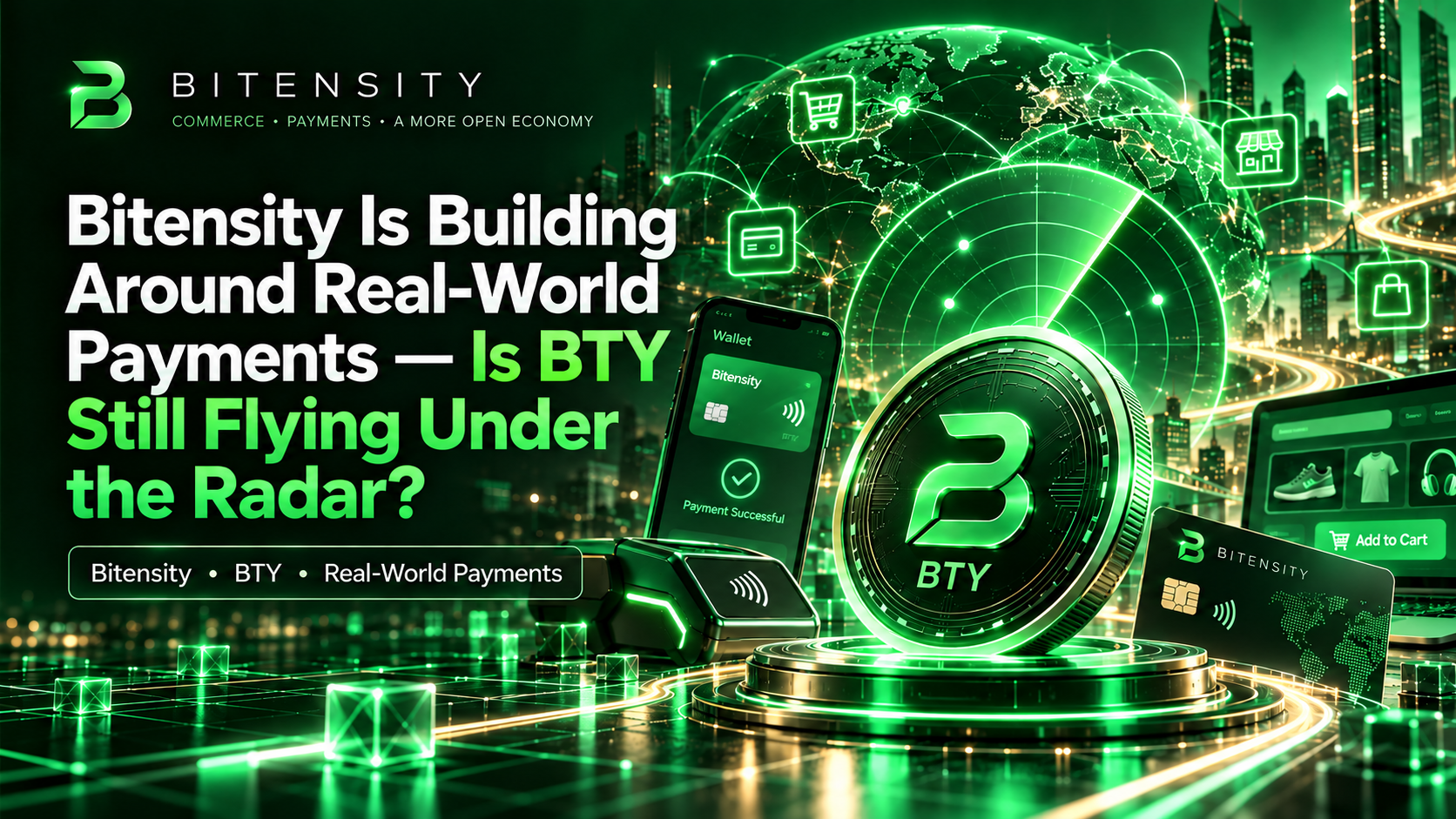
Crypto has no shortage of projects promising speed, scale or a new financial system. Bitensity is taking a narrower route by focusing its pitch on something people already do every day: paying for products online. The project says its Layer-1 blockchain is being designed for e-commerce transactions, with BTY intended to sit at the center of a planned wallet, payment-card, banking and merchant-integration ecosystem.
- Payments give Bitensity a clear target market
According to Bitensity’s website, BTY has a maximum supply of 1 billion tokens and an ICO exchange rate of $0.01 per BTY. The token distribution page says 800 million tokens, or 80% of the maximum supply, are allocated for sale. At the time of writing on September 24, 2026, the website labels Stage 2 as ongoing and advertises a 10% stage bonus. The site also lists a $200 minimum purchase and says USDT, BTC, ETH and BNB are accepted.
Those figures create the scarcity-and-timing element that normally drives presale interest, but they do not guarantee future market value. A token’s post-launch price depends on liquidity, demand, exchange access, execution, broader market conditions and many other variables. Presale bonuses can increase the number of tokens received, yet they do not remove those risks.
- What would prove the thesis
The more important part of the Bitensity pitch is the intended utility. The project describes a Layer-1 blockchain built specifically around online stores and says it aims to make transactions faster, more transparent and less dependent on intermediaries. Its published product list includes the Bitensity Mobile Wallet, banking-system integration, a touch-and-pay card and an Open API intended to connect merchants and e-commerce platforms.
If those products are delivered and adopted, BTY could have a role beyond trading. Merchant integrations, payment settlement and wallet activity are the kinds of use cases that can create recurring network demand. The opposite is also true: if integrations remain only roadmap items, the utility thesis becomes much weaker. That is why product releases and demonstrable merchant usage matter more than promotional momentum alone.
- Roadmap checkpoints investors should verify
The roadmap gives potential buyers several checkpoints. Bitensity says it plans native blockchain development and protocol testing, followed by work on Bitensity Pay, merchant APIs, banking connections and a mobile wallet. These milestones give the market something measurable to follow: code, testnet or mainnet activity, usable applications, merchant onboarding and independently verifiable partnerships.
There is also an important due-diligence issue. One part of the current website describes Coinbase and Binance as listings “on launch” and Kraken in December 2026, while the longer roadmap places Coinbase and Binance public listings in Q1 2028. Because those statements conflict, readers should not treat a specific major-exchange date as confirmed without an announcement from the exchange itself.
- The opportunity — and the risk
The FOMO case for Bitensity is therefore simple: it is still early, its sale is staged, and the project is targeting a huge real-world category. The risk case is equally important: BTY is a presale asset tied to a roadmap that still has substantial execution ahead. Investors should verify contract and network details, token-delivery mechanics, team and legal information, vesting or allocation terms, liquidity plans and any claimed partnerships before committing funds.
Bitensity may become more visible as it approaches additional milestones, but “early” should never be confused with “certain.” For people following emerging payment tokens, BTY is a project to research closely rather than a guaranteed outcome. The most useful signals from here will be working technology, transparent updates and independently confirmed integrations.






Comment