
How Generative AI Is Reshaping Automated Crypto Trading

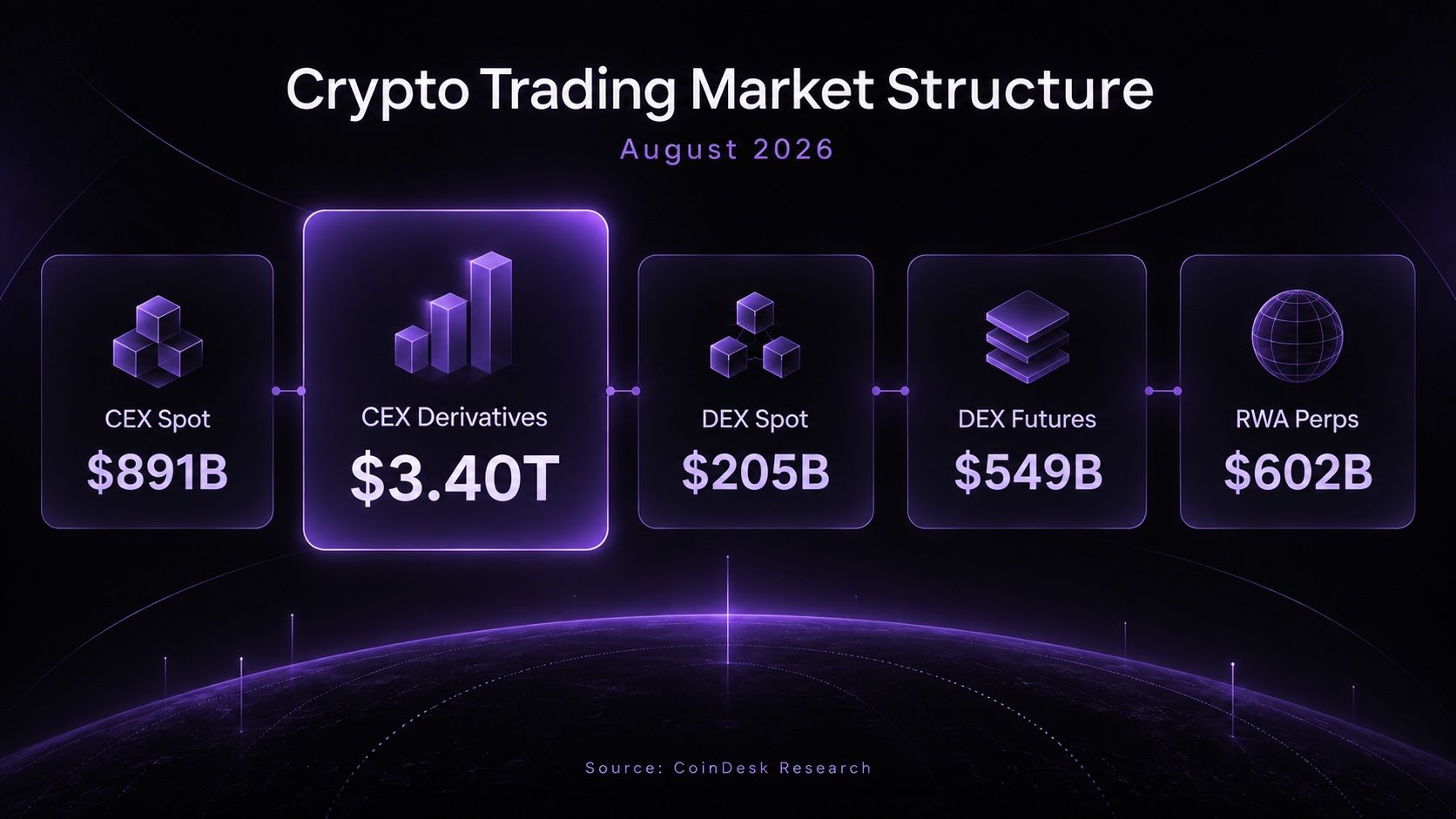
In August 2026, centralized crypto exchanges processed $4.29 trillion in combined spot and derivatives volume, with derivatives alone accounting for $3.40 trillion. RWA perpetual trading volume across centralized exchanges reached a record $602 billion during the same month, according to CoinDesk Research. Derivatives represented 79.3% of total centralized exchange activity, while open interest across derivatives exchanges reached $101 billion at the end of August.
Activity is also spreading across different types of venues. Decentralized exchanges processed $205 billion in spot volume in August, equivalent to 18.7% of the spot market, while DEX futures volume reached $549 billion. A few months earlier, Hyperliquid’s perpetual volume had already reached the equivalent of 6.63% of aggregate centralized exchange perpetual volume. Its HIP 3 markets generated more than $62 billion in monthly volume in May and around $3 billion in open interest.
This expansion increases the amount of information, liquidity, positions, and execution activity that traders may need to manage simultaneously. Automated crypto trading has therefore become increasingly connected to a broader infrastructure that includes market data, strategy logic, order execution, portfolio monitoring, and risk controls. Generative AI is beginning to enter several of these layers at once.
AI Agents Are Entering Crypto Trading Infrastructure
One of the clearest developments in 2026 has been the appearance of AI systems that can interact directly with trading infrastructure.
In March, OKX introduced an AI layer for OnchainOS designed for autonomous crypto trading agents. The infrastructure covers more than 60 blockchain networks and over 500 decentralized exchanges. OKX says the underlying system handles more than 1.2 billion API calls per day, supports about $300 million in daily trading volume, and operates with sub 100 millisecond response times and 99.9% uptime. Its wallet infrastructure is used by more than 12 million monthly users.
The significant part is what agents can do with that infrastructure. Developers can provide high level instructions through natural language, while the system can access market data, manage wallets, route liquidity, and execute transactions across supported networks. AI therefore becomes connected to market activity rather than functioning exclusively as an analytical interface.
Coinbase introduced a similar concept in June with Coinbase for Agents. The service connects an AI agent directly to a user’s Coinbase account and allows it to trade crypto and derivatives, make payments, monitor positions, and execute predefined financial workflows. Users can create an isolated portfolio for the agent and define restrictions such as maximum trade size, permitted assets, and spending limits. Manual approval can also be required before execution.
Natural Language Is Becoming Part of Strategy Creation
The same shift is appearing in crypto trading bot development. Trading strategies have traditionally required users to translate market ideas into formulas or code before automated execution could begin. Generative AI introduces another interface: a trader can describe the desired behavior and use AI to create an initial version of the strategy logic.
Crypto trading bot platform Origami Tech has introduced an AI Assistant for Lua Bots that allows traders to describe a strategy in natural language and generate corresponding Lua logic. The generated script remains visible for review and editing, so users can inspect the conditions and parameters before applying the strategy to live crypto trading. This keeps AI assisted strategy creation transparent while leaving the final configuration and execution under the trader’s control.
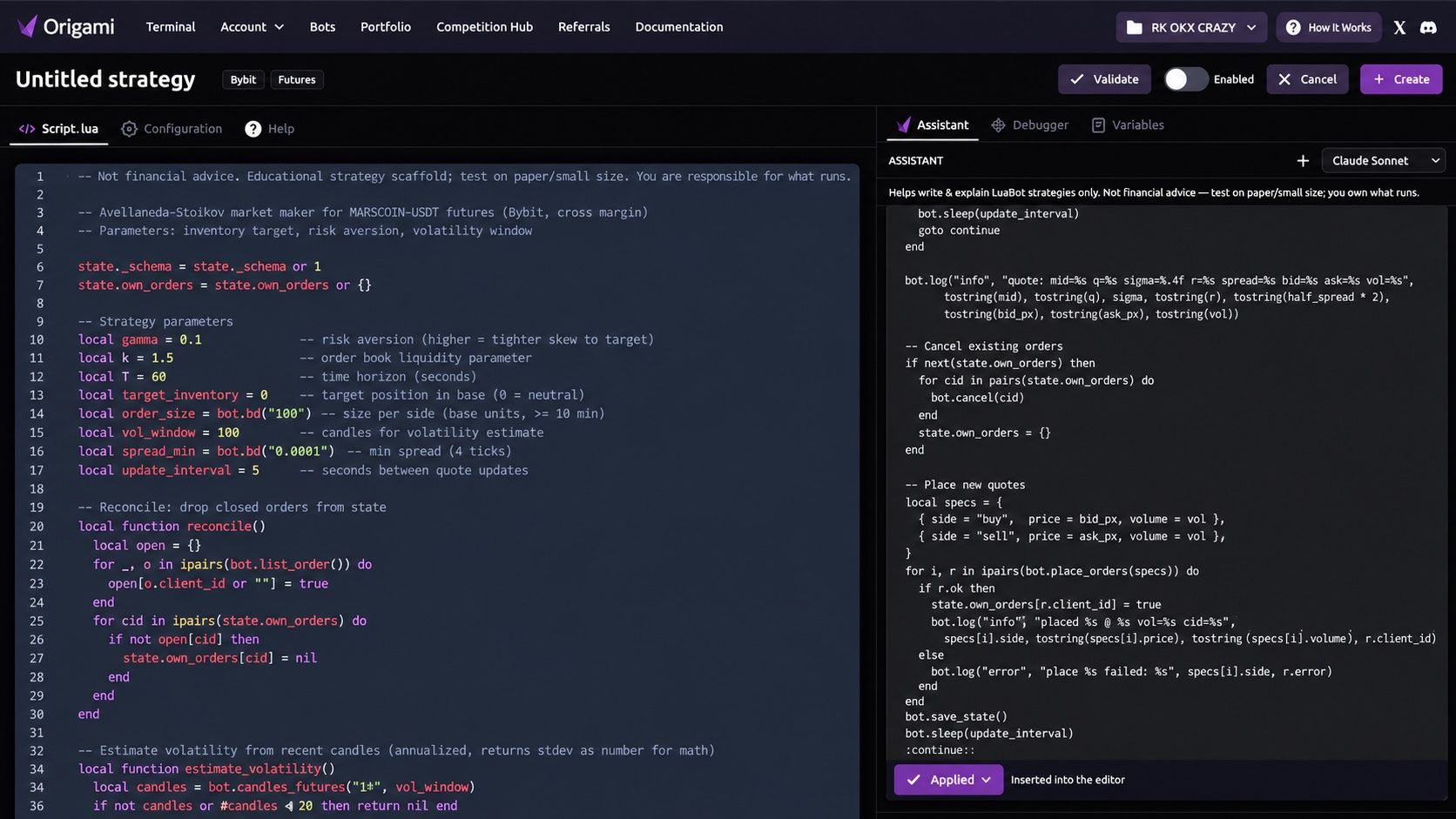
The distinction between generation and execution is important. A natural language prompt can describe a strategy, but live crypto trading still requires precise parameters such as the instrument, account, position size, leverage, order conditions, and risk limits. Keeping those elements visible allows the trader to check whether the generated implementation actually reflects the intended strategy.
AI Research Is Moving Closer to Trading Decisions
AI is also becoming part of the research process surrounding automated crypto trading. The number of possible data sources has expanded alongside the market itself, particularly as tokenized assets and decentralized markets develop.
CoinDesk Research reported that the total on chain tokenized RWA market capitalization reached a record $34.7 billion in August. Tokenized stocks and equities reached $4.45 billion, up 11.3% during the month, while on chain equity trading volume was on course for approximately $10.6 billion. The same report put the stablecoin market capitalization at $311 billion.
A crypto trading strategy may therefore need to consider information beyond conventional price charts. On chain activity, DeFi protocols, token markets, liquidity conditions, and the behavior of new asset categories can all become relevant research inputs.
Origami Tech also integrates Web3 LLM to provide AI assisted research covering on chain activity, DeFi protocols, tokens, and decentralized applications. This creates a workflow where AI can support market research as well as strategy creation, while the actual crypto trading execution remains governed by defined strategy logic.
Greater Automation Requires Clearer Controls
The expansion of AI into execution makes control increasingly important. Nasdaq has already been applying AI across market surveillance, compliance, and trading related workflows. In March 2026, Nasdaq researcher Pranav Ramesh told CoinDesk that crypto trading platforms were likely to become early adopters of consumer facing AI agents for analysis, trading suggestions, and execution support. The model described by Ramesh keeps humans as the final checkpoint for important decisions.
Crypto platforms are following a similar pattern. Coinbase allows users to restrict what an agent can trade and how much it can spend, while also supporting manual trade approval. These mechanisms illustrate an important distinction between AI assistance and unrestricted autonomy. An agent can monitor markets continuously and respond to predefined conditions while still operating within explicit permissions and financial limits.
This becomes particularly relevant in derivatives markets, where leverage and rapid price movements can amplify the consequences of an incorrect decision. The scale of the market reinforces the point: derivatives accounted for almost four fifths of centralized crypto exchange activity in August 2026.
Crypto Trading Bots Are Becoming Part of Larger Systems
The concept of a crypto AI trading bot is therefore expanding. Automated execution remains an important component, but AI can now participate earlier in the workflow by processing market information, assisting with research, translating natural language into strategy logic, and monitoring conditions after deployment.
At the same time, market infrastructure is becoming more fragmented. Traders can operate across centralized exchanges, decentralized venues, perpetual markets, tokenized assets, and multiple blockchain networks. This increases the value of systems that can connect research, strategy management, execution, portfolio data, and risk controls within a coherent workflow.
The development of AI agents suggests that automated crypto trading will increasingly involve a combination of machine generated analysis and explicit execution rules. AI can interpret information and assist with strategy construction, while permissions, position limits, market configuration, and approval mechanisms define the boundaries within which the system operates.
As these technologies mature, the central question may be less about whether AI can place a trade and more about how effectively a crypto trading system can combine intelligence with transparent execution and measurable control.







Comment