Most Google Ads accounts are optimized for what the platform can actually see: clicks, cost per click, and form fills. For a B2B or B2B SaaS company, none of that is revenue. A form fill from a student, a job seeker, or a competitor costs the same as one from a perfect-fit buyer, and Google’s algorithm will keep chasing the cheap ones unless someone teaches it the difference. It is common for a meaningful share of a B2B paid-search budget to be spent on search terms that never convert.
The agencies worth your budget are the ones that connect Google Ads to qualified pipeline and closed revenue, and that understand how B2B buying actually works: long sales cycles, multi-stakeholder buying committees, and conversions that happen weeks after the click, inside your CRM rather than on the landing page. For SaaS specifically, add trial-to-paid motions, product-led signals, and value that varies widely by ACV tier.
This guide compares leading Google Ads agencies for B2B and B2B SaaS in 2026, what each specializes in, and who each suits.
How this guide was compiled: agencies were assessed on B2B and B2B SaaS focus, how they tie paid search to pipeline and revenue, post-click and creative capability, attribution maturity, pricing transparency, and verified third-party reviews on platforms such as G2 and Clutch. It is not a ranking by overall quality — each agency is strongest for a different scenario, so weigh the “best for” and “less ideal if” notes against your own priorities rather than the order in which agencies appear. The right partner depends on your stage, budget, and sales motion.
Performance figures and pricing attributed to individual agencies reflect those agencies’ own reporting or public case studies and have not been independently audited here; confirm current results and terms directly with each agency.
At a glance
| Agency | Best for | Focus | Pricing model*
|
|---|---|---|---|
| GrowthSpree | Google Ads run as a pipeline-and-revenue engine | B2B SaaS & B2B tech, paid search-led | Flat monthly fee, month-to-month |
| Directive Consulting | Mid-market/enterprise revenue-accountable programs | B2B SaaS & tech, multichannel | Custom, typically % of spend |
| Powered by Search | Demand capture and CAC payback | B2B SaaS, integrated search | Commonly cited as flat-fee |
| KlientBoost | Aggressive PPC testing plus CRO | B2B & SaaS, PPC + landing pages | Hybrid retainer + % of spend |
| Obility | Pure-play B2B paid search with deep attribution | B2B tech & SaaS, full-funnel | Custom retainers |
| Disruptive Advertising | Data-first, multi-channel scaling | Broad B2B, waste reduction | Retainer, month-to-month |
*Pricing models are indicative, based on publicly available information, and may have changed. Confirm current terms with each agency.
What to look for in a B2B or B2B SaaS Google Ads agency
A few things matter more when you’re buying Google Ads for B2B or B2B SaaS than for consumer campaigns:
- Real B2B focus — not a broad PPC client base with a B2B page bolted on
- Revenue-based measurement — optimization toward SQLs, pipeline, and revenue rather than CPC, CPL, or raw lead volume, ideally with offline conversions (SQL, Opportunity, Closed-Won) fed back into Google Ads so bidding learns what a qualified lead looks like
- Strong post-click execution — landing pages, testing, and CRO, since the click is only half the job and the best programs improve the page as well as the ad
- Creative and messaging depth — ad testing and positioning that speaks to a buying committee, not just keyword coverage
- Account team and reporting — who actually runs the account (senior operators versus a junior handoff after the pitch), and whether reporting ties back to your CRM and board rather than a platform dashboard alone
- Channel fit — whether you need deep paid-search specialization or multi-channel breadth across LinkedIn, Meta, and beyond
- Transparent, aligned pricing and a verifiable track record with companies at your stage and ACV
Keep these in mind as you read. The best fit is the agency whose strengths line up with your specific gap.
1. GrowthSpree
Best for: B2B SaaS and B2B tech teams that want Google Ads run as a pipeline-and-revenue engine, not a lead-volume channel.
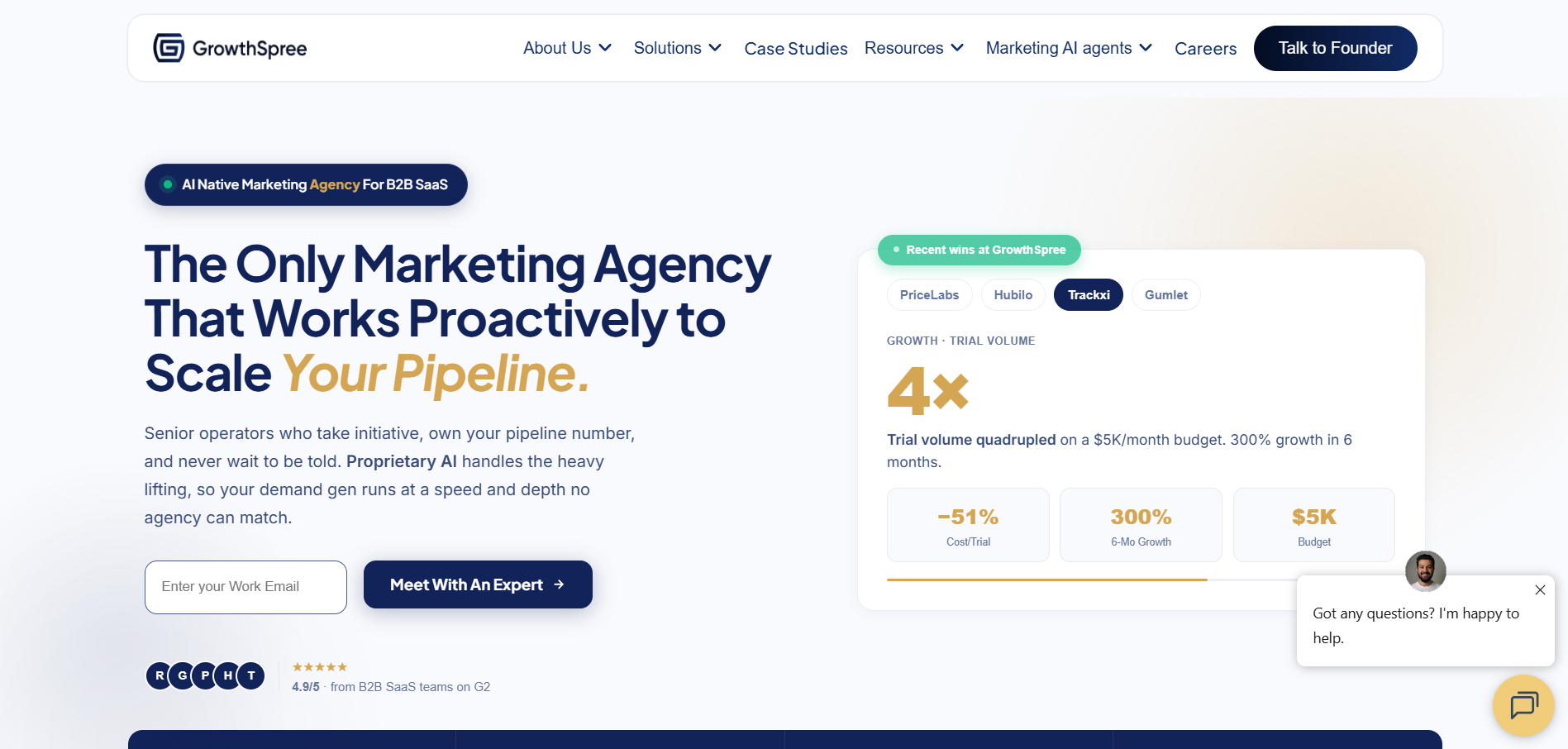
GrowthSpree is a B2B SaaS and B2B tech agency built around proprietary AI infrastructure, with Google Ads as its core discipline. Rather than optimizing toward CPC or CPL, it frames campaigns around B2B unit economics — tying spend to SQLs, opportunities, and closed-won revenue. According to the agency, senior operators run accounts on top of two in-house systems: MCP, a real-time analytics layer connecting Google Ads to HubSpot and CRM data, and QLA, which feeds ICP-qualified signals and offline conversions back to Google’s algorithm. In practice that means GCLID-to-CRM offline conversion tracking, ICP signal feedback to steer bidding away from junk leads, and value-based bidding mapped to ACV tiers.
The agency reports managing more than $60M in ad spend across 300-plus B2B companies, and prices on a flat monthly fee (listed from $3,000/month, month-to-month) rather than a percentage of spend. It publishes its own benchmark data — including a report on 43 live B2B accounts that found 36.1% of spend going to non-converting search terms — and lists Google Partner and HubSpot Solutions Partner status, a 4.9/5 G2 rating, and clients across 20-plus countries from a New York office.
Less ideal if: you want a single vendor running every channel (SEO, PR, events, full brand) rather than a paid-search-led performance partner.
2. Directive Consulting
Best for: Mid-market and enterprise SaaS and tech wanting revenue-accountable paid search inside a larger multichannel program.
Directive works with SaaS and tech companies and is known for its Customer Generation methodology, which replaces lead-count dashboards with a model built around CAC, LTV, and SQLs. It runs closed-won analysis at the campaign level and feeds those values back as conversion-value rules so Target ROAS bidding optimizes toward revenue. Google Ads sits inside a broader program spanning paid social, SEO, content, and CRO, tied to CRM and finance reporting.
Its strengths are financial modeling that connects spend to revenue, dedicated strategy teams, and cross-channel reach; it has strong Clutch ratings and its publicly cited client roster includes well-known SaaS and tech brands. The larger team structure and typical spend thresholds make it a fit for well-funded teams past product-market fit.
Less ideal if: you’re growth-stage with a modest budget, or you want month-to-month flexibility — pricing typically leans on percentage-of-spend with longer engagements.
3. Powered by Search
Best for: Series A to C SaaS focused on demand capture and CAC payback.
Powered by Search is a B2B SaaS-exclusive agency with 15-plus years behind it, centered on demand capture. Its paid-search approach maps each keyword to where a buyer sits in the purchase process, mines the search-terms report, and concentrates spend on bottom-of-funnel intent, supported by RevOps data so channels compound over time.
Its institutional knowledge of SaaS is a real differentiator, and its CAC-focused approach appeals to teams that need to tie acquisition to payback. It is frequently cited for a flat-fee structure, which many SaaS marketing leaders prefer over percentage-of-spend models.
Less ideal if: your priority is broad multi-channel brand building rather than converting existing search demand into pipeline.
4. KlientBoost
Best for: B2B and SaaS teams that want aggressive PPC testing paired with landing-page and CRO work.
Founded in 2015, KlientBoost is a performance marketing agency widely recognized for treating the Google Ads click and the landing page as one system. Rather than separating media buying from conversion work, it builds landing-page testing and creative iteration into every engagement, so ad spend works harder from the first click. Its published materials describe managing Search, Performance Max, Display, and YouTube campaigns for 250-plus active B2B and SaaS clients.
Its strengths are volume and velocity: a large library of published case studies, a sizeable specialist team, and a testing-driven model with structured improvement targets per cycle. Pricing is typically a hybrid of retainer plus a percentage of spend, generally suited to mid-market teams with meaningful monthly budgets.
Less ideal if: you want a SaaS-exclusive partner with deep pipeline attribution — the model spans many industries, so confirm how revenue and SQL quality, not just lead volume, are weighted in reporting.
5. Obility
Best for: B2B tech and SaaS companies where paid search is the primary acquisition channel and CRM-connected attribution matters.
Obility is a Portland-based agency that has worked exclusively in B2B for well over a decade, with campaign structures, bidding models, and attribution setups built specifically for B2B buying cycles. It spans paid search, paid social, SEO, and RevOps, and connects campaign activity to pipeline and closed revenue through CRM configuration and multi-touch attribution. It also offers clients benchmark data drawn from a large set of B2B campaigns.
Its strengths are pure-play B2B focus and attribution depth; its publicly cited client roster includes major enterprise software brands, and it was reportedly one of the earlier agency practices to run LinkedIn advertising as a standalone discipline. It suits B2B tech and SaaS teams that want paid search connected to buying stages and revenue reporting.
Less ideal if: you need upstream demand-generation strategy or brand positioning rather than paid-search execution.
6. Disruptive Advertising
Best for: Established B2B brands wanting a data-first, multi-channel paid program with disciplined waste reduction.
Disruptive Advertising is a paid media agency known for a data-first, testing-heavy approach across Google Ads and other channels, with an emphasis on auditing account structure and cutting wasted spend. Clients frequently describe the team as responsive, and it offers month-to-month contracts — relatively rare in this category and useful for teams wary of annual lock-ins. It has been recognized by DesignRush among top US advertising agencies for performance marketing in 2026.
It tends to suit established brands with existing spend that want a multi-channel paid partner and a rigorous, data-led process.
Less ideal if: you want deep B2B-SaaS-specific attribution and pipeline modeling — it is broader by design, so confirm how offline pipeline data feeds back into bidding.
How to choose the right agency for you
Start with your gap. If your core challenge is making Google Ads commercially viable — turning high-intent search into qualified pipeline instead of cheap form fills — a paid-first B2B specialist like GrowthSpree or Obility fits the brief. If you need paid search inside a larger, revenue-accountable program, Directive or Powered by Search make sense. If your bottleneck sits between the click and the conversion, a PPC-plus-CRO shop like KlientBoost is built for that.
Then pressure-test fit for B2B specifically. Ask each agency to walk you through its offline-conversion workflow, since that is what separates a form-fill machine from a pipeline engine. Ask for case studies that show SQLs, pipeline, and revenue — not just traffic or CPL — for companies at your stage and ACV. And confirm how they measure ROAS across a realistic sales cycle rather than a 30-day window.
Weigh specialization against breadth, and check pricing alignment. A paid-search specialist goes deeper in the channel where high-intent B2B buyers show up; a full-service agency offers convenience across channels. On pricing, flat-fee models keep incentives aligned as you scale spend, while percentage-of-spend models reward the agency for spending more, and hybrids sit in between. Neither is automatically better, but understand how your partner gets paid, and whether the contract locks you in, before you sign.
Frequently asked questions
What does a B2B or B2B SaaS Google Ads agency do?
It plans, runs, and optimizes paid search (and often Performance Max and related campaigns) to attract high-intent buyers actively searching for solutions like yours. The strongest agencies tie those campaigns to pipeline and revenue through CRM-connected attribution, rather than reporting on clicks or form fills.
Why is Google Ads for B2B different from ecommerce or B2C?
B2B deals close over weeks or months, involve multiple stakeholders, and rarely convert on the first click. That requires offline conversion tracking from the CRM, ICP-based signal feedback so the algorithm learns what a qualified lead looks like, and value-based bidding mapped to deal value — none of which apply to same-day consumer purchases.
Is a B2B SaaS specialist different from a general B2B agency?
Often, yes. A SaaS specialist is fluent in trials, product-led signals, ACV tiers, and long sales cycles, and usually connects Google Ads to tools like HubSpot or Salesforce. A general B2B agency may cover more industries but with less SaaS-specific depth. Match the choice to how specialized your motion is.
How do I know if the agency is actually working?
Look beyond clicks, CPC, and form fills to sales-qualified leads, pipeline created, and revenue attributed to paid search. Agree on those metrics, and on how ROAS is measured across your real sales cycle, before you start.
Should I choose a paid-search specialist or a full-service agency?
A specialist goes deeper on the channel where high-intent B2B buyers show up; a full-service agency covers more ground across channels. Match the choice to your biggest gap and your internal capacity.
Does the pricing model matter?
It can. Flat-fee retainers keep the agency’s incentives aligned with yours as spend grows; percentage-of-spend models reward higher budgets. Understand how your partner gets paid, and whether you are locked into a long contract, before you commit.
The bottom line
The right Google Ads agency for B2B or B2B SaaS is the one whose focus matches your needs and whose work ties back to pipeline and revenue rather than clicks. GrowthSpree and Obility go deep on paid search wired to CRM pipeline; Directive and Powered by Search bring integrated, revenue-accountable programs; KlientBoost pairs PPC with rigorous CRO; and Disruptive brings a data-first, multi-channel approach with flexible terms.
Shortlist two or three, ask each to walk you through its offline-conversion workflow and show pipeline and revenue impact for companies like yours, and choose the partner whose strengths match where you need to grow.