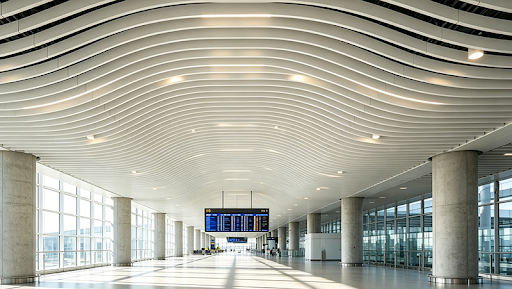
When specifying aluminum cladding for a facade, architects are often faced with a fundamental finishing decision: anodizing or powder coating. Both processes protect aluminum from corrosion and weathering, and both are widely used across curtain wall systems, rainscreen cladding, and ceiling panels. Yet the two finishes differ significantly in appearance, performance, cost, and long-term maintenance — differences that can shape a building’s aesthetic identity for decades.
This article breaks down the key distinctions to help design teams and specifiers choose the right finish for their project.
How the Two Finishes Are Made
Anodizing is an electrochemical process that thickens the natural oxide layer already present on aluminum’s surface. The aluminum panel is submerged in an electrolytic bath, and an electrical current causes oxygen ions to bond with the aluminum, forming a hard, integrated aluminum oxide layer. Because this layer is part of the metal itself rather than a coating applied on top, it cannot peel, chip, or flake away under normal conditions.
Powder coating, by contrast, is a dry finishing process in which electrostatically charged polymer powder is sprayed onto the aluminum surface and then cured under heat, forming a durable paint-like film. Unlike anodizing, powder coating sits on top of the metal as a separate layer, similar to conventional paint but far more durable and resistant to chipping.
Appearance and Design Flexibility
This is where the two finishes diverge most clearly.
- Anodized aluminum produces a finish that reveals the metal’s natural character — subtle variations in grain, a metallic sheen, and a sense of material authenticity that many architects value for contemporary and minimalist facades. Anodizing is available in a range of tones, typically clear/natural, champagne, bronze, black, and select color anodizing processes, but the palette is inherently more limited than powder coating.
- Powder coated aluminum offers virtually unlimited color options, including custom RAL and Pantone matching, textured finishes, metallics, and even wood-grain or stone-look effects. For projects where a specific brand color or a bold, saturated hue is part of the design concept, powder coating is usually the more practical route.
If the design intent is to celebrate the material itself, anodizing tends to be the stronger choice. If the design intent is to achieve a very specific, non-metallic color story, powder coating offers far more freedom.
Durability and Weathering Performance
Both finishes are engineered to perform in exterior environments, but they age differently.
Anodized coatings are extremely resistant to UV degradation because the oxide layer is inorganic — it does not contain the organic pigments that can fade over time. This is why anodized finishes are often specified for facades in high-UV climates or for buildings with very long design life expectations. The finish is also highly resistant to abrasion, since it is fused with the substrate rather than sitting on the surface.
High-quality powder coating, particularly systems that meet AAMA 2604 or AAMA 2605 performance specifications, can also deliver strong long-term color retention and weathering resistance. AAMA 2605-rated coatings, typically PVDF (Kynar) based, are formulated specifically for extended exterior exposure and are widely used on high-rise curtain walls. The key variable is coating quality: a lower-grade powder coating system will fade and chalk noticeably faster than a premium fluoropolymer system, whereas anodizing quality is comparatively easier to standardize and verify (via coating thickness testing to ASTM B244 or similar).
In short: premium powder coating (AAMA 2605) and anodizing can both achieve excellent 20–30 year performance, but anodizing has a structural advantage — it cannot delaminate or peel, since there is no separate film to fail.
Repair, Touch-Ups, and Field Conditions
This is a practical consideration that often gets overlooked at the specification stage.
- Powder coating can be relatively easier to touch up on-site with matching paint systems if a panel is scratched or damaged during installation.
- Anodized panels are more difficult to repair once installed. Because the finish is created electrochemically in a controlled bath, field touch-ups cannot fully replicate the original anodized layer, and repaired areas may show slight color variation. This makes handling, transport, and installation quality control especially important for anodized panels.
Architects specifying anodized aluminum should build in clear handling, packaging, and installation protocols with the fabricator to minimize the risk of surface damage before the panels reach the site.
Cost Considerations
Anodizing is generally a more energy- and process-intensive treatment, and it typically carries a higher unit cost than standard powder coating, particularly for custom or premium color anodizing. Powder coating, especially in standard colors, tends to offer lower upfront costs and faster turnaround for large-volume orders.
However, cost comparisons should account for lifecycle value, not just unit price. On projects where facade replacement or repainting is difficult or expensive (high-rise buildings, buildings with limited access for maintenance), the long-term durability of anodized finishes can offset the higher initial investment.
Sustainability Considerations
Both finishes are compatible with aluminum’s inherent recyclability, but anodizing has some specific advantages from an environmental standpoint. The anodizing process does not introduce VOCs (volatile organic compounds) into the finished product in the way that some paint and coating systems can during application, and anodized aluminum can be recycled without the need to strip a separate coating layer first. For projects targeting green building certifications, this can be a relevant factor in material selection documentation.
Quick Comparison
| Criteria | Anodized Aluminum | Powder Coated Aluminum |
| Color range | Limited (metallic tones) | Virtually unlimited |
| UV/color stability | Excellent, inorganic finish | Excellent with AAMA 2605-grade coatings |
| Risk of peeling/chipping | Very low (finish is part of the metal) | Low with quality coatings, but coating can delaminate if damaged |
| Field repair | Difficult, visible variation possible | Easier to touch up on-site |
| Typical cost | Higher | Generally lower |
| Best suited for | Facades emphasizing natural metal character, long design life | Facades requiring specific brand colors or bold hues |
Which Should You Specify?
There is no universally “better” option — the right choice depends on the design language of the project, the climate, the maintenance access, and the budget. As a general guideline:
- Choose anodized aluminum panels when the design calls for an authentic metallic appearance, maximum long-term color and finish stability, and the building has limited access for future maintenance.
- Choose powder coated aluminum when the project requires a specific custom color, a non-metallic look, or when budget and fast-track delivery are priorities — provided a high-performance coating system (AAMA 2604/2605) is specified.
For manufacturers and fabricators, offering both finishing options allows design teams to make the choice based on project-specific performance and aesthetic requirements rather than being limited by what a single supplier can produce.