
Introduction to FinTech in America: Use Cases, Benefits, Risks, and Long-Term Opportunities
Fintech in America now moves real money at scale. A clear introduction to how it works, its benefits, the risks, and what the next decade holds.

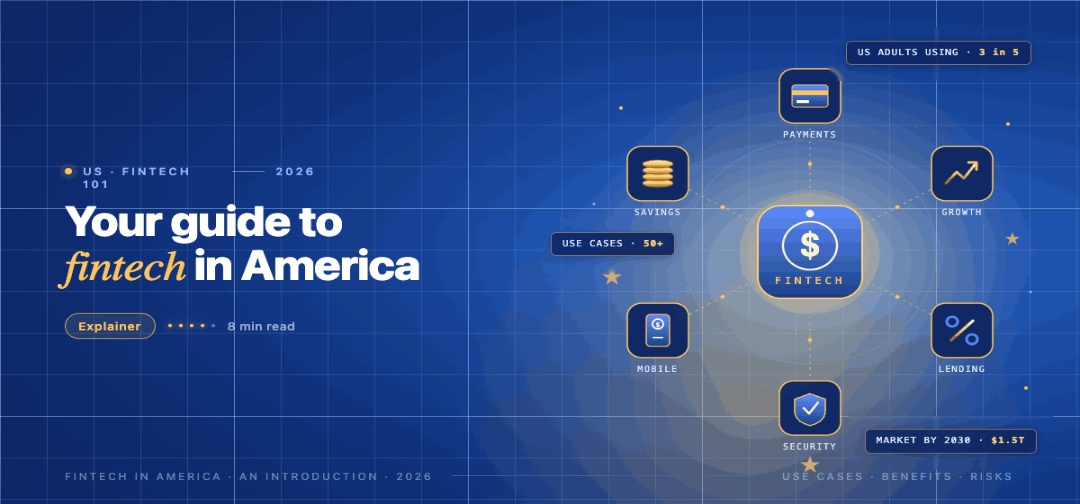
Walk into a coffee shop in Austin and watch how people pay: a tap of a phone, a scan of a code, a transfer split between four friends before the drinks arrive. None of it runs through a bank branch. That quiet shift is fintech in America, and it now moves real money at scale, with the United States fintech market valued at USD 58.01 billion in 2025, according to Mordor Intelligence.
For newcomers the word can sound abstract. This guide keeps it concrete: what fintech actually is, how Americans use it, what it offers consumers and businesses, where the risks sit, and what the next decade may hold.
What fintech in America actually means
Fintech, short for financial technology, is software that delivers a financial service a bank or broker once controlled. The service might be payments, lending, saving, investing, or insurance, but the pattern is the same: take a slow, paperwork-heavy process and rebuild it as an app or an interface other companies can plug into. Most fintech firms do not hold a bank charter. They build a focused tool and partner with a chartered bank for the regulated parts. That division of labor is why a two-person startup can launch a payment app without owning a vault, and why the same app can reach millions of phones once it works.
The market splits into clear segments. Digital payments held the largest share of the United States fintech market in 2025 at 46.78 percent, while neobanking, the branch-free banking model, is the fastest growing at a 21.05 percent annual rate through 2031. Lending, investing, and insurance technology fill out the rest, and many products now lean on artificial intelligence to make faster decisions. The West region led adoption in 2025 with a 35.92 percent share, anchored by venture funding and cloud infrastructure, while the South posts the quickest growth as states like Texas and Florida court fintech firms with friendly charters.
How Americans use it day to day
For most people fintech shows up as convenience. A payment app splits a dinner bill, a neobank offers fee-free checking, a lending tool approves a thin-file borrower in minutes, and a robo-advisor invests spare change automatically. Behind the scenes, real-time payment systems such as FedNow, now used by more than 1,300 banks, let money move in seconds rather than days. The shift is generational as much as technical, since tokenized wallets and biometric logins have pulled older and less wealthy customers onto digital rails that once felt out of reach. Much of this rests on data tools like those described in our look at AI-powered fintech research.
Businesses use it differently. A software company can now embed payments, cards, or lending directly into its product, a model called embedded finance that turns finance into a feature. Firms that scale these tools usually pair them with strong product engineering and cloud capacity so the systems hold up as volume grows.
The two sides reinforce each other. As more businesses embed financial features, consumers meet fintech in places that have nothing to do with banking, such as a rideshare app that pays drivers instantly or a retailer that offers installments at checkout. Each of those touchpoints started as a deliberate choice by a company to build finance into its product rather than send customers elsewhere, and that choice is now common enough that most Americans use fintech daily without naming it.
The benefits for consumers and businesses
The clearest gain is access. Fintech reaches customers traditional banks overlook, including thin-file borrowers, gig workers, and small businesses that need cross-border payouts. Costs fall too, because branch-free models carry less overhead and pass some savings on as lower fees. Speed is the third benefit: approvals, transfers, and onboarding that once took days now take minutes. For a small business, that speed can be the difference between making payroll and missing it.
For the wider economy, competition is the quiet benefit. The United States fintech market is not controlled by a few giants; Mordor Intelligence describes its concentration as low, with no single firm holding a double-digit share. That open structure pushes incumbents and startups alike to ship better products, a dynamic visible across the country’s fintech ecosystem.
By the numbers: digital payments make up 46.78 percent of the US fintech market, neobanking is growing fastest at 21.05 percent a year, and the whole market is set to more than double by 2031.
The risks to weigh
The same speed that helps can hurt. Instant payment rails are irreversible, which scammers exploit, and United States consumers lost USD 12.5 billion to scams in 2024. A young fintech can also fail, change its terms, or ship a feature with weak privacy defaults. Because many firms rely on a partner bank for their license, a compliance slip can shut a product down with little warning to its users. New federal guidance on bank-fintech partnerships has raised the cost of that model, which favors firms with clean controls over those moving fastest.
Funding adds another layer. Global fintech investment fell to a seven-year low of USD 95.6 billion in 2024, though United States activity rose cautiously toward the end of the year, according to KPMG. Tighter capital means some startups will not survive, so consumers benefit from checking which chartered bank holds their money before trusting an app with a paycheck.
The long-term outlook
The direction is toward more reach, not less. Mordor Intelligence projects the United States fintech market will more than double to USD 135.42 billion by 2031, growing at a 15.18 percent annual rate, with neobanking and the southern states expanding fastest. Banking, financial services, and insurance remain the heaviest users of the underlying technology, which keeps capital and talent flowing into the sector even when headline funding cools. Real-time payments and embedded finance keep widening where fintech can operate, from small-business treasury tools to gig-worker payouts. Civic programs aimed at financial inclusion could extend those tools to communities that traditional banking has underserved, widening who benefits rather than just deepening existing markets.
The firms that last will likely look less like banks and more like infrastructure, judged by whether they earn the trust of the people whose money they move. For American consumers and businesses, fintech is no longer a novelty at the edge of finance; it is becoming the default way money moves, and the next decade will decide how fairly and safely it does so.






Comment