
PCB Fabrication and Assembly: How to Choose a Reliable One-Stop PCBA Manufacturer

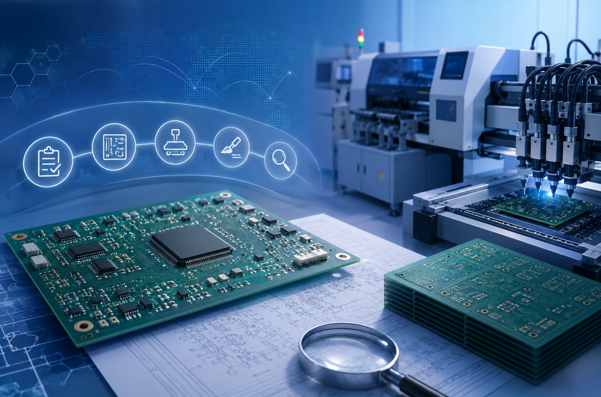
The one-stop model has gained momentum over the past few years, and for good reason. Consolidating fabrication and assembly under one roof eliminates inter-vendor logistics, reduces total lead time, and creates single-point accountability. When a board fails, there’s no finger-pointing between the fab and the assembler. One company owns the outcome.
What Defines a True One-Stop PCBA Manufacturer?
The term “one-stop” gets thrown around loosely. A genuine one-stop PCBA manufacturer offers both PCB fabrication and PCB assembly under their own roof, with tightly integrated processes and a single quality management system.
| Capability | True One-Stop | Broker Model |
| PCB fabrication | In-house factory | Subcontracted to third-party fab |
| SMT assembly | In-house assembly line | Subcontracted to third-party assembler |
| Component sourcing | In-house procurement team | Managed through distributors or subcontracted |
| Quality control | Unified QC system across fab + assembly | Separate QC at each subcontractor |
| DFM feedback | Holistic review considering both fab and assembly constraints | Fragmented — fab and assembler may not communicate |
| Accountability | Single point of responsibility | Blame shifting between subcontractors |
The In-House Advantage
When fabrication and assembly happen under one roof, the engineering team can optimize the board for both processes simultaneously. The assembler’s feedback on pad design, solder mask clearance, and panelization flows directly back to the fabrication side. This feedback loop catches issues that would otherwise surface as defects during assembly — and that’s a loop that separate vendors simply cannot close.
The practical result: higher first-pass yield, fewer delays, and a faster overall timeline from design submission to finished boards.
Critical Capabilities to Evaluate
A one-stop PCBA manufacturer’s capability set determines whether they can handle your project — both now and as your requirements scale.
PCB Fabrication Capabilities
| Parameter | Standard | Advanced |
| Layer count | Up to 20 layers | 30+ layers with HDI |
| Minimum trace/space | 4/4 mil | 3/3 mil or finer |
| Minimum via size | 0.3 mm | 0.15 mm (laser-drilled microvia) |
| Copper weight | 1–2 oz | 0.5 oz to 6+ oz |
| Materials | FR-4 standard | High-Tg, Rogers, PTFE, metal core, hybrid |
| Surface finishes | HASL, ENIG | ENEPIG, immersion silver, hard gold, OSP |
| Board size | Up to 500×600 mm | Larger panels with custom tooling |
| Special processes | — | Blind/buried vias, via-in-pad, back-drilling, impedance control |
Assembly Capabilities
| Parameter | Standard | Advanced |
| Minimum component size | 0402 | 0201, 01005 |
| BGA pitch | 0.5 mm+ | 0.3–0.4 mm |
| Package support | QFN, QFP, SOP | PoP, SiP, flip chip, micro-BGA |
| Assembly technology | SMT + THT | Mixed-technology, press-fit, selective wave |
| Special processes | — | Conformal coating, potting, encapsulation, wire bonding |
| Box build | Basic assembly | Full enclosure integration, cable harness, system-level testing |
Testing Capabilities
Testing is where many one-stop manufacturers differentiate themselves. In-house testing capability means immediate feedback loops and faster issue resolution.
| Test Method | What It Detects | When It’s Essential |
| AOI | Missing/wrong components, polarity, visible soldering defects | Every board, every run |
| X-ray (AXI) | Hidden solder joints under BGA/QFN, voiding, shorts | Any board with leadless packages |
| SPI | Solder paste volume and alignment (pre-reflow) | Process control — indicates mature quality system |
| ICT | Open/short circuits, passive values, basic IC connectivity | Medium-to-high volume production |
| Functional test | Board-level function under real operating conditions | Critical for medical, automotive, aerospace |
| Burn-in | Infant mortality under elevated temperature and voltage | High-reliability applications |
Why One-Stop Often Delivers Faster Lead Times
The time savings of the one-stop model are significant — typically 20-30% faster than managing separate fab and assembly vendors.
| Timeline Component | Separate Fab + Assembly | One-Stop Manufacturer |
| DFM/DFA review | Two separate reviews (fab then assembly) | Single integrated review |
| PCB fabrication | 5–10 days | 5–10 days |
| Shipping fab → assembly | 2–5 days (domestic) or 5–10 days (international) | 0 days — same facility |
| Component sourcing | Your team or assembler sources separately | Runs in parallel with fabrication |
| Assembly setup | Begins after boards arrive | Can begin immediately after fabrication completes |
| Testing | Separate testing handoff | Integrated into assembly workflow |
| Total | 12–25 days (plus logistics) | 8–15 days |
The advantage compounds when issues arise. If a fabrication issue is caught during assembly, the one-stop manufacturer can correct it immediately. With separate vendors, you’re managing a cross-company RCA process that can stretch for weeks.
Cost: One-Stop vs. Separate Vendors
Unit price comparisons often favor separate vendors — you can negotiate fabrication and assembly independently and pick the lowest-cost option for each. But total cost tells a different story.
| Cost Factor | Separate Vendors | One-Stop Manufacturer |
| Unit price (fab + assembly) | Lower — can optimize each independently | Marginally higher — single margin structure |
| Shipping between vendors | 2–5 shipments, full cost | 0 — eliminated |
| Incoming inspection | You inspect boards from fab before sending to assembler | Not needed — single QC system |
| Project management | Your team manages 2+ vendors | Manufacturer manages internally |
| Rework from miscommunication | Higher risk — fab/assembler don’t share process data | Lower risk — integrated engineering |
| Expediting fees | Common when coordination fails | Rare — streamlined workflow |
| Total cost of ownership | Higher — hidden coordination costs | Lower — transparent, consolidated |
The right way to compare: Request a total cost breakdown from each candidate — unit price, tooling/NRE, testing, packaging, and shipping. Then add your internal project management cost for managing multiple vendors. The one-stop option often wins on total cost even when the per-unit price appears higher.
FAQs
What’s the difference between a one-stop PCBA manufacturer and a broker?
A true one-stop manufacturer owns and operates both PCB fabrication and assembly facilities in-house. A broker accepts your order, then subcontracts fabrication and/or assembly to third-party factories. The broker model adds margin without adding engineering integration or single-point accountability.
Is one-stop PCBA more expensive than separate vendors?
One-stop typically has a marginally higher unit price but lower total cost of ownership when you account for eliminated shipping, reduced project management overhead, and fewer rework events. Compare total cost, not just unit price.
What certifications should a one-stop PCBA manufacturer have?
ISO 9001 is the minimum. Add IPC-A-610 Class 2 or 3 for workmanship standards. Industry-specific certifications — ISO 13485 (medical), IATF 16949 (automotive), AS9100 (aerospace) — are required for regulated products.
How do I verify a manufacturer is truly one-stop?
Ask for a facility tour. Confirm both PCB fabrication and assembly lines operate in the same location. Ask for specifics: “How many fabrication lines do you operate? How many SMT lines? Which testing equipment do you run in-house?” Vague answers suggest they’re outsourcing core processes.
What testing should a one-stop manufacturer offer in-house?
At minimum: AOI (every board), X-ray (for BGA/QFN inspection), and functional test capability. SPI indicates mature process control. ICT and burn-in are valuable for higher-volume or high-reliability production.
Conclusion
A manufacturer that communicates clearly during evaluation, provides thorough DFM feedback on your design files, and backs their capabilities with transparent metrics is likely to be a reliable production partner. Manufacturers that combine in-house fabrication, assembly, and engineering under one roof — such as PCBAndAssembly — demonstrate the integrated approach that consistently delivers higher first-pass yield and shorter lead times. Take the time to evaluate thoroughly, and the payoff is smoother production runs, fewer surprises, and a stronger path from prototype to volume.






Comment