
Why US Businesses Are Rethinking What “SEO Company” Even Means in 2026


For most of the last decade, hiring an SEO company meant hiring a link-building and keyword-optimization service. The deliverable was predictable: better rankings on a Google results page, tracked through a handful of familiar metrics, reported monthly, renewed quarterly. That model isn’t gone, but it is no longer sufficient on its own — and a growing number of US businesses are discovering that the hard way, watching traffic and lead volume drift even while their traditional rankings hold steady.
The reason is structural, not cyclical. Search itself has changed shape. AI Overviews now sit above the organic results for a large share of Google queries, answering the user’s question directly. ChatGPT, Perplexity, and Gemini have become genuine discovery channels in their own right, particularly for research-heavy, high-consideration purchases. A business can still rank #1 for its core keyword and simultaneously see referral traffic decline, because a meaningful slice of searchers never make it past the AI-generated answer at the top of the page.
The Metric That Matters Now: Are You the Answer, Not Just the Result
The practical consequence is that visibility has split into two related but distinct problems. The first is the familiar one — ranking in the traditional sense. The second, newer problem is being the source an AI system chooses to cite, summarize, or recommend when it assembles an answer. These two outcomes correlate, but they are not the same thing, and optimizing purely for the first no longer guarantees the second.
Winning at the second requires a different kind of content discipline: clear, direct answers to specific questions rather than broad marketing copy; structured data and schema markup that make a page’s meaning explicit to a machine rather than implicit to a human reader; and topical depth that signals genuine authority on a subject rather than a single page trying to cover everything at once. Businesses that built their SEO around the old rules — thin service pages, generic “About Us” positioning, keyword density over clarity — are finding those same pages simply don’t get picked up by AI systems, regardless of how much link equity sits behind them.
Local and Service-Based Businesses Feel It First
The shift is most visible for local and service-based businesses — contractors, healthcare practices, legal firms, home service providers — because a large share of their prospective customers now start the decision process with a conversational, intent-heavy query rather than a short keyword. “Best roofing contractor near me that handles insurance claims” behaves very differently, from a search-engine and AI-model perspective, than “roofing contractor.” Businesses whose content still speaks in short, generic phrases rather than answering the fuller question are losing ground to competitors whose sites are built around exactly these longer, more specific queries.
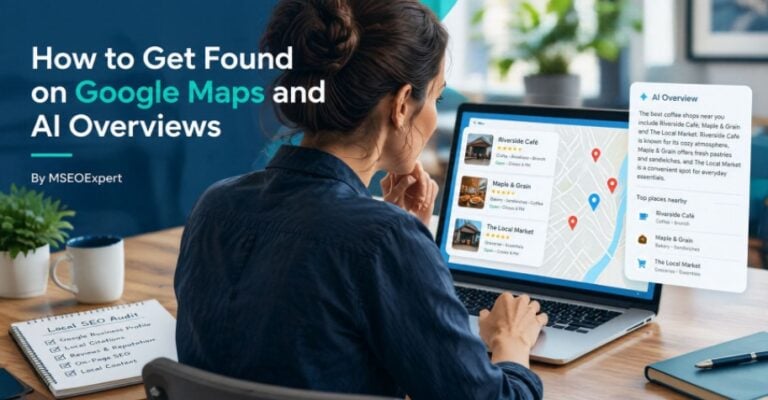
Google’s own Business Profile ecosystem compounds this for local businesses specifically. Between AI-generated summaries and the local pack, a meaningful share of consumers now make a decision before ever visiting a website at all — based entirely on reviews, profile completeness, and how a business’s name, address, and phone number appear across the web. SEO work that stops at the website and ignores that layer is, in a real sense, incomplete.
What This Means for Buying SEO Services
This is reshaping what businesses should actually look for when evaluating an SEO company. Generic keyword-and-backlink packages, once the industry standard, are increasingly a commodity service — cheap to buy, easy to compare, and no longer sufficient to move the needle on their own. The agencies gaining traction in the US market right now tend to share a few traits: industry-specific strategy rather than one generic playbook applied to every client, demonstrated experience building content and structured data for AI visibility rather than just traditional rankings, and transparent reporting that shows both ranking movement and AI-citation performance rather than rankings alone.
Firms like SEO Yodha, an SEO Company USA working with clients across multiple US-based industries, illustrate the direction the category is moving — building out condition- and service-specific pages for individual verticals (legal, healthcare, home services, SaaS) rather than treating every client’s site the same way, while also building the technical and structural foundation that AI search tools rely on to cite a source at all.
The Bottom Line
The businesses that treat this as a passing trend are likely to notice the cost quietly, through softening lead volume that’s hard to trace back to a single cause. The businesses that treat it as a genuine shift in how discovery works — and adjust their content, structure, and local presence accordingly — are the ones positioned to still be visible, to both traditional search and AI systems, over the next several years. In a market this competitive, that gap compounds fast.






Comment