In a fast-changing market, Tron (TRX) and VeChain (VET) continue to make headlines. TRX has shown notable strength recently, rising by 19% in just a month to reach $0.362. Analysts now suggest a possible breakout as the coin approaches $0.378. Meanwhile, VeChain is building momentum, with its staking program locking in over 4.75 billion tokens and pushing toward a clear $0.027 target.
However, beyond these steady performers, a new name is entering the conversation around top altcoins: BlockDAG(BDAG). With a revolutionary hybrid model that combines Proof-of-Work security with the speed of Directed Acyclic Graph technology, BlockDAG is showing signs of leadership in a space saturated by traditional Layer 1 competitors. Now with more than $388 million raised and over 25.8 billion coins sold, BlockDAG is becoming a project too important to ignore.
TRX Climbs Toward $0.378 as Market Strength Holds
TRON (TRX) has performed strongly over the past 30 days, notching a 19% increase and trading around $0.362 at the time of writing. It now holds a market cap of $33.5 billion, outperforming larger names like Bitcoin and Ethereum in terms of percentage growth. Although trading volume has dipped by 39.71% to $372.59 million, open interest remains solid at $624.11 million, suggesting that cautious optimism still exists among market participants.
Analysts believe that breaking above the $0.368 resistance level could push TRX into a new price zone, between $0.375 and $0.378. The token’s support around $0.361 continues to provide a foundation for future upward movement. With consistent price action and reduced volatility, TRON is being recognized as a more stable pick in today’s market.

This ongoing TRON (TRX) price surge helps explain its place among the top altcoins that traders are watching closely for consistent returns and breakout opportunities.
VET Price Pushes Higher with Staking Surge & ETF Buzz
VeChain (VET) is also making progress, showing a 4% increase in just 24 hours and reaching $0.02597. With a market cap of $2.23 billion, VET’s price is rising in response to strong staking activity and increased attention from major institutions. Its staking program has now locked away more than 4.75 billion tokens, cutting liquid supply and increasing upward price pressure. Trading volume has surged by 201.67%, reaching $152.3 million.
Resistance sits at $0.02696, with support holding near $0.02480. If the price pushes above this resistance zone, VET may rally toward $0.028. If not, traders could see the price consolidate around $0.02345.

Momentum is also building from strategic partnerships, such as VeChain’s collaboration with BitGo and its role in Franklin Templeton’s tokenized fund initiative. These moves bring more credibility to the platform and add weight to the current VeChain (VET) price target. Still, traders should watch for potential profit-taking near $0.027, as that level could act as temporary resistance.
How BlockDAG’s PoW-DAG Blend Sets It Apart in a Crowded Market
BlockDAG (BDAG) is quickly emerging as one of the most innovative contenders among the top altcoins, thanks to its groundbreaking hybrid architecture. By merging the high throughput of Directed Acyclic Graph (DAG) systems with the proven security of Proof-of-Work (PoW), BlockDAG delivers speed without sacrificing decentralization. Its network can process up to 10 blocks per second, significantly outpacing many traditional Layer-1 blockchains.
What sets BlockDAG apart is its focus on solving real limitations in blockchain technology. While other platforms often prioritize speed at the expense of security or stability, BlockDAG achieves balance across all three. Its design supports fast, secure, and decentralized transactions, making it scalable for global adoption.
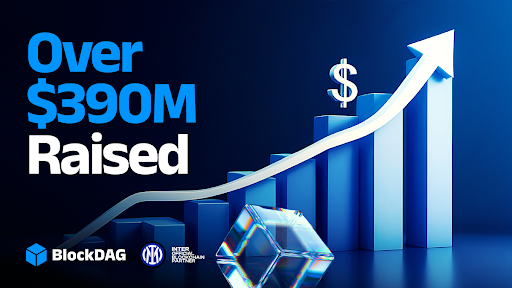
The presale has already raised more than $395 million with 25.8 billion coins sold, highlighting strong support from early participants. At its current presale price, anticipation around launch continues to build, as many see BDAG as more than just a newcomer, it’s positioning itself as a serious long-term contender.
Among the top altcoins gaining momentum in 2025, BlockDAG stands out not only for innovation but also for delivering measurable progress ahead of its official debut.
Wrapping Up
Both TRX and VET are clearly performing well in the current market. TRON’s steady climb toward $0.378 and VeChain’s rapid progress toward its $0.027 price target make them key players in the short term. They continue to show why they’re considered part of the top altcoins for consistent results.
However, BlockDAG is offering something different, a long-term foundation built on technical strength, actual user traction, and a hybrid design that solves real issues. With strong presale momentum, unmatched scalability, and a fast-growing user base, it’s paving a new path forward in blockchain development.
For those closely following the top altcoins that combine speed, security, and potential upside, BlockDAG is a name that belongs at the top of that list in 2025 and beyond.

Presale: https://purchase.blockdag.network
Website: https://blockdag.network
Telegram: https://t.me/blockDAGnetworkOfficial
Discord: https://discord.gg/Q7BxghMVyu