The shift toward visual-centric digital banking has made traditional video production a bottleneck for fintech scalability. The Kling 2.6 API addresses this by providing a production-ready infrastructure to automate high-fidelity, synchronized audio-visual content. By integrating these generative capabilities via Kie.ai, financial platforms can now deliver personalized, data-driven video insights that enhance user engagement and trust while eliminating the prohibitive costs of manual media creation.
Implementing The Kling Text To Video API In Digital Financial Ecosystems
Integrating generative video into a financial platform requires more than just a creative engine; it requires a system that interprets the nuances of professional communication. The breakthrough of native audio-visual generation in the 2.6 version addresses a long-standing pain point in automated media: the lack of synchronization between speech and visual movement. In the fintech world, where professional delivery is a prerequisite for credibility, the ability to generate perfectly lip-synced virtual advisors is a transformative advantage. This technical leap allows for the creation of content that feels human and authoritative, rather than robotic or disjointed.
The Impact Of Native Audio-Visual Synchronization
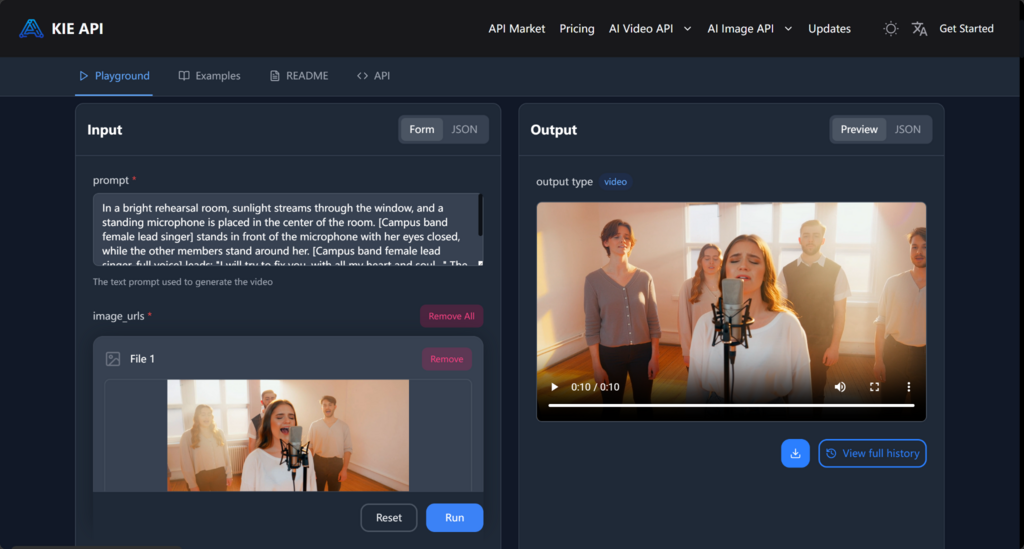
Unlike earlier generative tools that required developers to manually layer audio over silent video files, the Kling Video 2.6 API generates visuals, human-like speech, and environmental acoustics simultaneously. This ensures that every verbal nuance in a financial explainer video is matched with corresponding facial expressions and micro-movements. For a digital wealth manager, this means the ability to generate a personalized daily market update where a virtual advisor explains a portfolio shift with a natural tone. The API allows for contextual acoustic control, meaning developers can adjust the rhythm and emotional resonance of the generated voice to suit specific user demographics or the gravity of the financial news being delivered. This level of synchronization reduces the uncanny valley effect, making the AI-generated advisor a trusted extension of the brand.
Semantic Precision In Automated Market Reporting
Accuracy is the non-negotiable standard for financial content. The Kling AI 2.6 API utilizes a deep semantic understanding engine that interprets instructional prompts of up to 1,000 characters. This allows the system to accurately translate complex fiscal data or regulatory changes into logical visual sequences. By providing a detailed text-based storyboard to the Kling Text to Video API, developers can ensure that abstract concepts like inflation trends or bond yield curves are rendered as digestible 1080p simulations that respect the original data points. This precision turns raw information into actionable insight, helping users navigate market volatility with greater clarity. The API ensures that the visual representation of a trend aligns perfectly with the narrated explanation, eliminating the risk of miscommunication in high-stakes financial scenarios.
Navigating The Kling 2.6 API Documentation For Seamless Integration
For technical teams at fintech firms, the speed of deployment is just as critical as the quality of the output. The Kling 2.6 API documentation outlines a streamlined RESTful architecture that prioritizes developer efficiency and system stability. By adhering to these documentation standards, engineering teams can build robust content pipelines that scale as the user base grows. The documentation provides a clear roadmap for everything from initial authentication to handling complex callback loops for high-volume video rendering.
Establishing The Technical Foundation With The Kling 2.6 API Key
The integration process begins with the acquisition of a unique Kling 2.6 API key from Kie.ai. This key acts as the primary gateway to the generation engine, allowing for secure Bearer Token authorization across all requests. The technical roadmap for deployment involves configuring the server-side environment to handle large media files and ensuring that all API calls are authenticated within a secure infrastructure. Because financial platforms handle sensitive user data, maintaining the integrity of the API key and following the security protocols detailed in the documentation is essential for maintaining operational compliance. Properly managing the API key environment prevents unauthorized access and ensures that the generation resources are used efficiently within the organization.
Architecting Asynchronous Financial Content Pipelines
High-volume fintech applications cannot afford to have their primary servers blocked by synchronous rendering tasks. The documentation recommends an asynchronous workflow, where tasks are submitted to the createTask endpoint and then monitored through the callBackUrl parameter. This approach allows the fintech platform to receive automated notifications as soon as a video generation is complete, ensuring that the user experience remains fast and responsive. Furthermore, the unified query strategy enables developers to track multiple concurrent tasks, which is particularly useful for generating multi-segment video series such as a comprehensive financial literacy course or an automated annual report. This asynchronous architecture is what allows for the mass personalization of content, as thousands of unique videos can be processed in parallel without degrading system performance.
Maximizing Business Efficiency Through Kling 2.6 API Price Scaling
For business leaders and procurement teams, the decision to adopt generative video often hinges on the return on investment. The Kling 2.6 API price structure is designed with transparency and scalability in mind, allowing fintech startups and established institutions to forecast their media production costs with extreme precision. This predictability is a significant departure from traditional video agency fees, where costs can fluctuate based on revisions and production delays.
The pricing model for the Kling 2.6 API on Kie.ai is tiered according to the duration of the video and whether it includes native audio. For a silent 5-second video, the price is set at $0.28, while a 10-second silent version costs $0.55. When audio synchronization is required—a necessity for professional financial explainers—the price for a 5-second video with native audio is $0.55. The cost for a 10-second high-fidelity video with native audio is $1.10. By comparing these costs to the thousands of dollars required for manual video production, the ROI becomes immediately apparent for any firm producing content at scale.
Beyond the direct per-video cost, the Kling 2.6 API enables massive savings through rapid iteration. Marketing teams can test different visual narratives for a new investment product by simply adjusting the text prompt in the API call and generating a new 1080p simulation in minutes. This agility allows fintech firms to optimize their marketing spend based on real-time user feedback. To maintain service continuity, the Common API provides real-time monitoring of account credits and usage status, ensuring that the Kling video generation API remains available even during periods of high market interest and increased content demand.
Advanced Applications Of The Kling Image To Video API For Asset Valuation
While text-to-video is ideal for explainers, the Kling Image to Video API opens up specialized use cases for visual assets, particularly in the fields of PropTech and alternative asset valuation. This specific API endpoint allows for the transformation of a single high-resolution image into a dynamic, 10-second motion sequence, providing a new layer of visual context for investors.
PropTech Asset Previews And Virtual Tours
Real estate investment platforms can use the Kling Image to Video API to animate static property photos. By uploading a 10MB image of a property interior and providing a prompt for a cinematic camera pan, the system can generate a smooth, professional-grade virtual tour. This helps potential investors better understand the layout and flow of an asset without the need for expensive on-site videography, making the valuation process more interactive and transparent.
Dynamic Narratives For Financial Trend Data
Financial analysts can turn static CSV-generated charts into engaging narratives. By utilizing the Image to Video endpoint, these charts are transformed into sequences where the camera zooms into specific data spikes or pans across a historical timeline. This makes the data significantly more impactful for institutional investors during a valuation presentation compared to a flat image, as it highlights the momentum and trajectory of market trends in a cinematic format.
Infrastructure And Development Bond Visualizations
For platforms dealing with infrastructure or development bonds, the API can take a static architectural blueprint and turn it into a realistic walk-through. This helps stakeholders visualize the end-state of a project, reducing the perceived risk and enhancing the valuation of the underlying investment vehicle through visual proof of concept. The ability to animate blueprints provides a tangible sense of progress that static renders cannot achieve.
Automated Personalized Investment Dashboards
Investment dashboards can be modernized by replacing static stock images with personalized videos. For example, if a user portfolio is heavily weighted in renewable energy, the platform can use the API to automatically generate and display a high-fidelity video of a wind farm. This creates a more emotionally resonant connection between the user and their specific financial goals, turning a standard dashboard into a living reflection of their investment strategy.
Distressed Asset Restoration Simulations
In the case of distressed assets or restoration projects, the Kling Image to Video API can take a photo of a property in its current state and simulate how the property would look after specific renovations. This before-and-after motion sequence serves as a powerful tool for asset managers looking to attract capital for redevelopment projects by showing the potential future value in motion. It allows investors to see the latent value in an asset that currently lacks visual appeal.
Dynamic UI Demos For SaaS Platforms
SaaS platforms providing financial tools can use the API to turn static screenshots of their mobile app into dynamic UI demos. These high-fidelity clips show the actual flow of an interface, such as a transaction being processed or a chart updating in real-time. These clips are significantly more effective for social media advertising and user onboarding than traditional static screenshots, as they demonstrate the software’s performance and ease of use in a professional video format.
The Strategic Evolution Of The Kling AI 2.6 API In Fintech Content Production
The integration of professional-grade generative video is not just a tactical upgrade; it is a strategic evolution in the fintech tech stack. By adopting the Kling AI 2.6 API, organizations are building a modular media infrastructure that is prepared for future advancements in multi-language support and multi-character consistency. This future-proofing is essential for companies aiming for international market expansion, as the API ability to interpret and generate content across different linguistic contexts allows for seamless localization of financial advice.
The ability to generate high-fidelity, synchronized audio-visual content at scale will likely become a foundational requirement for any digital platform focusing on the intersection of finance and technology. As the Kling video generation API continues to evolve, those who have already integrated these tools into their development workflows will be uniquely positioned to lead the market in personalized, visual-first customer experiences.
Conclusion
The release of Kling 2.6 redefines the boundaries of what is possible in automated financial media. By combining a transparent pricing model on Kie.ai with a robust RESTful architecture and native audio-visual synchronization, the API enables fintech platforms to deliver a level of personalization that was previously unattainable. From enhancing PropTech asset valuations through the Kling Image to Video API to providing clear, authoritative market explainers via the Kling Text to Video API, the potential for innovation is vast. For fintech leaders, the transition from static information to dynamic, synchronized video is an essential move toward a more immersive and efficient future for financial communication. Establishing a foundation on the Kling 2.6 API is the critical first step in this digital evolution.