
Your WoW Account Might Be Worth More Than Your Car – Here’s Why

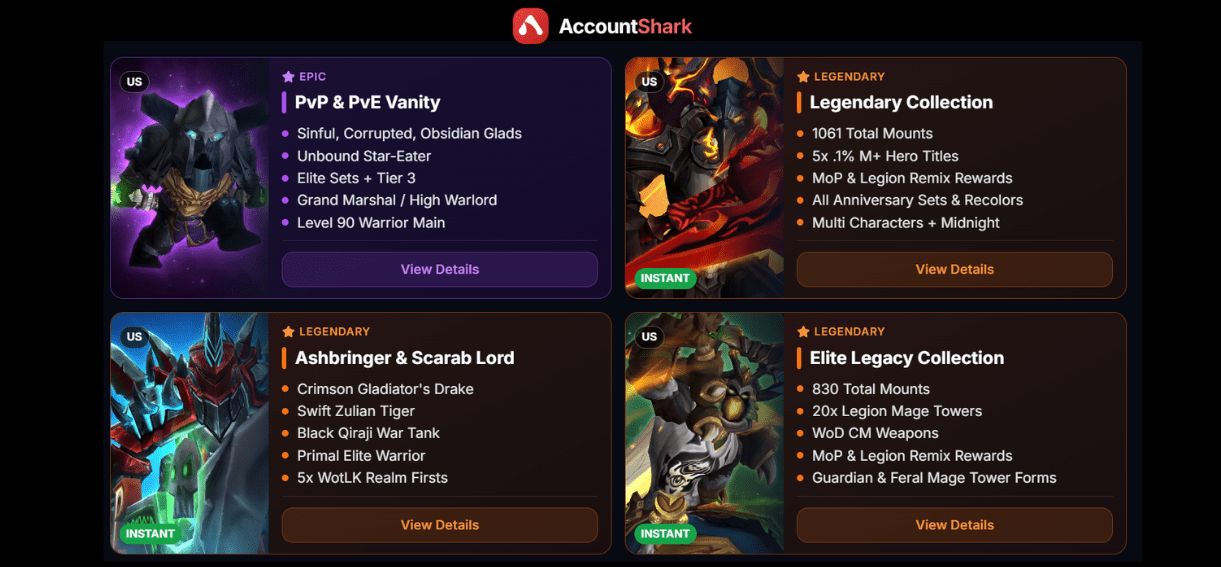
World of Warcraft has been around for over two decades, and millions of players have built characters with years of progress baked into them. Some of those accounts are worth more than people realize. We’re talking $5,000, $10,000, sometimes $15,000 or more for a single account.
But what drives that kind of value? It’s not just about having a max-level character. The price range goes from a couple hundred dollars to five figures, and the difference comes down to specific factors that most players never think about until they’re buying or selling.
Unobtainable Content Is the Biggest Driver
The single most important factor in WoW account pricing is content that can no longer be earned. Blizzard removes rewards after each season or expansion, which means older accounts with these items become increasingly rare over time.
Elite PvP transmog sets are a prime example. Every PvP season since Cataclysm Season 9 has had an exclusive armor set available only to players who hit a certain rating threshold. In Midnight Season 1, that means 1,800 for the elite set and 1,950 for the Galaxy weapon illusion. Once the season ends, those appearances are gone forever. An account with a full collection of elite sets from Cataclysm through Midnight represents over a decade of high-level PvP that simply cannot be replicated. That’s exactly why players buy WoW accounts with these collections. There’s no other way to get them.
The same applies to Challenge Mode gear from Mists of Pandaria and Warlords of Draenor. These appearances were available only to players who completed all Challenge Mode dungeons on Gold. When Warlords ended, Blizzard removed them entirely. A full set of CM weapons, especially the Warlords variants with their particle effects, is one of the most sought-after cosmetic collections in the game.
Mage Tower appearances from Legion follow the same pattern. Each spec had a unique weapon appearance locked behind a solo challenge. The Guardian Druid Fel Werebear form remains one of the most recognizable unobtainable appearances in WoW. Blizzard brought the Mage Tower back as Timewalking but kept the original appearances locked.
Rare Mounts Move the Needle
Mount collectors drive a significant portion of the high-end account market. The most sought-after accounts have 500+ unique mounts, including ones removed from the game years ago.
Farmable mounts like Ashes of Al’ar or Invincible don’t add much premium. What matters are the ones you can’t get anymore: the Plagued Proto-Drake, the original Amani War Bear, the Black Qiraji Battle Tank, and the Gladiator mounts tied to specific PvP seasons.
The Black Qiraji Battle Tank was available only during the Gates of Ahn’Qiraj opening event in 2006. Only a handful of players on each server earned it, and it has never been obtainable since. An account with one is a piece of WoW history.
TCG mounts are another major value driver. The Spectral Tiger, Magic Rooster, and Big Battle Bear came from physical trading card game loot codes produced in limited quantities. The Swift Spectral Tiger alone can account for $2,000-3,000 of an account’s total value.
Transmog and Rare Appearances
WoW’s wardrobe system saves every appearance ever collected on any character permanently. For collectors, this is everything.
The most valuable transmog items are tier sets from early raids (Judgement for Paladins, Bloodfang for Rogues), removed quest rewards from Vanilla and Burning Crusade, and weapons with unique models removed during Cataclysm’s world revamp. The original Corrupted Ashbringer from Naxxramas 40-man and the Zin’rokh from original Zul’Gurub are genuinely one-of-a-kind.
Tabards are an underrated value signal. Many early tabards from limited-time events or removed factions are no longer available. The Tabard of the Protector and Competitor’s Tabard mark an account as genuinely old.
PvP Titles and Legacy Rankings
The original Vanilla PvP ranking system produced titles that are impossible to earn through that system today. High Warlord and Grand Marshal required weeks of grinding at the highest honor bracket. While Midnight’s Blitz mode now awards these titles at 2,300 rating, the original versions carry different prestige.
Gladiator is awarded to players who reach 2,300 rating and win 50 games in 3v3 Arena. Every season produces a unique title variant and mount. A character with multiple Gladiator titles spanning different expansions represents years of elite PvP performance.
Midnight Season 1 adds Legend from Solo Shuffle, Strategist from Blitz, and Hero of the Horde/Alliance from Rated Battlegrounds. When this season ends, those specific variants become permanent history.
Server and Faction History
An account’s server history affects its value. Certain servers have better economies, more active guilds, and stronger communities. A character on Illidan or Area 52 is generally worth more than the same character on a dead server, even with cross-realm technology.
Faction balance matters too. Horde-dominated servers tend to have more competitive PvE and PvP scenes, which is why accounts with deep server history carry a premium.
Achievements and Feats of Strength
Total achievement points are a quick proxy for time invested, but the real value is in Feats of Strength. Realm First kills, pre-nerf raid clears, and legacy PvP titles signal irreplaceable history.
An account with 30,000+ achievement points and stacked Feats of Strength tells a story that no amount of current content can replicate. Realm First Level 80 from Wrath launch, Cutting Edge from every raid tier, Insane in the Membrane when it required Shen’dralar. Buyers pay for that story.
Gold and Liquid Assets
Accounts sitting on millions of gold or valuable BoE items add tangible value. Rare crafting recipes, maxed professions across multiple characters, and legacy items that are no longer obtainable all contribute.
Battle pets are another liquid asset. TCG pets, Blizzcon exclusives, and removed promotional pets are tradeable and can be worth tens of thousands of gold each. An account with 1,000+ unique pets adds both collection value and liquidation potential.
The Verification Problem
WoW accounts are tied to a Battle.net account, and Battle.net accounts are tied to a real person’s identity. The original owner can always contact Blizzard support and recover the account using their government ID, even years after selling it.
This is why securing a WoW account properly matters more than anything else in the buying process. A legitimate marketplace will verify seller identity, confirm account ownership, and broker the transaction so both parties are protected.
The verification process involves confirming the seller’s identity matches the Battle.net registration, ensuring no restrictions or bans, verifying the email and authenticator can be fully transferred, and checking that no one else has recovery claims. Skipping any of these steps opens the door to recovery scams. This account buying guide breaks down the most common mistakes in detail.
The Warband Factor
The Warband system changed the equation. Account-wide progression means reputation, collections, currencies, and bank access carry over between characters. Anyone looking to sell a WoW account with deep Warband progression can command a higher price because of it.
An account with 8-10 max-level characters, each with their own profession specializations and gear sets, is an entire guild’s worth of utility in one Battle.net account. Heritage armor sets earned by leveling each race from scratch are another checkbox buyers look for.
What Makes 2026 Different
Midnight has shifted the landscape. The Voidspire raid tier, evolving Delve system, and current PvP season have added fresh content that will eventually become unobtainable. The accounts being built right now, with Cutting Edge achievements, Season 1 Gladiator mounts, and early Midnight Feats of Strength, are the ones that will command premiums years from now.
The gaming account market has also matured. Five years ago, most sales happened through forum trades with no protection. Today, brokered marketplaces like AccountShark handle verification, escrow, and transfer, making the process safer for both buyers and sellers.
If you’re sitting on a WoW account with years of progress and you’ve ever wondered what it’s worth, the answer might surprise you. And if you’re looking to buy, knowing what drives value is the difference between getting a deal and getting scammed.





Comment