
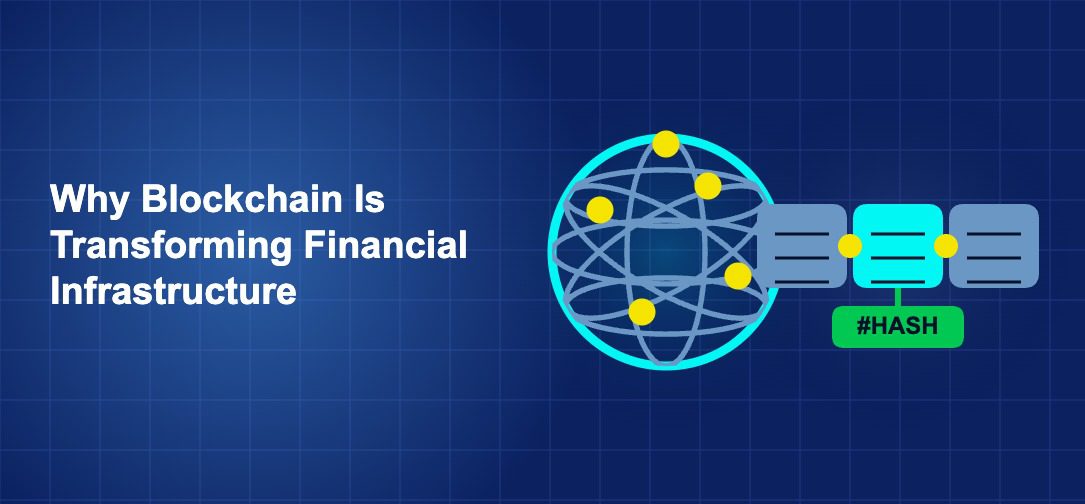
Why Blockchain Is Transforming Financial Infrastructure

The Depository Trust and Clearing Corporation (DTCC) processed $2.5 quadrillion in securities transactions in 2023, making it the most important financial infrastructure entity that most people have never heard of. In the same year, DTCC launched Project Ion, a blockchain-based alternative settlement platform for US equities, running in parallel with its traditional systems. When the institution responsible for clearing nearly every stock trade in America builds a blockchain replacement for its own infrastructure, the direction of travel is clear. The global blockchain market reached $31.18 billion in 2025, per Fortune Business Insights, and financial infrastructure replacement is among the largest drivers of that figure.
The Infrastructure That Runs Global Finance
Global finance operates on a small number of infrastructure systems, most of which were designed decades ago. SWIFT, founded in 1973, provides the messaging layer for cross-border payments. DTCC, established in 1999 from the merger of two older entities, handles clearing and settlement for US securities. CLS Bank, launched in 2002, settles foreign exchange transactions. ACH, created in 1972, processes domestic bank transfers in the United States. Fedwire, operated by the Federal Reserve, handles high-value interbank transfers.
Each system was built to solve a specific problem and has been incrementally upgraded over decades. SWIFT moved from telex to electronic messaging to APIs. DTCC compressed settlement from T+5 (five business days) in the 1990s to T+1 in May 2024. ACH added same-day processing in 2016. These improvements are real but limited by the fundamental architecture: centralised systems where a single operator maintains records and all participants must interface with that operator.
Data from Chainalysis’s 2024 Global Crypto Adoption Index shows that emerging markets in South and Southeast Asia continue to lead grassroots cryptocurrency adoption, driven by remittance use cases and limited access to traditional banking services.
According to CoinGecko’s 2024 annual crypto report, total cryptocurrency market capitalisation exceeded $3.5 trillion by the end of 2024, reflecting renewed institutional interest following spot ETF approvals in the United States.
The cost of maintaining this architecture is substantial. Post-trade processing across global securities markets costs $17 to $24 billion annually. Cross-border payment fees average 6.2% of transaction value for $200 transfers, according to the World Bank. Foreign exchange settlement requires CLS to hold trillions in collateral to manage counterparty risk. Each cost is a direct consequence of the centralised, intermediary-dependent design.
How Blockchain Replaces Each Infrastructure Layer
Blockchain technology offers a replacement architecture for each major infrastructure component. The replacements are not theoretical. They are in various stages of deployment.
For messaging and settlement (SWIFT’s function), blockchain combines both into a single operation. Blockchain-based cross-border payments now handle approximately $3 trillion annually, growing at 45% per year, per Coinlaw. RippleNet connects over 300 institutions and settles transactions in seconds. Stablecoin payments on networks like Solana and Tron provide an alternative payment rail that requires no correspondent banking relationships.
For securities clearing and settlement (DTCC’s function), blockchain enables atomic settlement where trade execution and settlement happen simultaneously. DTCC’s own Project Ion tests this model for US equities. JPMorgan’s Onyx processes over $1 billion in daily repo volume with blockchain settlement. Broadridge’s blockchain-based repo platform has processed over $1 trillion in cumulative volume.
For foreign exchange settlement (CLS Bank’s function), blockchain-based multi-currency settlement eliminates the need for centralised collateral management. Project mBridge, coordinated by the BIS with central banks from China, Thailand, the UAE, and Hong Kong, tests multi-CBDC settlement that bypasses CLS entirely. Each participating central bank settles directly with counterparts on a shared blockchain network.
For domestic payments (ACH and Fedwire functions), the Federal Reserve launched FedNow in 2023 for real-time settlement, though not blockchain-based. Stablecoin payments provide a blockchain-native alternative that settles instantly regardless of whether the sender’s or recipient’s bank participates in FedNow.
Why Incumbents Are Building Blockchain Alternatives to Themselves
The most significant development in blockchain-based financial infrastructure is that incumbents are building it. DTCC launched Project Ion. SWIFT began blockchain interoperability testing with over 30 institutions. CLS explored blockchain-based netting for foreign exchange. These organisations are building potential replacements for their own systems.
The reason is defensive. If incumbents do not build blockchain alternatives, competitors will. JPMorgan’s Onyx already processes repo trades outside DTCC’s traditional system. RippleNet routes payments outside SWIFT’s network. Stablecoin rails move money without touching ACH. Each alternative erodes the incumbent’s transaction volume and fee revenue.
By building blockchain alternatives themselves, incumbents aim to capture the efficiency gains while maintaining their position as infrastructure operators. SWIFT’s strategy is particularly explicit: rather than building its own blockchain, SWIFT is positioning itself as the interoperability layer that connects other institutions’ blockchain networks. If successful, SWIFT remains the hub of cross-border financial communication, with blockchain networks as spokes rather than competitors.
DTCC’s approach is similar. Project Ion runs as an alternative settlement rail alongside the traditional system. Institutions can choose which rail to use for each transaction. Over time, as blockchain settlement proves more efficient, volume should shift organically from the traditional system to the blockchain alternative.
The Role of BaaS in Infrastructure Transition
Blockchain-as-a-Service platforms account for 51.72% of blockchain market revenue, per Fortune Business Insights. This dominance reflects the reality that most financial institutions adopting blockchain are buying infrastructure rather than building it.
IBM’s blockchain services power trade finance networks and supply chain platforms for banks and corporations. Amazon Web Services offers managed blockchain through Amazon Managed Blockchain and partnerships with R3 and Hyperledger. Microsoft Azure provides blockchain development tools and hosting through its Azure Blockchain Service. R3’s Corda Network provides a pre-built financial services blockchain that institutions subscribe to rather than operate.
For mid-sized banks and financial institutions, BaaS eliminates the barrier of building blockchain expertise internally. A regional bank that wants blockchain-based trade finance can subscribe to a BaaS platform, integrate through APIs, and begin processing within months. Without BaaS, the same bank would need two to three years and a specialised engineering team to build equivalent capability.
Private blockchains account for 42.47% of enterprise deployments, per Fortune Business Insights. Most institutional blockchain infrastructure runs on private or permissioned networks where participation is controlled, compliance is enforced at the network level, and the operator can modify parameters as regulatory requirements evolve.
Timeline and Transition Mechanics
83% of financial institutions are exploring or deploying blockchain, per Coinlaw. But the transition from legacy infrastructure to blockchain infrastructure will take a decade or more for several reasons.
Regulatory approval is required for each infrastructure change. When the US moved from T+2 to T+1 settlement in May 2024, the SEC required years of industry consultation, testing, and rule-making. Moving to T+0 or atomic settlement on blockchain will require a similar regulatory process.
Network effects lock in existing infrastructure. SWIFT connects 11,000 institutions. A blockchain alternative must connect the same institutions to be useful, and adoption is gradual. Each institution must evaluate, test, integrate, and deploy, a process that takes years per institution.
Interoperability between old and new systems must be maintained during transition. Financial institutions cannot shut down their SWIFT connection to switch to blockchain. They must run both systems in parallel, routing transactions to whichever system the counterparty supports.
North America holds 43.80% of the global blockchain market, per Fortune Business Insights. The region’s financial infrastructure, the most sophisticated and deeply entrenched globally, will be the hardest to replace and the most valuable to replace. The BFSI sector’s 23.52% share of blockchain revenue reflects institutions investing in this transition. The infrastructure of 2035 will not look like the infrastructure of 2015. The institutions building blockchain alternatives today are positioning themselves to operate that future infrastructure rather than be displaced by it.




Comment