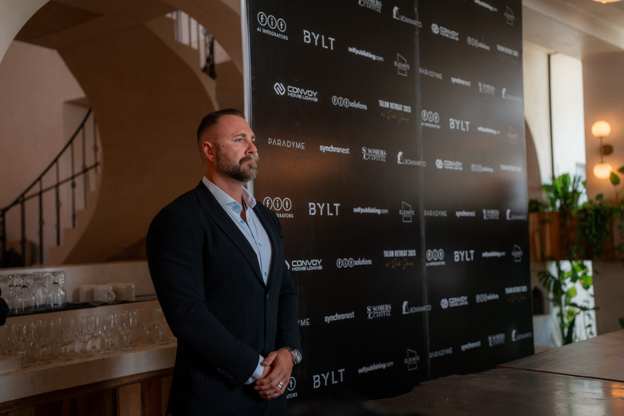
Paradyme Companies Founder and Chairman Ryan J. Garland says technology is making real estate development faster, more measurable and more transparent—but the industry’s physical realities still place limits on what algorithms can solve.
Artificial intelligence can organize hundreds of pages of documents in seconds.
It can help compare market data, model financial scenarios, generate concept visuals, organize leads, assist with investor communications and surface information that once required hours of manual work.
What it cannot do, Ryan J. Garland says, is make bad dirt good.
It cannot eliminate an unfavorable cost basis. It cannot create utility capacity that does not exist. It cannot replace a permit, widen an access point or make an unrealistic construction budget suddenly work.
For Garland, the Founder and Chairman of Paradyme Companies, that distinction matters as real estate firms increasingly adopt AI, automation and data-driven decision-making.
“AI cannot repair a poor basis, replace a permit, or change the physical limits of dirt, power, water, and access,” Garland said.
Paradyme Companies, a real estate investment and development platform operating across development, private lending and credit, construction oversight, asset operations and investor communications, has integrated technology into numerous parts of its workflow.
But Garland is careful not to describe Paradyme as a technology company.
Instead, he sees technology as a tool that can make experienced real estate operators faster and more accountable.
That is a very different proposition from expecting technology to replace them.
From Static Reports to Real-Time Information
When Garland began his career, real estate underwriting depended heavily on personal networks, spreadsheets, static research reports and information that could already be months old by the time a decision was made.
That environment has changed dramatically.
Development teams can now combine public datasets, demographic platforms, property records, mapping tools, live market listings, construction information, customer-response data and internal operating results far more quickly.
At Paradyme, data can include population growth, household formation, migration, income, employment, tourism, traffic, housing inventory, permits, construction costs, rents, sale comparables, competitive supply and absorption.
For some of the company’s lifestyle-oriented projects, the research can become even more specific.
Garland says the team may examine vehicle ownership, boat and RV registrations where available, search behavior, existing storage availability and local business demand.
But he does not believe an abundance of data eliminates the need for interpretation.
“Data drives a significant part of our strategy, but it does not make the decision by itself,” Garland said.
The numbers are tested against what Paradyme sees in the market.
The company speaks with brokers, contractors, operators, local officials, residents and potential customers before determining whether a trend visible on a screen represents a real investment opportunity.
“Data can identify a pattern,” Garland said. “Local evidence helps determine whether the pattern is investable.”
The Danger of False Precision
Garland believes one of technology’s greatest strengths in underwriting is also one of its potential weaknesses.
Modern tools can make complicated assumptions appear exceptionally precise.
A financial model can calculate returns to multiple decimal places. A demographic dashboard can generate polished maps and projections. AI can organize information into a coherent narrative almost instantly.
None of that guarantees the underlying inputs are correct.
“The improvement is not simply speed,” Garland said. “Technology makes assumptions easier to compare, document, and challenge. It also creates a new risk: false precision.”
That concept has become increasingly important as real estate firms gain access to larger amounts of information.
Garland says a developer can have excellent software and still make a poor investment if the team misunderstands the customer, overestimates demand or fails to recognize a physical constraint at the site.
Paradyme therefore looks for multiple indicators moving in the same direction.
Migration by itself may not be enough if incomes cannot support the intended product.
Strong permitting activity could eventually signal oversupply if absorption is weak.
Tourism can support certain developments, but a seasonal visitor economy may require a different product than a market with a large permanent population.
Garland says some of the strongest signals occur when there is a growing qualified customer base, limited purpose-built supply, supportable pricing and evidence that consumers are already solving a problem inefficiently.
For large-format storage projects, for example, that could include boat and RV ownership, residential restrictions on storage, customer wait lists, resale activity, search trends or customers traveling significant distances to find an acceptable facility.
Technology helps Paradyme find those patterns faster.
Human judgment is still required to understand what they mean.
How Paradyme Uses AI
Paradyme already uses AI-assisted technology across several parts of the organization.
The company says those applications include market research, document review, preliminary financial and scenario analysis, concept development, rendering workflows, transcription, content production, lead organization, CRM support and investor communication.
In development and marketing workflows, the company can also take architect-approved structural plans or floor plans and use AI-assisted tools to develop early visuals and video concepts that help investors, potential buyers or project stakeholders better understand the intended product.
Garland says selected workflows involving research, rendering, fund launches and marketing have reduced what traditionally would have been outside costs.
But he emphasizes that faster production does not remove review.
Paradyme continues to rely on attorneys and relevant professionals to review important information before it is relied upon externally.
The objective, Garland says, is not to replace expertise.
It is to remove repetitive work that prevents experienced professionals from spending more time on higher-value decisions.
“The key is to work smarter, faster and more efficiently,” Garland said.
AI’s Biggest Opportunity May Be Between Information and Action
Asked where he believes AI will have its largest near-term impact on commercial real estate, Garland points less toward replacing developers and more toward improving the steps between receiving information and making a decision.
Diligence is one example.
AI-assisted systems can help organize documents, identify differences between files and accelerate first-pass reviews.
Financial teams can use technology to compare scenarios and identify changing assumptions.
Construction teams can monitor budgets and schedules while identifying anomalies earlier.
Design and marketing teams can create early visualizations before committing substantial time and money to traditional production.
Investor communication can become faster and more consistent when relevant information is organized more effectively.
For Garland, the common thread is shortening the feedback loop.
A problem that becomes visible earlier is usually easier to manage than one discovered after significant capital has already been committed.
That concept extends beyond AI.
Bringing More Visibility to the Construction Site
Physical construction remains one of the areas where information can break down quickly.
Paradyme uses or evaluates tools including digital plans, shared project documentation, drone photography, construction time-lapse systems, remote progress review, cost and schedule tracking and AI-assisted visualization.
The purpose is straightforward: give development, construction, finance and communications teams a more consistent picture of what is happening.
Garland believes many construction inefficiencies originate when different teams are effectively operating from different versions of reality.
A designer may be working from an outdated scope.
An estimator may price a different set of drawings.
Procurement may not receive notice of a change in lead times.
A field team may discover a conflict after installation has already begun.
Ownership may learn about a budget consequence only after work has progressed too far to respond efficiently.
Those information gaps can create rework, delays and cost increases.
Garland expects better version control, automated quantity verification, clash detection, procurement monitoring, schedule-risk alerts, improved field documentation and faster reconciliation of change orders to reduce those problems over the next decade.
“The goal is not to remove experienced people,” Garland said. “It is to give them earlier and more reliable information.”
Why Construction Technology Still Meets Physical Reality
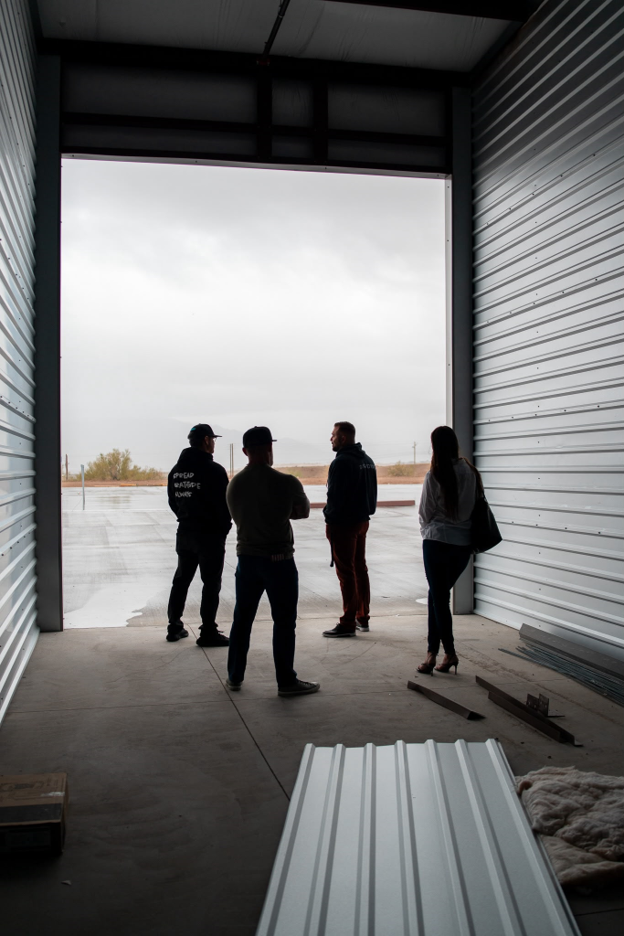
Paradyme’s use of steel construction illustrates the same tension between technological efficiency and real-world constraints.
The company uses steel in projects where wide clear spans, tall openings, durability, repeatable components and future flexibility support the intended use.
Those characteristics can be particularly valuable for Paradyme’s large-format storage and flex developments, which may accommodate boats, RVs, collector vehicles, workshops or other uses requiring significant interior volume.
Standardization can also potentially improve predictability when design, fabrication, site preparation and erection are coordinated early.
But Garland rejects the idea that choosing a specific building system automatically guarantees lower costs or faster delivery.
Steel prices can be affected by freight and tariffs.
Lead times matter.
Fire protection, corrosion resistance, insulation, energy performance, local labor availability and building codes can all alter the economics.
“Steel is not automatically cheaper or faster,” Garland said.
The correct system depends on the project.
That distinction reflects Garland’s broader view of technology: the tool should serve the underlying investment thesis rather than become the thesis itself.
Vertical Integration as an Information Strategy
Technology also connects to another major part of Paradyme’s operating model: vertical integration.
Garland believes every handoff between organizations creates an opportunity for delays, cost increases or information loss.
Paradyme therefore wants strong visibility across market selection, underwriting, capital formation, design, construction oversight, sales or leasing, operations, investor reporting and media.
That does not mean Garland wants every function performed internally.
Paradyme continues to use outside attorneys, architects, engineers, contractors, brokers and other specialists when independent expertise adds value.
For Garland, vertical integration is less about owning every company involved and more about maintaining control over the information moving between them.
“The principle is to control the decision, the data, the standard and the communication, even when a partner performs the work,” Garland said.
Technology can make that coordination significantly easier.
A shared operating system for information allows people in different disciplines to evaluate the same assumptions, identify inconsistencies and understand how one decision affects another part of the project.
That transparency becomes particularly valuable as projects grow more complex.
What the Real Estate Company of 2035 Could Look Like
Garland expects the real estate organization of the next decade to look materially different from the traditional development company.
Administrative teams may become smaller as software handles more repetitive work.
At the same time, successful firms could have significantly greater visibility into customer behavior, construction performance, asset operations and capital exposure.
Garland believes the best companies will ultimately combine three disciplines.
They will need the judgment of an investment firm, the data discipline of a technology company, and the operating depth of a service business.
But the physical side of the industry is not disappearing.
Developers will still need to understand entitlements.
They will still need access to utilities.
Buildings will still need to be financed and constructed.
Contractors will still need to execute.
Customers will still need to use the finished property.
And relationships with municipalities, communities, lenders, investors and operating partners will remain difficult to reduce to an algorithm.
“The future of real estate will be driven by better customer data, stronger operations, and technology that connects the original underwriting to what is happening in the building every day,” Garland said.
For Paradyme, that may be the most realistic way to think about AI’s role in real estate.
Technology is not valuable because it makes physical development less physical.
It is valuable because it can give people making expensive, long-term decisions better information earlier.
That still leaves the hardest part to the operator.
Someone has to determine whether the numbers reflect reality.
Someone has to visit the site.
Someone has to decide whether the customer actually exists.
And eventually, someone still has to build it.
For more information visit: https://paradymecompanies.com/.