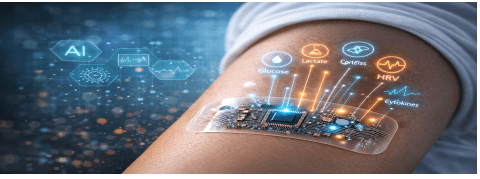
The next generation of wearable health technology may not look like a smartwatch. Instead, it could resemble a thin, flexible skin patch, embedded with nanoscale sensors capable of continuously monitoring biochemical signals in real time.
Over the past decade, companies such as Abbott Laboratories and Dexcom have transformed diabetes management with continuous glucose monitoring (CGM) systems. Their wearable sensors, placed on the arm or abdomen, transmit glucose readings every few minutes, reducing reliance on finger-prick testing.
At the same time, startups including Epicore Biosystems and GraphWear Technologies are developing graphene-based and sweat-analyzing patches that measure hydration, electrolyte levels, and metabolic markers.
Researchers suggest the field is gradually moving beyond single-analyte monitoring.
According to industry estimates, the global wearable medical device market is projected to exceed $60 billion within the next decade, reflecting accelerating investment in continuous health monitoring technologies.
From Glucose Monitoring to Multi-Biomarker Intelligence
Most commercial wearable patches today measure one primary biomarker, typically glucose. Emerging academic research, however, is exploring whether flexible nano-sensor platforms could simultaneously monitor multiple biochemical and physiological signals, including glucose, lactate, cortisol, inflammatory cytokines, and heart rate variability.
Studies indexed by the National Library of Medicine describe advances in wearable microfluidic systems and graphene-based electrodes that improve sensitivity and reduce signal drift. A recent paper in Biosensors (MDPI) highlights how nanostructured materials enhance electrochemical detection in low concentration biofluids such as sweat and interstitial fluid.
Researchers are also integrating artificial intelligence into wearable systems. Instead of triggering alerts based solely on fixed thresholds, machine learning models can analyze longitudinal time-series data to detect subtle deviations from an individual’s baseline.
A 2023 study published in Frontiers in Health Informatics by independent researcher Ankit Sharma and co-authors proposed a conceptual AI–IoT enabled nano-sensor skin patch architecture designed for continuous multi-biomarker detection and predictive monitoring. The framework emphasizes individualized baseline modeling and hybrid edge–cloud analytics to enable earlier risk identification rather than reactive alerts.
While the study presents a conceptual design rather than a commercial prototype, it reflects a broader academic push toward predictive wearable diagnostics.
Figure 1: Nano-Sensor Transducer Mechanism
Source: Frontiers in Health Informatics
Why AI Matters in Wearable Health Monitoring
Continuous biomarker monitoring generates vast streams of time-series data. Traditional threshold-based alerts can miss gradual deterioration patterns or produce excessive false alarms.
To address this, researchers are exploring models such as Long Short-Term Memory (LSTM) networks and ensemble classifiers to detect anomalies across multiple correlated signals. Multimodal analysis, combining biochemical markers with physiological signals, may improve early detection of infection, metabolic instability, or cardiovascular irregularities.
Some frameworks also propose “edge intelligence,” where partial processing occurs on a smartphone or gateway device before encrypted data is transmitted to cloud servers for deeper analysis. This hybrid architecture aims to balance latency, battery efficiency, and computational power.
Figure 2: Hybrid Edge–Cloud AI Architecture for Wearable Biomarker Monitoring
Source: Illustration created for this article
Technical and Regulatory Challenges
Despite promising research, several barriers remain before multi-biomarker skin patches become mainstream medical tools:
- Sensor stability and biofoulingover extended wear
- Inter-individual variabilityin sweat and interstitial chemistry
- Energy constraints in ultra-thin wearable electronics
- Data privacy and cybersecurity compliance
- Regulatory validation and clinical trials
Continuous glucose monitoring devices required years of clinical validation before widespread adoption. Multi-analyte AI-driven patches would likely face even more rigorous scrutiny.
A Shift Toward Predictive and Preventive Care
The broader vision behind smart nano-sensor patches is a transition from episodic testing to continuous preventive health monitoring.
Rather than identifying disease after symptoms appear, wearable systems could flag early biochemical deviations, enabling timely intervention. Applications under investigation include:
- Early infection detection
- Stress and inflammation tracking
- Cardiovascular risk stratification
- Remote patient monitoring in telehealth environments
Analysts note that as nanomaterials, flexible electronics, and AI analytics mature in parallel, technological convergence appears to be accelerating.
For now, most commercial offerings remain focused on single metrics. But the next wave of wearable innovation may integrate materials science, data engineering, and clinical modeling into seamless, skin-mounted platforms.
If validated at scale, nano-sensor patches could redefine digital health — shifting care models from episodic treatment toward continuous, data-driven prevention.
Integrating Wearable Data with AI and Electronic Health Records
As wearable biosensors grow more sophisticated, a parallel conversation emerges around how their data will integrate with broader healthcare systems.
Industry experts note that collecting real-time biomarker data is only part of the challenge. The greater complexity lies in securely integrating wearable-generated signals with artificial intelligence models and electronic health record (EHR) platforms in a clinically meaningful way.
Figure 3: Integration Framework for AI, Wearable Data, and Electronic Health Records
Source: Illustration created for this article.
Experts emphasize the importance of explainable AI models, diverse training datasets, and ethical oversight mechanisms to mitigate bias and maintain patient trust. Data privacy, informed consent, and transparency are increasingly viewed as core components of next-generation wearable ecosystems rather than optional add-ons.
Analysts suggest that widespread adoption of multi-biomarker nano-sensor patches will depend not only on materials science and AI performance, but also on robust integration frameworks that address security, ethics, and accountability from the outset.