
The Quiet Shift From Workflow Tools to Decision-Making Software

For three decades, software waited for us to decide. It has stopped waiting and most teams never noticed the moment it happened.
Somewhere in your stack this quarter, a service stopped asking. It didn’t render three options and wait for a click. It called the endpoint, wrote the row, and emitted the event for you to review later, if you reviewed it at all.
That is the shift. Not a robot uprising, not a new icon on the home screen, but a slow reassignment of who actually decides. For thirty years, software helped us execute decisions faster. Now the software is making them.
Gartner puts a number on the pace: by 2028, at least 15% of routine work decisions will be made autonomously by AI agents, up from effectively zero in 2024. The striking part isn’t the percentage. It’s that it arrives as a config change, not a launch.
01 From “How” to “Whether”
Workflow software answers how: how to route a ticket, how to advance a deal, how to get a document signed. It is the connective tissue of execution queues, state machines, forms. The judgment stays human: which lead matters, which invoice is wrong, which candidate advances.
Decision-making software answers whether and which. It reads the same tables and commits an action: approve this refund, reorder this SKU, hold this transaction, merge this pull request. The click you used to make is now a function call the system makes on your behalf.
That boundary has moved further than most teams realize. A CRM that once surfaced a “next best action” now fires the send. A detection console that once queued alerts now closes most of them before an analyst logs in. Same schema, same UI the tool crossed from returning a recommendation to committing a write.
| Dimension | Workflow software | Decision-making software |
| Question it answers | How to execute a task | Which action to take |
| Its output | A faster path for a human | A committed write / API call |
| The human’s job | Decide, then let the tool run it | Set the limits, review the exceptions |
| How you judge it | Speed, throughput, completion | Decision quality, measured over time |
| How it fails | A slow or broken process | A confident, wrong call at scale |
02 The Decision Ladder
It helps to see the change as ladder software has been climbing one rung at a time. Each rung keeps everything beneath it and adds a single layer of autonomy.
Enterprise systems lived on rungs one through three for years: a database (Record), a router (Route), a ranking model or recommender (Recommend). The quiet shift is the climb onto four and five, Decide and Act, where the model’s output isn’t a score returned to a UI but a call to issue_refund() or a commit to the event log. Every question that follows is really about how high up this ladder you’ll let a given decision go.
03 The Stack That Made It Possible

Software could have “decided” for decades a hard-coded rule is a decision. What changed is that decisions over messy, open-ended inputs became reliable enough to automate, and three layers of the stack had to mature at once.
- Inference got cheap and good enough. A language model turns an unstructured input an email thread, a contract clause, a support transcript into a structured judgment: a JSON object with a field you can branch on. What used to need a human reader is now a sub-cent, sub-second call.
- Tool use gave models hands. Function calling and structured outputs let a model do more than emit text; it can call issue_refund(amount) or open_pull_request(diff) with typed arguments a system can execute. Protocols like MCP standardize how models reach those tools and data, so an agent isn’t hard-wired to a single app.
- Grounding made outputs defensible. Retrieval-augmented generation pulls the relevant policy, ticket history or product record into context before the model decides, tying the judgment to your data instead of the model’s training. Vector search turned “find the relevant precedent” into a sub-100ms lookup.
Wrap those in an agent loop, observe, reason, call a tool, read the result, repeat and you have software that plans and acts across steps. Reliable function calling only shipped across 2023 and 2024, which is why a change in this structural feels sudden: the last load-bearing piece is barely two years old.
04 Where It’s Already Living
This isn’t a 2030 forecast. Decision software is already in production across domains that rarely make headlines.
- Security operations. SOAR platforms auto-triage and auto-close a large share of alerts, quarantining an endpoint, revoking a session, isolating a host running playbooks before an analyst opens the queue, because no team can read every signal at machine speed.
- Supply chain. Replenishment systems set reorder quantity and timing per SKU from live demand signals, writing purchase orders no planner approves line by line.
- Financial services. Fraud and underwriting models approve, decline or hold transactions in single-digit milliseconds; humans see only the flagged tail.
- Software engineering. Coding agents open pull requests, write tests and run them, and propose fixes for the jump from autocomplete (Recommend) to authored, mergeable change (Act).
- Revenue. Lead-scoring agents qualify inbound and book meetings directly, one agent triaging 200 leads, ranking them and scheduling the top slice with no rep in the loop.
Gartner’s read on the trajectory: 40% of enterprise applications will embed task-specific agents by the end of 2026, up from under 5% a year earlier. The center of gravity is moving from dashboards you read to decisions you inherit.
05 The Interface Quietly Disappears
When software decides, the interface shrinks, the clicking was the part that got automated.
The dashboard, the defining artifact of the workflow era, starts to look like overhead. Why render twelve charts for a call the system already made? What you need instead is an exception queue and a trace: the decisions the model wasn’t confident enough to make alone, and a replayable record of the ones it did.
This is management by exception, and it rewrites the job. Gartner expects a third of enterprise user experiences to shift from opening apps to reviewing agent output by 2028. The screen becomes an approval desk “here’s what I did, here’s what I wasn’t sure about.” The trap hides in that same sentence: fewer clicks can mean less visibility, not less activity, so the interface you remove has to be replaced by logging you can actually audit.
06 The Trust Handoff
As software climbs from Recommend to Decide, the human role inverts. You stop being the operator who makes each call and become the supervisor who spot-checks then the auditor who reviews after the fact.
That handoff carries two costs that never show up in a latency graph.
- Automation bias. When a system is right most of the time, people stop checking. In one computational-pathology study, trained experts overturned their own correct reads to follow the model’s wrong answer 7% of the time and time pressure made the errors worse. A reviewer who rubber-stamps is oversight in name only.
- Skill atrophy. Let the software make the routine calls for a year and the humans lose the fluency to catch the non-routine ones. The expertise meant to backstop the system erodes precisely because the system is absorbing the volume that used to build it.
“Human in the loop” is a real control only when the human is engaged, accountable and facing decisions at a rate they can actually process. Past that rate it’s a signature, not a review.
07 Accountability Gets a New Address
When a workflow tool failed, the fault was easy to place if a person made a call, or a rule was misconfigured. When decision software fails, responsibility scatters.
The bad decision now has several parents: the vendor who trained the model, the team that deployed it, the engineer who set the confidence threshold, the reviewer who waved it through. Each can point at the others and research on algorithmic decision-making finds that handing a choice to a machine makes exactly that blame-shifting easier.
That diffusion is tolerable when the stakes are a mis-sent email. It stops being tolerable the moment an automated decision becomes a formal claim, filing or attestation especially one submitted to a government program.
08 The Legal Edge of Automated Decisions
Some decisions aren’t internal at all; they become legal statements the instant they’re generated. A billing code submitted to Medicare, a cybersecurity attestation filed by a federal contractor, an eligibility determination for a public subsidy: each is a claim the government relies on, and each is increasingly produced by software rather than typed by a person.
When one of those automated claims is wrong, the exposure isn’t hypothetical. Under the U.S. False Claims Act, submitting false claims to federal programs carries treble damages and per-claim penalties and the Department of Justice recovered more than $2.9 billion under the statute in fiscal year 2024, roughly $1.67 billion of it (about 58%) tied to healthcare alone. Automation doesn’t shrink that risk; it multiplies the number of claims a single flawed rule or mis-tuned model can emit before anyone notices.
That’s where the accountability question stops being philosophical. If a coding model systematically upcodes, or a compliance system attests to controls that were never in place, the organization that submitted the claims is on the hook whether or not a human reviewed each one. Untangling who is responsible when an automated system produces a false claim has become a live question for a False Claims Act Lawyer rather than a distant one, and it’s a growing reason engineering and compliance teams now sit in the same design reviews.
09 Shipping a Decision Is Not Shipping a Feature
Here is where the shift gets genuinely hard, and where a lot of deployments quietly fall over. A workflow feature is easy to grade: did the ticket close faster, did the funnel convert, is p99 latency under budget. Efficiency is countable and the tests are deterministic.
The broader numbers show that this is not one isolated product trend. Enterprise software is moving toward agents across deployment, interface design, decision-making and workforce roles at the same time, while a large share of projects are also expected to fail when controls and business value are weak.
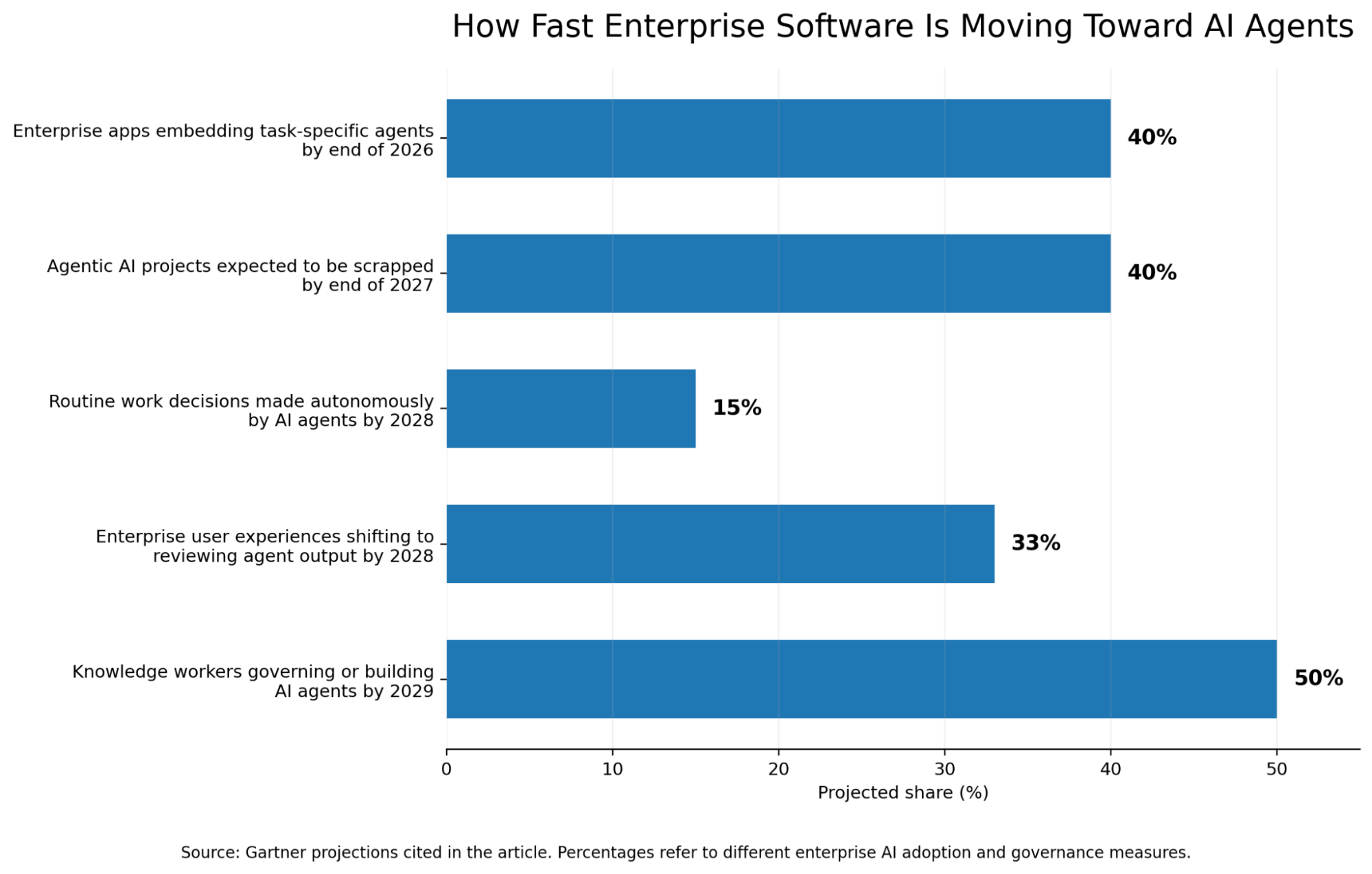
Key enterprise AI projections on autonomous decisions and agent adoption (Generated by chartgpt.co)
A decision has to be judged on decision quality, which is slipperier and non-deterministic. A refund agent that approves everything looks fast and cheap right up until the chargebacks land a quarter later. You often can’t see the counterfactual what a human would have decided so you can’t measure what the automation saved or cost, and the feedback arrives long after the metric dashboard turned green.
That’s why the tooling looks different. You don’t unit-test a judgment; you build an offline eval set of labeled cases and score the model against it, run new versions in shadow mode against live traffic without letting them act, and gate deploys on an eval suite in CI the way you’d gate on tests. LLM-as-judge and golden datasets stand in for the assertions you can’t write by hand.
| Concern | Workflow feature | Autonomous decision |
| How you test it | Unit + integration tests | Offline eval sets + shadow runs |
| Catching regressions | CI test suite | Eval suite in CI + drift monitors |
| Rolling back | Revert the deploy | Kill switch + idempotent reversal |
| What you watch | Uptime, latency, error rate | Decision quality, override rate, drift |
The gap shows up in the failure rate. Gartner projects that more than 40% of agentic AI projects will be scrapped by the end of 2027 citing unclear business value and weak risk controls as much as raw cost. Deciding is easy to ship and hard to prove.
10 Designing for Reversibility
If decisions are going to be made by software, the design goal shifts from “make the right call” to “make wrong calls cheap to undo.” Reversibility, not accuracy alone, becomes the property you engineer for. At that point, software governance becomes less about policy documents and more about the practical controls built into the system: thresholds, escalation paths, logs, and the ability to undo a bad decision
- Tier by stakes and reversibility. Let the system fully own decisions that are high-volume, low-stakes and easy to reverse closing a duplicate alert, reordering a staple item. Route the rare, costly or irreversible ones to a person, the same instinct as making destructive operations idempotent and undoable.
- Gate on calibrated confidence. A call the model makes at 0.55 confidence should escalate; one at 0.99 can proceed but only if the score is calibrated, so 0.9 actually means right nine times in ten. The threshold is a dial you tune against real outcomes, backed by a circuit breaker that trips when the override rate spikes.
- Log the reasoning, not just the result. An auditable decision needs a trace: the inputs, the retrieved context, the model version, the tool call and the alternative that was rejected so a wrong call can be replayed, explained and corrected instead of merely discovered.
The recurring pattern is the split rung: software decides, but every decision above a stakes line stays provisional behind a human confirm. That isn’t friction for its own sake, it’s what lets you trust the automated majority and still sleep.
11 The Skills That Survive
If software absorbs the routine decisions, the human premium moves to what software can’t take. Three capabilities gain value.
- Framing the problem. A model optimizes the objective you hand it; choosing that objective refunds fast versus refunds correct, recall versus precision, growth versus risk is judgment no agent supplies. Badly specified objectives are how efficient systems produce expensive outcomes.
- Owning the edge cases. The exceptions a system escalates are, by definition, the ambiguous, high-stakes ones. Handling the fraction the machine won’t touch takes more expertise than handling the average case, not less.
- Carrying accountability. Someone sets the thresholds, reads the traces and stands behind the result part ML, part ops, part risk. That is becoming a named role, not a footnote in someone else’s job.
Gartner expects at least half of knowledge workers to be governing or building AI agents by 2029. Fluency is shifting from doing the task to specifying, supervising and answering for the system that does it.
12 The Quiet Part, Said Plainly
The shift is quiet for a structural reason: it doesn’t arrive as a product you evaluate. It arrives as a default that flips inside tools you already run a “recommend” that becomes “auto-approve,” a draft that becomes a send. No one signs a change request for crossing from advice to action, because it happens one setting at a time.
That is exactly why it deserves a deliberate decision instead of a drift. The teams that handle it well won’t be the ones that automate the most decisions; they’ll be the ones that stay clear about which decisions they handed over, on what terms, and with what recourse when the model is wrong. The difference is rarely the technology; it’s whether anyone wrote down the terms of the handoff, with a threshold, a trace and an owner.
Software has stopped waiting for us to decide. The work now is to decide, on purpose, what we let it decide. Do that and you get the efficiency without silently inheriting the liability. Skip it and you’ll find out the way anyone learns a button pressed itself: after the fact, from the log.





Comment