What 41,770 AI Search Citations Reveal About the New Rules of GEO

AI search optimization is quickly becoming an industry of dashboards.
Companies are measuring how often their brands appear in ChatGPT, Google AI Overviews, Perplexity, Claude, Gemini and other AI platforms. They track share of voice, brand mentions, average position and prompt coverage.
Those metrics are useful, but they only show part of what is happening.
The more important question may be one layer deeper:
What information sources are AI systems relying on when they decide which companies to mention and recommend?
At CiteWorks Studio, we have been studying that question through data collected for the AI Marketing Consensus Index and LLM Authority Index.
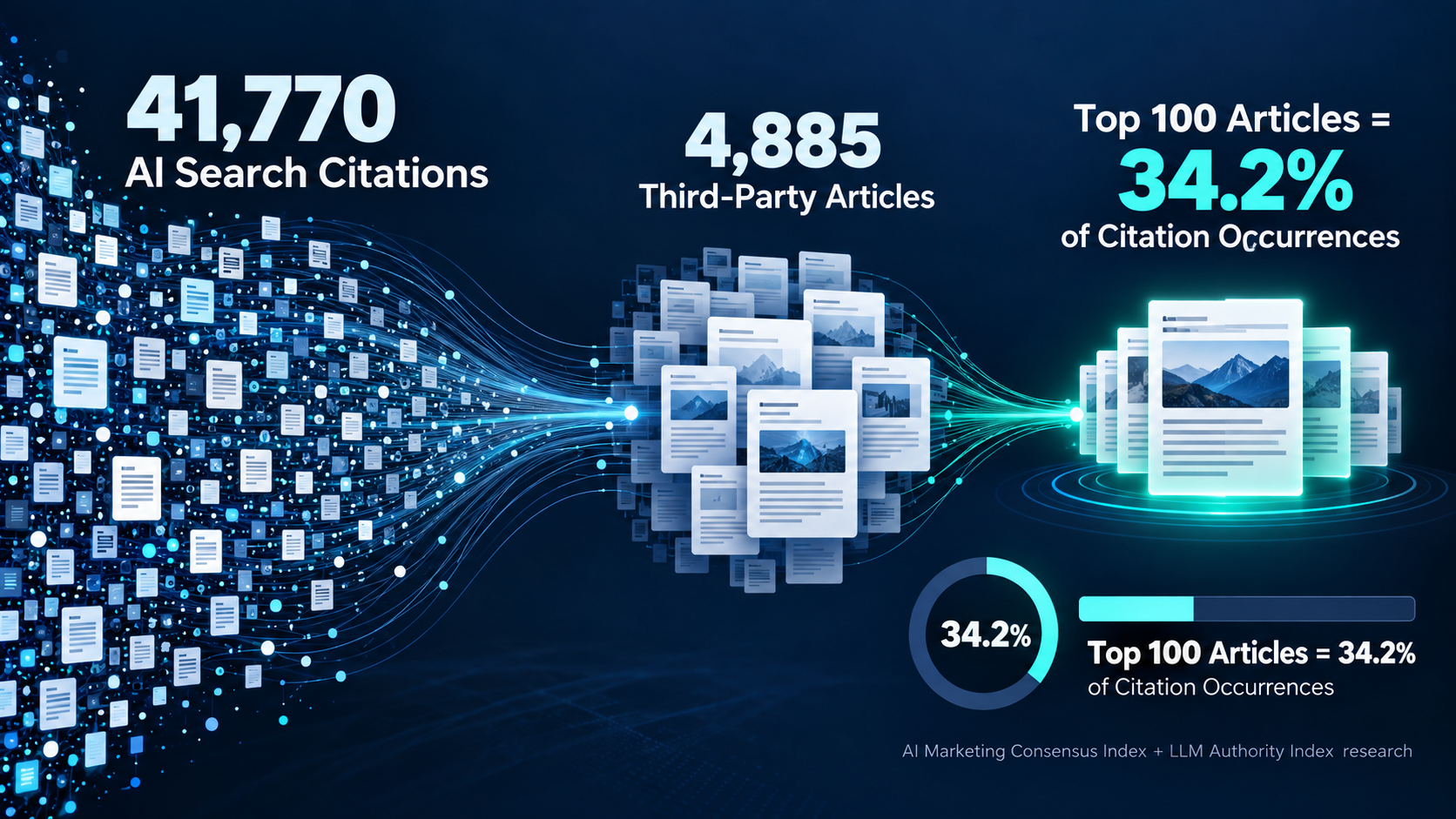
A recent analysis covered 135 final consensus research articles and 41,770 individual source-citation records across five commercial AI marketing categories. After normalizing URLs and removing duplicates, the dataset contained 4,885 unique third-party editorial articles cited by AI systems.
The results suggest that AI search may be developing a citation economy in which a relatively small number of highly relevant pages repeatedly influence answers across large numbers of commercial prompts.
For marketers, that changes the optimization problem considerably.
AI Citations Are More Concentrated Than They Appear
The first surprising finding was the degree of concentration.
Across the dataset, third-party sources generated 29,844 citation occurrences. The 100 most frequently cited individual articles accounted for 10,199 of those citations.
That means just the top 100 pages represented approximately 34.2% of all third-party citation occurrences in the study.
These were not 100 domains. They were 100 individual URLs.
That distinction matters.
Traditional SEO often encourages marketers to think at the domain level. A website builds authority, pages rank within that website, and the domain’s overall reputation can improve its ability to compete.
AI search appears to introduce another important level of analysis: the individual source document.
Certain articles were repeatedly selected as evidence across dozens of different AI-generated answers.
For example, several product reviews in the dataset appeared as citations across more than 50 separate consensus articles. One review appeared in 78. Others appeared in 76, 77 and 73.
The practical implication is significant.
A single authoritative comparison or review page can potentially influence far more AI answers than its traditional search traffic would suggest.
Review and Comparison Content Has Become AI Infrastructure
Another pattern was difficult to ignore.
Many of the most frequently cited pages were not company homepages or generic educational articles.
They were:
- Individual product reviews
- Pricing analyses
- Product comparisons
- Alternatives pages
- Buyer guides
- Best-of lists
- Feature breakdowns
- Independent evaluations
This makes sense when we consider the types of questions consumers increasingly ask AI systems.
A user rarely asks an AI assistant simply to define a product category.
Commercial prompts are more likely to resemble:
“Which platform is best for a small agency?”
“Is this tool worth the price?”
“What are the alternatives?”
“Which company is better for enterprise customers?”
“What are the weaknesses of this product?”
These questions require evidence that goes beyond what a company says about itself.
An AI system trying to answer them needs comparative information.
That creates an important distinction between traditional content marketing and what we might call citation architecture.
Publishing more content on a company’s website may improve the information AI systems have available about the company. But that does not necessarily provide the independent comparative evidence required to recommend the company over competitors.
Third-party sources frequently fill that role.
This is one reason the AI search optimization work we conduct at CiteWorks Studio separates company-owned citations from third-party citations instead of treating all citations as equivalent.
Mentions, Recommendations and Citations Are Different Metrics
The AI visibility industry also needs greater precision in how it defines success.
Consider three different outcomes:
An AI system mentions a company.
An AI system recommends a company.
An AI system cites the company’s website.
Those are not the same event.
A company can be widely mentioned without being recommended.
It can be recommended while another website provides the supporting citation.
Its own website can be cited as a factual source without the company being included among the recommended providers.
This is why a single “AI visibility score” can obscure important information.
For commercial prompts, we believe companies should separately measure at least four conditions:
Mentioned: Did the model name the company?
Recommended: Did the model actually include the company among its suggested choices?
Cited: Which source or sources supported the answer?
Absent: Which commercially important prompts did not surface the company at all?
This distinction becomes especially important when studying competitors.
If three competitors are repeatedly recommended for a prompt cluster and your company is absent, the next question should not simply be, “How do we create more content?”
The better question is:
What evidence ecosystem exists around those competitors that does not exist around us?
That is where citation analysis becomes actionable.
The Source Gap May Matter More Than the Content Gap
SEO professionals have spent decades performing content-gap analysis.
If a competitor ranks for a keyword and you do not, identify the missing topic and create a better page.
AI search requires an expanded version of that model.
There can be a company-owned content gap, but there can also be a third-party source gap.
Suppose an AI system repeatedly recommends Company A over Company B.
Company A might have:
- Strong product documentation
- Clear pricing information
- Consistent entity information
- Independent product reviews
- Comparison articles
- Industry mentions
- Expert commentary
- Relevant datasets
- Multiple authoritative sources confirming the same claims
Company B may have an equally good product but considerably less external evidence available to AI systems.
From the model’s perspective, those companies do not necessarily look equal.
This becomes even more important when third-party information disagrees with company-owned information.
We frequently find conflicting pricing, outdated product capabilities, inconsistent service descriptions, old company information and contradictory third-party claims.
An AI platform must reconcile those conflicts somehow.
That means AI optimization increasingly includes not only publishing information but also reducing information ambiguity.
AI Search Optimization Is Becoming an Evidence Problem
The broader lesson from the citation data is that GEO, AEO and AI search optimization may ultimately become less about manipulating an algorithm and more about engineering a trustworthy information environment.
The companies most likely to perform consistently in AI search will need more than optimized webpages.
They will need a coherent evidence network.
That includes:
- Clear company-owned information that machines can understand.
- Consistency across the company’s digital footprint.
- Independent third-party validation.
- Relevant comparative coverage.
- Structured factual information.
- Evidence aligned with the commercial questions buyers actually ask.
This is also why prompt selection matters enormously.
A company can look highly visible when measured against broad informational prompts and almost disappear when the analysis is narrowed to high-intent buying questions.
At LLM Authority Index, we increasingly analyze citations at the prompt-cluster level because the sources influencing “What is a medical alert system?” may be completely different from those influencing “What is the best medical alert system for a senior living alone?”
The second question is much closer to a buying decision.
That distinction should influence how businesses allocate their AI search budgets.
The Most Valuable Optimization Target May Be Someone Else’s Website
Perhaps the most important strategic shift is psychological.
For more than two decades, digital marketers primarily optimized assets they controlled.
Their website.
Their landing pages.
Their blog.
Their technical SEO.
Their backlinks.
AI search expands the optimization surface.
The page influencing a recommendation may belong to a publisher, trade journal, review website, analyst, journalist, association, data provider or niche expert.
The question then becomes:
Which external sources repeatedly shape AI answers in the prompt categories that matter to our business?
The citation dataset shows that this is not merely theoretical. Certain individual third-party articles recur across large numbers of commercial AI responses.
Companies therefore need to understand their citation neighborhood.
Who is being cited?
Which URLs recur?
Which competitors appear in those sources?
Which claims are being reinforced?
Which claims are contradictory?
Which influential publications do not mention the company at all?
Those questions produce an entirely different marketing roadmap than a conventional keyword-gap report.
Citation Frequency Is Not the Same as Causation
There is an important limitation to this analysis.
A citation does not prove that a particular source caused an AI system to recommend a company.
Different models use retrieval differently. Some citations may support a narrow factual statement rather than the central recommendation. AI answers are also probabilistic and can change between executions.
Citation analysis should therefore not be treated as a simple formula where acquiring Source X automatically produces Recommendation Y.
What repeated citations do provide is evidence of source preference and information reliance.
When the same article is selected repeatedly across related commercial queries, it becomes a useful signal that the source is part of the information environment AI systems are using to construct answers.
That makes citation frequency valuable for prioritization even when causality cannot be established.
A New Competitive Intelligence Layer Is Emerging
The AI search industry is still early.
Terminology is inconsistent. Measurement standards are evolving. Models change rapidly. Retrieval systems change even faster.
But one thing is becoming clearer from the data.
Businesses should not evaluate AI visibility only by asking:
“Do the models mention us?”
They should also ask:
“What evidence causes the models to believe what they believe about us and our competitors?”
Our analysis of 41,770 citation records suggests that the answer is often concentrated in a surprisingly small group of influential pages.
Finding those pages, understanding why they are repeatedly selected, correcting conflicting information and becoming part of the sources that shape commercial recommendations may become one of the central disciplines of AI search marketing.
Traditional SEO taught companies to compete for rankings.
AI search may require them to compete for something broader:
a place inside the evidence layer from which machines construct their answers.
Methodology
The analysis referenced in this article was conducted using data from the AI Marketing Consensus Index and related citation research from LLM Authority Index.
The dataset included 135 final consensus articles covering five AI marketing categories and 41,770 raw source-citation records. Fit-review reports were excluded to prevent double counting. URLs were normalized for protocol, www, trailing slashes, fragments and common tracking parameters. Exact-title variants from the same domain were merged. Unresolved Google grounding redirect URLs were excluded.
After normalization and filtering, 4,885 unique third-party editorial articles remained. Those articles generated 29,844 citation occurrences. The 100 most frequently cited individual articles generated 10,199 occurrences, or approximately 34.2% of the third-party citation total.
About the Author
Mark Huntley is the founder of CiteWorks Studio and LLM Authority Index. His work focuses on measuring how brands are mentioned, recommended and cited across AI search platforms, identifying the sources influencing commercial AI responses, and developing strategies to improve visibility within high-intent prompt categories.