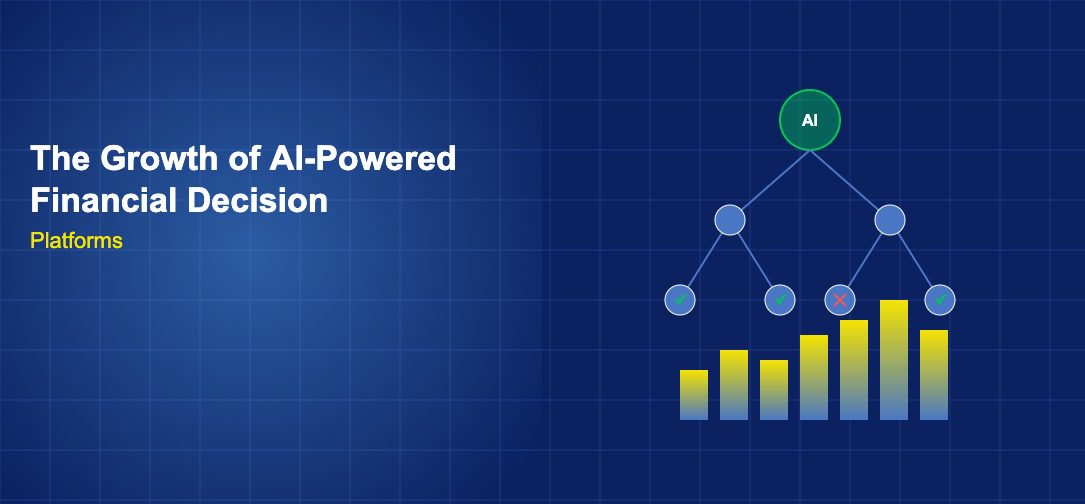
AI-powered financial decision platforms are growing into a multi-billion dollar market as banks, lenders, insurers, and asset managers adopt machine learning to improve the speed and accuracy of financial decisions. The global market for AI decision platforms in financial services reached $8 billion in 2024 and is projected to exceed $25 billion by 2030, according to a report by MarketsandMarkets. Companies like Pagaya, Zest AI, and Upstart are processing millions of financial decisions daily using models that outperform traditional scoring methods.
What AI Decision Platforms Do
These platforms automate financial decisions that traditionally required human judgment. A bank evaluating a loan application might use a decision platform that analyses thousands of data points in seconds: bank account transactions, employment history, spending patterns, education, and dozens of alternative data signals. The platform returns a risk score, recommended pricing, and a decision in under a minute, compared to the days or weeks a manual process requires.
Pagaya, an AI-powered lending platform, partnered with banks and fintech lenders to originate more than $20 billion in consumer loans and point-of-sale financing in 2024. The company’s AI evaluates loan applications that traditional models reject, finding creditworthy borrowers among those with limited credit histories. Pagaya reported that its models approve 30% more applicants while maintaining default rates at or below industry averages, according to its SEC filings.
Insurance underwriting is another major application. Companies like Lemonade, Tractable, and Shift Technology use AI to evaluate insurance applications, process claims, and detect fraud. Lemonade’s AI chatbot Maya handles the entire insurance purchase process from quote to binding in under 90 seconds. Tractable’s AI assesses vehicle damage from photos in seconds, replacing manual inspections that take days. Fintech revenue growing at a 23% CAGR includes significant contributions from AI decision platform companies.
The Shift from Rules to Models
Traditional financial decision-making uses rules-based systems. A credit policy might state: approve applicants with FICO scores above 680, debt-to-income ratios below 43%, and at least two years of employment history. These rules are transparent but rigid. They miss creditworthy borrowers who fall slightly outside the boundaries and approve risky borrowers who happen to meet all the criteria.
Machine learning models consider hundreds or thousands of variables simultaneously and can identify non-linear relationships between them. A model might learn that applicants with certain education backgrounds, consistent savings behaviour, and stable rental payment histories are low-risk even if their credit scores are below traditional thresholds. Zest AI reported that its models reduce charge-offs by 20% to 30% compared to traditional scorecards, according to case studies published on its website.
The Federal Reserve Bank of Philadelphia found in a 2023 study that AI lending models approved 27% more minority applicants compared to traditional models while maintaining the same default rates. This suggests that AI can reduce bias in lending when properly designed and monitored. More than 30,000 fintech companies are implementing these model-based approaches across their product lines.
Enterprise Adoption
Large banks are building and buying AI decision capabilities. JPMorgan spent more than $15 billion on technology in 2024, with AI as a priority area. The bank uses AI for credit decisions, trading strategies, and customer relationship management. Goldman Sachs deployed AI across its consumer lending platform Marcus and its wealth management advisory services.
Mid-sized banks are licensing AI decision platforms rather than building their own. Upstart partners with more than 100 banks and credit unions, providing AI-powered lending decisions through API integration. The bank provides the balance sheet and customer relationship while Upstart provides the decision technology. This model allows community banks to compete with large institutions on decision quality.
Asset management firms use AI for portfolio construction and trading decisions. Renaissance Technologies, Two Sigma, and DE Shaw have used quantitative AI models for decades. More recently, BlackRock’s Aladdin platform, which manages risk for more than $21 trillion in assets, has incorporated machine learning for portfolio optimisation and risk assessment. Fintech companies capturing 25% of banking revenues increasingly compete on decision quality powered by AI.
Regulatory Framework and Challenges
Regulators require that AI decision-making be explainable. The Equal Credit Opportunity Act in the US requires lenders to provide specific reasons when denying credit applications. AI models that function as black boxes can struggle to meet this requirement. Companies like Zest AI and FICO have developed explainability tools that generate human-readable explanations for AI credit decisions.
The EU AI Act classifies AI systems used for credit scoring and insurance pricing as high-risk, requiring risk assessments, documentation, and human oversight. Financial regulators in the UK, Singapore, and Australia have issued similar guidance. These requirements add compliance costs but also increase trust in AI decision-making.
AI-powered financial decision platforms are becoming standard infrastructure. The growth from 20 to over 300 fintech unicorns includes companies like Pagaya, Upstart, and Lemonade that are built entirely around AI decision-making. As models improve and regulatory frameworks mature, AI will become the default method for making financial decisions at every scale.