Every reseller I know has done this at least once. You open two panels side by side, you find the same service on both — Instagram followers, non-drop, 30-day refill — and one of them is $0.42 per thousand while the other is $0.61. You move your orders. Two weeks later your costs have not gone down. Sometimes they have gone up.
The rate was not lying to you. It just was not the whole price.
I spend most of my working week inside panel price data, and the pattern that shows up over and over is that resellers compare the one number that is easy to compare and ignore the four numbers that decide what they actually pay. This piece is about those four.
1. The minimum order is a price
A rate is quoted per 1,000 units. Nobody pays per 1,000 units. You pay per order, and the order has a floor.
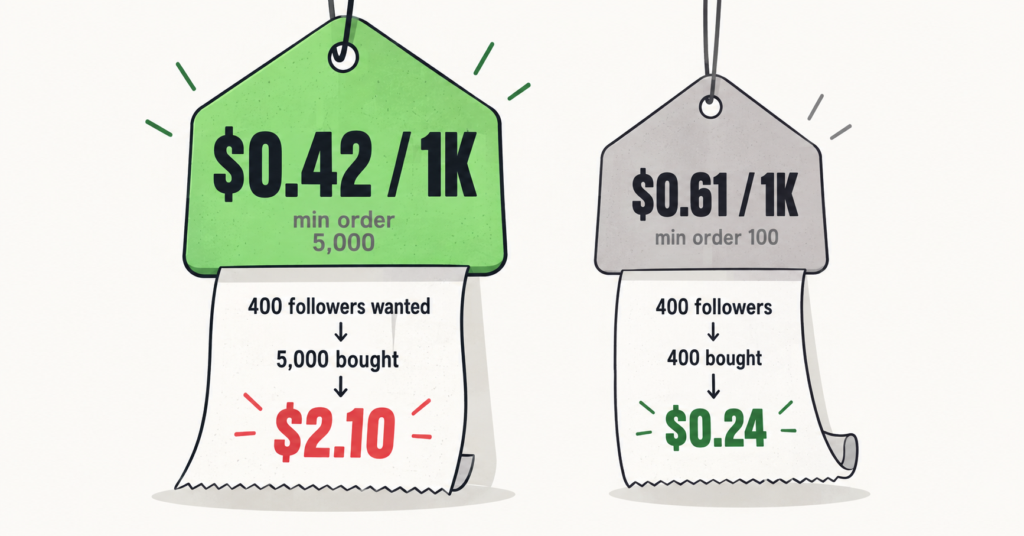
Panel A: $0.42 per 1k, minimum 5,000. Panel B: $0.61 per 1k, minimum 100.
Your client wants 400 followers. On Panel A you cannot buy 400 followers. You buy 5,000, which costs $2.10, and you have 4,600 followers you did not want and cannot resell today. Panel B sells you exactly 400 for $0.24.
Panel B is 45% more expensive per thousand and roughly nine times cheaper for the order you actually had.
This is not a corner case. A huge share of retail SMM demand is small — a few hundred followers, a few thousand views, one post’s worth of likes. If your order book looks like that and your supplier’s minimums do not, you are buying inventory, not fulfilling orders. You will tell yourself you will use the rest later. Some of it you will. The drop-off in the meantime is yours to eat.
The fix is boring: before you switch suppliers, take your last fifty orders, look at the size distribution, and check the new panel’s minimum against the median order — not against the biggest one you ever got.
2. The refill window is a price
“Refill” is the single most abused word in this industry. It appears in a service name as R30, or 30 Days, or Refill ♻️, or nothing at all while the description promises “lifetime guarantee”. Those are not the same product, and they are frequently priced as though they were.
A 30-day refill means: if the count drops inside 30 days of delivery, you can ask for a top-up. Outside 30 days, you cannot. A no-refill service at a 15% lower rate is a perfectly reasonable thing to buy — for a client who wants views on a video that will be irrelevant by Friday. It is a terrible thing to buy for a client on a monthly retainer, because every drop after delivery is a re-order you pay for a second time.
Do the arithmetic once. A service at $0.42 with no refill and a realistic 20% drop over the first month costs you $0.42 plus a 20% re-order — call it $0.50 delivered and held. A service at $0.48 with a 30-day refill costs you $0.48 and one support ticket. The cheaper-looking option is the more expensive one, and nothing on the panel page tells you that.
The trap inside the trap: refill windows are often written into the service name and then contradicted by the service description. When they disagree, the description usually wins in a dispute, and the name is what you read. Read both.
3. The drop rate is a price, and nobody publishes it
Refill policy is what a panel promises. Drop rate is what actually happens. No panel publishes its drop rate, for obvious reasons.
You can measure it yourself and it takes about ten minutes of setup. Pick one service from each supplier you use. Order the same quantity to the same kind of target on the same day. Write down the delivered count at 24 hours, day 7 and day 30 in a spreadsheet. Three rows, three columns. Do it once a quarter.
What you will find is that two services with identical names, identical refill labels and near-identical rates behave completely differently, and that the gap between them is bigger than any rate difference you were agonising over. I have seen the same nominal service hold 96% at thirty days on one panel and 61% on another. Nothing in either listing predicted it.
This is the number that separates resellers who quietly keep clients from resellers who quietly lose them.
4. The catalogue depth is a price
This one is invisible until it bites. You find a panel with genuinely excellent rates on Instagram followers, you move everything, and then a client asks for something ordinary — Spotify saves, or Telegram post views from a specific country, or YouTube watch hours — and your cheap panel does not carry it.
Now you are running two suppliers. Two balances to top up, two APIs, two support queues, two sets of order IDs to reconcile when something goes wrong at 11pm. The 20 cents per thousand you saved is gone, and it went into your own time, which you were probably not costing.
Depth is worth paying a small premium for when you are small, because at small volume your bottleneck is your attention, not your margin. Once you have real volume on a single service, split it out to a specialist. Not before.
Putting it together
The practical version of all of this is a comparison that includes the things a rate hides. When you are evaluating a new supplier, get these on one line:
- Rate per 1k — the number you were going to look at anyway.
- Minimum order — and what it costs, which is rate ÷ 1000 × minimum. That is the real smallest cheque you can write.
- Maximum order — because a 10,000 cap on a service your biggest client orders 50,000 of means five orders and five chances for one to stall.
- Refill window — the number, not the emoji.
- Cancel / partial — can you get money back on a stuck order, or is it gone?
- Your own measured drop at day 30.
Six numbers. Once you have them for your top ten services across your top three suppliers, the decision usually makes itself, and it is frequently not the panel with the lowest headline rate.
Doing this by hand across a catalogue of several thousand services is not realistic, which is the honest reason most resellers skip it and just chase the rate. If you want the comparison without the spreadsheet work, you can look up any service across indexed panels and see rate, minimum, maximum and refill together on SMM Compare — that at least removes the tab-switching. The same data sorted by price is at cheapest SMM panels, though I would encourage you to read the rest of the row before you act on the first one.
What I would do with your next hour
Not a full audit. Just this:
- Export your last fifty orders. Find the median quantity.
- For your three most-ordered services, write down the minimum order cost at each supplier you currently use.
- Check whether any of them is above your median order quantity. If it is, you have been buying inventory without noticing.
That is it. Most resellers who do this find one service where they have been overbuying for months, and fixing that one line is worth more than the rate hunt they were about to start.
The headline rate is the cheapest thing to compare, and that is exactly why it is the least useful. Price per thousand is what the panel wants you to shop on. Cost per delivered, retained unit is what you actually pay.