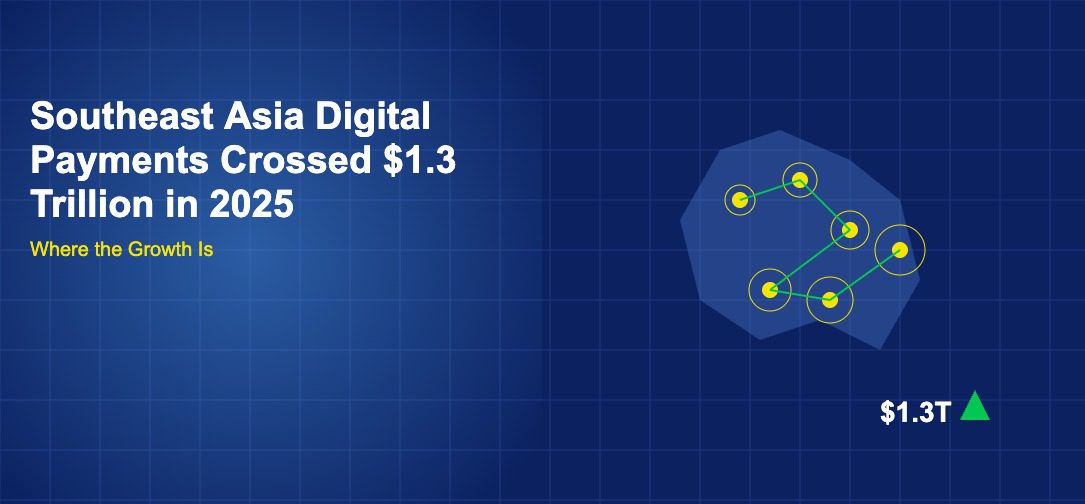
Southeast Asia’s digital payments volume crossed $1.3 trillion in 2025. That figure, reported by Google, Temasek, and Bain’s annual e-Conomy SEA report, represents a 31% increase over 2024 and makes the region the fastest-growing digital payments market in the world by percentage gain. Six countries drive the bulk of that volume: Indonesia, Thailand, Vietnam, the Philippines, Malaysia, and Singapore.
Country-Level Breakdown
Indonesia accounts for 44% of the regional total, with $572 billion in digital payment volume. The country’s population of 280 million, combined with a banking penetration rate that was just 49% in 2019, created massive room for digital adoption. GoPay, OVO, ShopeePay, and Dana are the four largest digital wallets. Bank Indonesia’s QRIS interoperable QR system processed 3.2 billion transactions in 2025, per the central bank.
Thailand processed $260 billion through its PromptPay system alone. PromptPay links national ID numbers and phone numbers to bank accounts, allowing instant transfers at zero cost. The Bank of Thailand reported that 94% of Thai adults used digital payments at least once per month in 2025.
Vietnam’s digital payment volume reached $195 billion, driven by MoMo, ZaloPay, and VNPay. The Vietnamese government’s cashless society initiative targets 80% of all transactions to be digital by 2030. The global digital payments market is projected to hit $20 trillion, and Vietnam is one of the countries growing fastest toward that target.
The Super-App Model
Southeast Asia’s payment growth is inseparable from the super-app model. Grab, Gojek (now GoTo), Sea (Shopee), and Lazada operate platforms that combine ride-hailing, food delivery, e-commerce, payments, lending, and insurance. Payments are the connective tissue.
Grab Financial Group processed $18 billion in loans in 2025 and has 40 million active payment users across Singapore, Malaysia, Indonesia, the Philippines, Thailand, and Vietnam. GoPay, the payment arm of GoTo, processed $120 billion in payment volume. Sea’s SeaMoney division reported $3.7 billion in revenue, up 38% from 2024, according to its earnings report.
Digital wallet usage has reached more than 4 billion users worldwide, and Southeast Asia accounts for approximately 600 million of those users, a penetration rate exceeding 85% among smartphone owners in the region.
Cross-Border Payment Corridors
One of the region’s most significant developments is cross-border real-time payment connectivity. Thailand’s PromptPay and Singapore’s PayNow connected in April 2021. Since then, Malaysia’s DuitNow, Indonesia’s QRIS, and the Philippines’ InstaPay have joined the network. By January 2026, citizens in five ASEAN countries can send instant, low-cost payments to each other using only a phone number.
The corridor volumes are still small relative to domestic payments. Thailand-Singapore cross-border instant payments totaled $2.1 billion in 2025. But the infrastructure is built, and remittance companies like Wise and Remitly are integrating with these rails to reduce costs. The average cost of sending $200 from Singapore to the Philippines fell from 4.8% in 2020 to 1.2% in 2025, according to the World Bank’s Remittance Prices Worldwide database.
The global open banking market is expected to exceed $123 billion by 2031, and ASEAN regulators are building open banking frameworks that will further enable cross-border financial services.
Digital Banking Licenses Reshape the Market
Regulators across Southeast Asia have issued digital banking licenses to both fintech companies and technology conglomerates. Singapore issued four licenses in 2020 to Grab-Singtel, Sea, Ant Group, and a consortium led by Greenland Financial. The Philippines issued six licenses between 2021 and 2023. Malaysia issued five in 2022. Indonesia has approved digital bank conversions for Bank Jago, Bank Neo Commerce, and Allo Bank.
These digital banks are now competing directly with incumbent banks for deposits and lending. Bank Jago, backed by GoTo, reached 12 million customers in Indonesia by December 2025. GXS Bank, the Grab-Singtel joint venture in Singapore, reported $1.2 billion in deposits within 18 months of launch, per The Straits Times.
Over 30,000 fintech companies now operate worldwide, and Southeast Asia hosts more than 3,500 of them. The region’s fintech ecosystem raised $4.8 billion in 2025, making it the third-largest fintech funding market after the United States and Europe.
What Limits Further Growth
Smartphone penetration in rural areas remains uneven. Indonesia’s internet penetration is 78% nationally but drops below 50% in eastern provinces. The Philippines has similar disparities between Metro Manila and rural Visayas and Mindanao. Myanmar’s political instability has stalled digital payment growth entirely.
Regulatory fragmentation is another challenge. Each ASEAN country has its own licensing requirements, data localization rules, and consumer protection frameworks. A fintech company operating in all six major ASEAN markets needs six separate licenses and six compliance teams. Fintech adoption rates surpass 64% globally, but adoption within Southeast Asia varies from 96% in Singapore to 42% in Myanmar.
Credit risk is a concern as digital lending scales. Non-performing loan rates at Indonesian digital lenders reached 4.8% in Q4 2025, above the 2.5% rate at traditional banks. Philippine digital lenders reported similar patterns. Regulators in both countries have tightened lending caps and disclosure requirements.
The $1.3 trillion in digital payment volume processed in 2025 makes Southeast Asia one of fintech’s most active regions. The infrastructure for cross-border payments, digital banking, and embedded finance is now in place. The next phase of growth will come from converting payment users into borrowers, savers, and insurance holders.