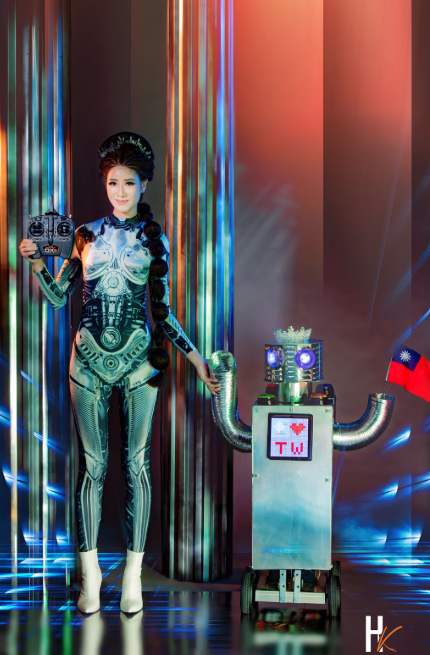
Talent shows at beauty pageants usually follow a predictable script, singing, dancing, or traditional performances. But in 2022, the Miss Taiwanese American pageant audience watched something they had never seen before: a robot walking the stage. It wasn’t just a technical display, but a performance that blended engineering, culture, and humor. Behind that moment was Tiffany Chang, a Stanford student who turned her love for STEM into a groundbreaking statement that earned her the Best Talent Award and the crown.
Tiffany’s decision to bring a robot to the stage was more than a creative choice; it was an expression of her belief that different passions don’t have to exist in separate worlds. As a Management Science and Engineering student, she had long been fascinated by the intersection of problem-solving, design, and innovation. But she also carried pride in her cultural roots and a desire to challenge outdated expectations. The robot became the bridge between these parts of her identity.
The machine itself carried layers of meaning. Its chest lit up with an LED panel that read “I love Taiwan,” while a small flag of Taiwan was displayed as part of the design. These choices were intentional, a way for Tiffany to honor her heritage while tying it to the broader conversation about Taiwan’s role in global technology. She even described the robot as a nod to the “Silicon Shield,” the term often used to describe Taiwan’s importance in the semiconductor industry. In other words, the robot wasn’t just built to move; it was built to tell a story.
Getting to that final version took persistence. Tiffany went through three prototypes before building the robot that could appear on stage. Each version forced her to rethink the design, functionality, and symbolism. By the time she reached the stage-ready model, she had not only created a functioning robot but also shown her ability to combine technical skill with artistic vision.
The performance itself was a blend of engineering and showmanship. Tiffany engaged in a lighthearted dialogue with her robot, programmed to respond during the talent portion. Then, in a moment that surprised the audience, she invited it to join her on a catwalk. The mix of humor and originality won over the crowd, leading to loud applause and, ultimately, recognition from the judges. Her act was described at the time as the first-ever robot featured in a beauty pageant.
For Tiffany, the significance went beyond winning awards. The performance was her way of showing that young women in STEM could take up space in places where they are not always expected. Beauty pageants have often carried stereotypes, and so has the tech world. By merging the two, she broke through both sets of assumptions. She has explained that she wanted the performance to spark curiosity and encourage young girls to explore STEM.
That message continues to guide her journey. Since the pageant, she has expanded her platform, winning Miss Asia USA in 2024 and walking the runway for designer David Tupaz. But whether on stage, in classrooms, or in tech spaces, her focus has stayed consistent, using her story to advocate for diversity, inclusion, and visibility. She sees leadership not just as a title but as the ability to show others what’s possible when they refuse to be boxed in.
The story of Tiffany Chang’s robot is not just about innovation; it’s about courage. She stepped into a space with something no one expected and used it to make a lasting statement. By turning engineering into performance, she proved that talent is not limited to tradition; it can be redefined. And in doing so, she gave audiences, especially young women, a reason to see themselves in both STEM and beyond.